
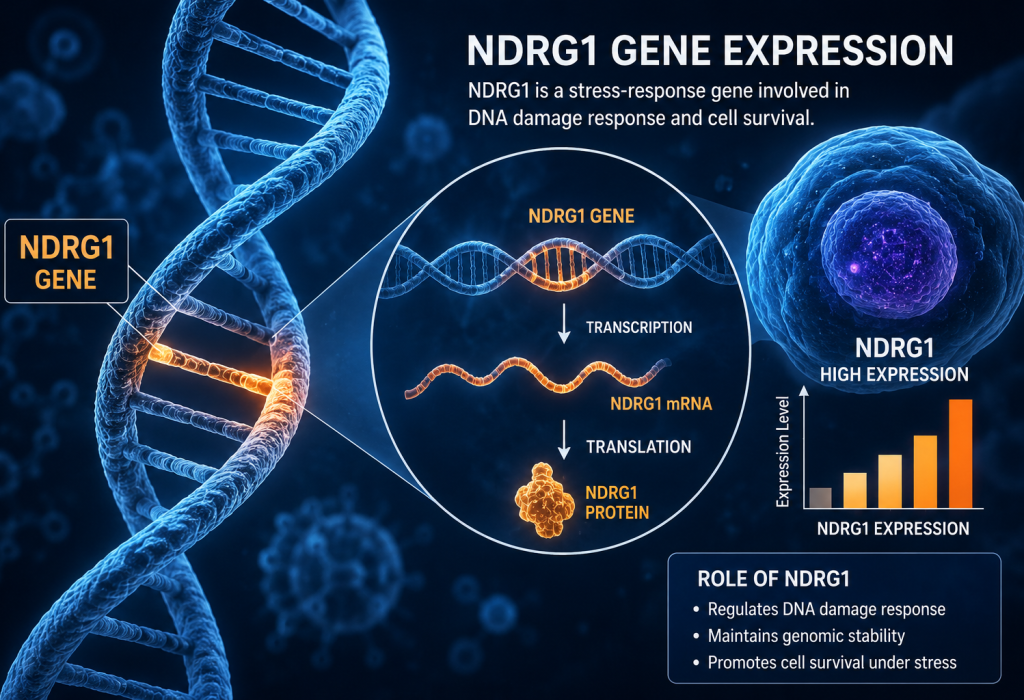
Researchers identified NDRG1 as a regulator of the DNA damage response and found that colorectal cancer cells with specific DNA repair alterations may be vulnerable to NDRG1-directed strategies.
Written by: Mayuresh Salvi, PharmD
Reviewed by: Pharmacally Editorial Team
Researchers from the University of Copenhagen, Insilico Medicine, Georgetown University School of Medicine, and collaborating institutions have identified the stress-response protein N-myc downstream-regulated gene 1 (NDRG1) as a previously unrecognized regulator of the DNA damage response (DDR).
The study combined in silico approaches, high-content genetic and cell-survival screens across more than 130 cancer cell lines, and molecular experiments to investigate cancer-cell dependencies associated with DNA repair. The researchers found that high NDRG1 expression was associated with dependence on DNA damage repair and sensitivity to the antimalarial agent quinacrine, with colorectal carcinoma cells showing particular vulnerability.
From Computational Analysis to Biological Mechanism
The researchers initially used computational and in silico approaches to analyze large-scale biological datasets and identify relationships between DNA damage-response disruption, cancer-cell dependencies, and candidate compounds. These analyses were followed by high-content genetic and cell-survival screens to experimentally investigate the identified vulnerabilities.
The screening experiments showed that quinacrine impaired the DNA damage response in multiple cancer cell lines. The researchers then investigated the underlying molecular mechanism and identified an interaction between NDRG1 and valosin-containing protein (VCP), a major cellular protein-processing factor.
Quinacrine disrupted the interaction between NDRG1 and VCP, which promoted degradation of the E3 ubiquitin ligase RNF8 and other proteins involved in DNA damage signaling. RNF8 plays an important role in recruiting DNA repair machinery to sites of DNA damage. Its degradation impaired recruitment of the critical DNA repair protein 53BP1, resulting in increased levels of γH2AX, a marker of DNA damage.
These findings indicate that disruption of NDRG1-associated signaling can compromise the cellular response to DNA damage.
Synthetic Lethality in Colorectal Cancer
The investigators evaluated quinacrine sensitivity across multiple cancer cell lines and performed genetic and molecular experiments to identify factors associated with this vulnerability.
Colorectal carcinoma cells were particularly vulnerable to pharmacological or genetic inhibition of NDRG1. The researchers further identified synthetic-lethal relationships involving high NDRG1 expression and alterations in the DNA repair-associated genes MLH1 and PARP3.
Synthetic lethality occurs when disruption of two biological dependencies produces a substantially greater effect on cell survival than disruption of either dependency alone. In this setting, cancer cells with existing DNA repair abnormalities may become increasingly dependent on remaining repair mechanisms. Further disruption of NDRG1-associated DNA repair activity could therefore increase DNA damage beyond the cell’s capacity to compensate.
The study also incorporated patient survival analyses. High NDRG1 expression was associated with poorer survival in the analyzed datasets, while genetic background influenced this relationship. Specifically, the combination of high NDRG1 expression with alterations involving MLH1 or PARP3 defined a genetic context associated with increased susceptibility to disruption of the DNA damage response.
These findings support further investigation of NDRG1 and DNA repair alterations as potential combination biomarkers, but do not establish NDRG1 as a clinically validated prognostic or predictive biomarker.
What This Means for Precision Oncology
The study does not establish quinacrine as a cancer treatment and provides no clinical evidence demonstrating its efficacy against colorectal cancer. Instead, quinacrine served as an experimental compound that helped reveal the NDRG1-associated DNA repair mechanism.
The potential therapeutic opportunity identified by the research lies in developing selective strategies to target the NDRG1 pathway in genetically defined cancers. Tumors characterized by elevated NDRG1 expression and specific DNA repair alterations could represent populations for future investigation.
The study also demonstrates how computational biology can complement experimental cancer research. By analyzing large-scale datasets and prioritizing candidate vulnerabilities for laboratory validation, computational approaches can help uncover relationships that may be difficult to identify through conventional screening alone.
Researcher Perspective
The study illustrates the value of integrating computational analysis with genetic screening and molecular biology to uncover previously unrecognized cancer dependencies. Rather than simply identifying a compound associated with cancer-cell sensitivity, the researchers connected quinacrine sensitivity to a biological mechanism involving NDRG1, VCP, RNF8, and 53BP1.
This integrated approach provides a framework for investigating DNA repair vulnerabilities across genetically distinct cancers and may help inform future precision-oncology strategies.
Study Limitations
The findings remain preclinical. The study relied on computational analyses, cancer-cell models, genetic and cell-survival screens, molecular experiments, and patient-dataset analyses rather than prospective clinical studies. It remains unclear whether NDRG1 can be selectively targeted in tumors without unacceptable effects on normal tissues or whether the identified genetic features will reliably predict treatment response in patients.
Path Forward
Further research is required to determine whether NDRG1 can be therapeutically targeted with sufficient selectivity and whether NDRG1 inhibition can produce meaningful antitumor effects in appropriate preclinical models. Future studies will also need to determine whether NDRG1 expression, MLH1 status, and PARP3 alterations can reliably identify tumors that are sensitive to NDRG1-directed intervention.
Overall, the study provides mechanistic evidence that NDRG1 contributes to the DNA damage response and identifies a potential vulnerability in colorectal carcinoma cells with specific genetic backgrounds. While substantial translational research remains necessary, the findings provide a foundation for exploring NDRG1-directed strategies as a potential precision-oncology approach.
References

About the Writer
Mayuresh Sunil Salvi (Linkedin) is a PharmD professional and healthcare writer with a strong interest in pharmacovigilance, drug safety, and emerging medical research. He is passionate about exploring new drug discoveries, clinical research, and advances in evidence-based medicine. His interests also include ward rounds, prescription audits, and treatment analysis to support rational pharmacotherapy and improved patient care.