
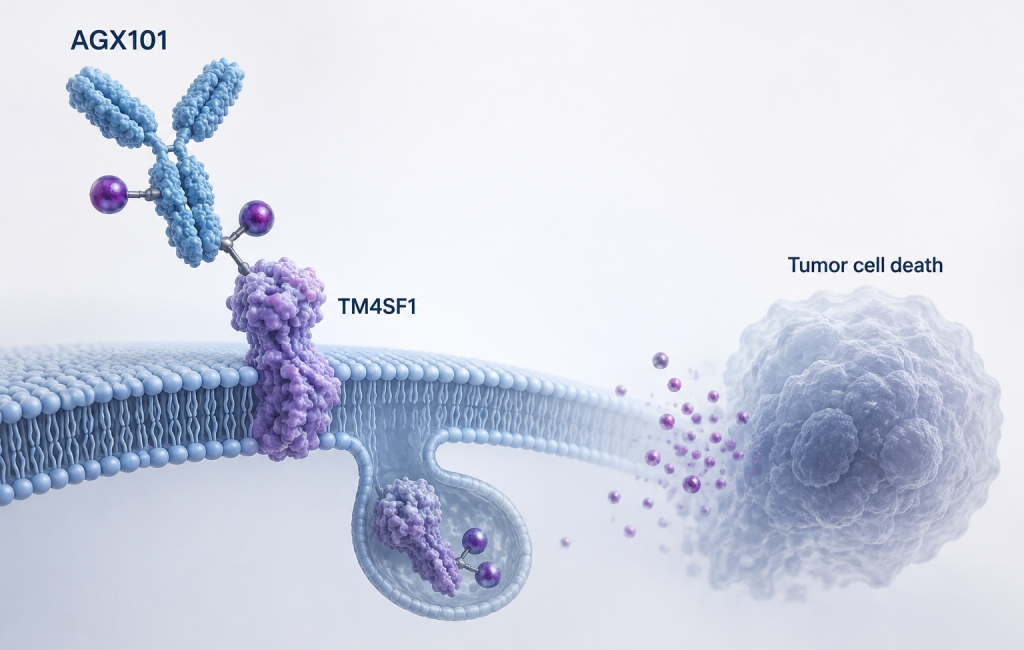
Natera and Angiex will evaluate longitudinal Signatera ctDNA monitoring in the Phase I trial of AGX101, a TM4SF1-directed ND-ADC for advanced solid tumors.
Written By: Umesh Hanumante,
M.Pharm (Reg. Affairs)
Reviewed By: Pharmacally Editorial Team
Natera and Angiex are expanding clinical development of AGX101, an investigational TM4SF1-directed nuclear-delivered antibody-drug conjugate (ND-ADC), through a collaboration that will add longitudinal Signatera circulating tumor DNA (ctDNA) testing to an ongoing Phase I trial in patients with advanced solid tumors.
The collaboration will assess whether serial ctDNA measurements can complement imaging-based response evaluation during treatment with AGX101 and provide an additional measure of tumor burden and biologic response.
AGX101 Targets Tumor Cells and Vasculature
AGX101 is an investigational ND-ADC that targets transmembrane 4 L six family member 1 (TM4SF1), a protein expressed on tumor cells and tumor-associated endothelial cells.
The approach combines targeted delivery of a cytotoxic payload with a dual-cellular target. By binding TM4SF1, AGX101 delivers its payload to TM4SF1-expressing tumor cells as well as tumor-associated endothelial cells within the tumor vasculature.
Angiex is evaluating the candidate in a Phase I clinical trial enrolling patients with unresectable, locally advanced or metastatic solid tumors. The study is intended to establish the clinical profile of AGX101 while generating early evidence to guide further development.
Signatera Adds Molecular Response Monitoring
Under the collaboration, patients in the AGX101 trial will undergo longitudinal testing with Natera’s Signatera assay, a personalized ctDNA test that tracks molecular signals associated with an individual patient’s tumor.
The testing will explore whether changes in ctDNA can provide an early or complementary indication of treatment response. This could be particularly relevant when radiologic findings are difficult to interpret, such as when imaging detects structural or metabolic changes that do not clearly distinguish viable tumor from treatment-related effects.
The collaboration does not establish that Signatera can predict or measure AGX101 efficacy. Instead, the longitudinal assessments will generate exploratory molecular response data that could help characterize treatment effects during early clinical development.
Implications for AGX101 Development
Paul Jaminet, Ph.D., co-founder and CEO of Angiex, said the collaboration will help the company evaluate whether longitudinal ctDNA measurements can complement imaging and improve its understanding of treatment response to AGX101.
Eric Matthews, general manager of biopharma at Natera, said Signatera could provide additional insight into early biologic response and support development of AGX101 and the broader ND-ADC approach.
The collaboration therefore adds a molecular monitoring component to an early-stage therapeutic program without changing the investigational status of AGX101.
Path Forward
The immediate focus remains the ongoing Phase I study in advanced solid tumors. Data from longitudinal Signatera testing will be evaluated alongside conventional clinical and radiologic assessments to determine whether ctDNA dynamics provide useful information about response during AGX101 treatment.
As the trial progresses, these findings could inform subsequent study design, including the selection of response-monitoring approaches and potentially the expansion of AGX101 development into additional solid-tumor settings.
Reference

About the Writer
Umesh Hanumante (M.Pharm) (LinkedIn) is a pharmacy professional and healthcare writer with a background in Regulatory Affairs, pharmaceutical innovation, and clinical research. He has around two years of industry experience as an Executive PMT at Troikaa Pharmaceuticals Ltd and qualified GPAT 2024. His areas of interest include regulatory compliance, dossier preparation, clinical trials, emerging therapies, and advancements in the global pharmaceutical and healthcare sector.