
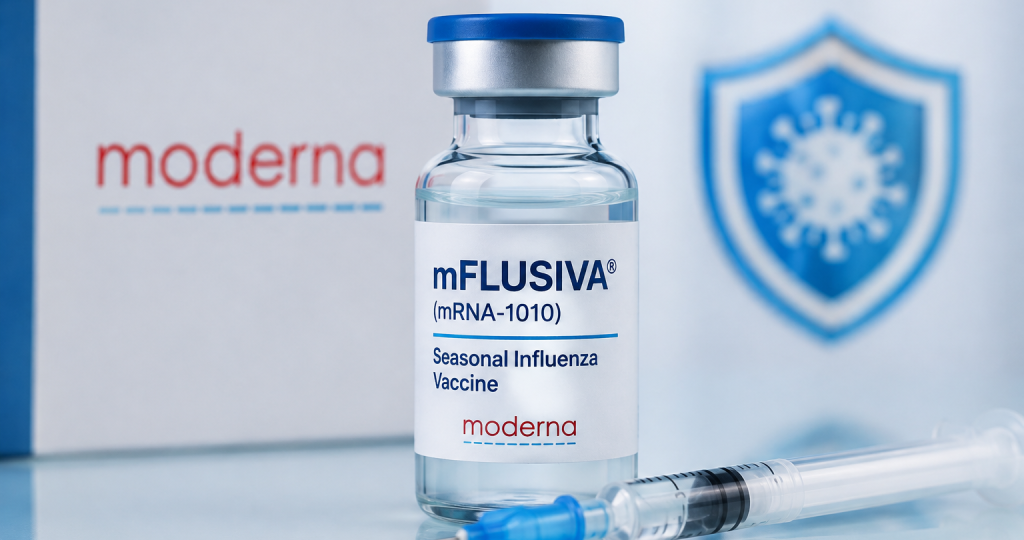
The FDA has approved Moderna’s mFLUSIVA (mRNA-1010), the first mRNA-based seasonal influenza vaccine for adults aged 50 years and older, supported by Phase 3 clinical trial data.
Written By: Umesh Hanumante,
M.Pharm (Reg. Affairs)
Reviewed By: Pharmacally Editorial Team
The U.S. Food and Drug Administration has approved mFLUSIVA® (mRNA-1010), Moderna’s seasonal influenza vaccine, making it the first approved mRNA-based influenza vaccine in the United States. The agency granted traditional approval for adults aged 50 through 64 years and accelerated approval for adults aged 65 years and older, supported by Phase 3 clinical data demonstrating improved protection against seasonal influenza and an acceptable safety profile.
The approval expands Moderna’s respiratory vaccine portfolio and provides a new mRNA vaccine option ahead of the 2026–2027 respiratory virus season.
mRNA Technology Expands into Seasonal Influenza Prevention
mFLUSIVA uses Moderna’s messenger RNA (mRNA) platform to encode influenza virus hemagglutinin (HA) antigens, enabling the body to generate immune responses against seasonal influenza strains.
Seasonal influenza remains a major public health challenge, particularly among older adults, who experience the highest rates of influenza-related hospitalization, complications, and mortality. Vaccine effectiveness also varies from season to season, highlighting the need for improved influenza vaccines that can be rapidly updated using mRNA technology.
The approval represents Moderna’s fourth FDA-approved product in the United States, following Spikevax®, mRESVIA®, and mNEXSPIKE®.
Phase 3 Trial Demonstrated Higher Relative Vaccine Efficacy
Traditional approval for adults aged 50 through 64 years was supported by the global Phase 3, randomized, observer-blind, active-controlled trial (NCT06602024), which enrolled 40,805 adults aged 50 years and older across 11 countries.
The study evaluated safety, reactogenicity, and relative vaccine efficacy (rVE) against a licensed standard-dose influenza vaccine using RT-PCR-confirmed protocol-defined influenza-like illness caused by influenza A or B viruses as the primary efficacy endpoint.
The trial demonstrated 26.6% higher relative vaccine efficacy for mFLUSIVA compared with the standard-dose influenza vaccine, supporting its clinical benefit in preventing laboratory-confirmed influenza among older adults.
Approval for adults 65 years and older was granted under the FDA’s accelerated approval pathway based on immunogenicity findings from the randomized, observer-blind, active-controlled Phase 3 trial (NCT05827978), which enrolled 2,992 participants in the United States. The study compared immune responses generated by mFLUSIVA with those produced by a licensed high-dose inactivated influenza vaccine. Descriptive analyses of relative vaccine efficacy from the larger Phase 3 efficacy study further supported use in this age group.
As part of the accelerated approval pathway, Moderna will conduct a postmarketing clinical trial to confirm clinical benefit in adults aged 65 years and older.
Safety Profile Consistent with Previous Clinical Studies
The Phase 3 development program showed an acceptable safety profile, with no new safety concerns identified.
The most frequently reported adverse reactions included injection-site pain, fatigue, headache, myalgia, and arthralgia. These reactions occurred more frequently than with conventional inactivated influenza vaccines but were generally mild to moderate in severity and transient, consistent with the reactogenicity profile observed with other mRNA vaccines.
Approval Highlights Continued Expansion of Moderna’s mRNA Platform
Moderna Chief Executive Officer Stéphane Bancel said the approval marks the company’s first authorized mRNA influenza vaccine and demonstrates the continued versatility of its mRNA platform beyond COVID-19.
He noted that seasonal influenza continues to impose a substantial public health burden, particularly among older adults, and said the approval provides an important new vaccination option while validating the broader potential of mRNA technology to address additional infectious diseases. He also acknowledged the contributions of clinical trial participants, investigators, regulators, and Moderna employees who supported the vaccine’s development.
Commercial Launch Planned for the 2026–2027 Influenza Season
Moderna expects to make mFLUSIVA available in the United States for eligible adults during the 2026–2027 respiratory virus season, alongside its approved COVID-19 and respiratory syncytial virus (RSV) vaccines.
Outside the United States, mRNA-1010 is currently under regulatory review in the European Union, Canada, and Australia, with additional submissions planned during 2026 as the company expands the global availability of its respiratory vaccine portfolio.
Reference
Moderna Receives U.S. FDA Approval for Influenza Vaccine mFLUSIVA

About the Writer
Umesh Hanumante (M.Pharm) (LinkedIn) is a pharmacy professional and healthcare writer with a background in Regulatory Affairs, pharmaceutical innovation, and clinical research. He has around two years of industry experience as an Executive PMT at Troikaa Pharmaceuticals Ltd and qualified GPAT 2024. His areas of interest include regulatory compliance, dossier preparation, clinical trials, emerging therapies, and advancements in the global pharmaceutical and healthcare sector.