
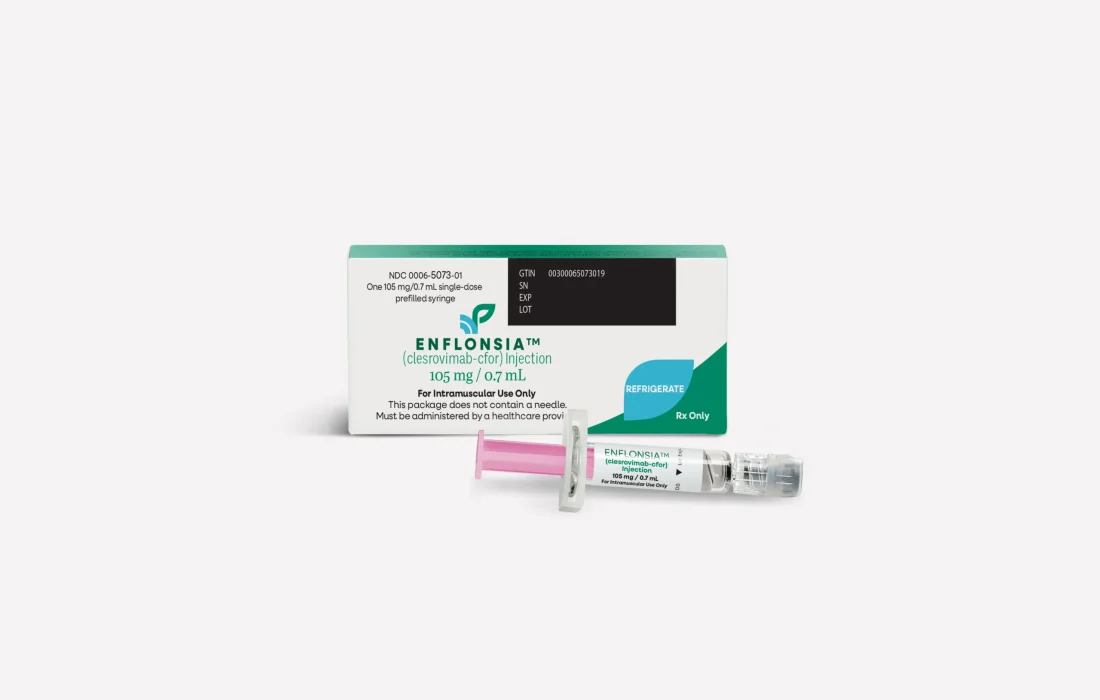
Merck receives positive EU CHMP opinion to expand ENFLONSIA (clesrovimab) for second-season RSV prevention in high-risk children up to 24 months.
Written By: Faiza, PharmD
Reviewed By: Pharmacally Editorial Team
Merck announced that the Committee for Medicinal Products for Human Use (CHMP) of the European Medicines Agency (EMA) has adopted a positive opinion recommending an expanded marketing authorization for ENFLONSIA® (clesrovimab) to prevent respiratory syncytial virus (RSV) lower respiratory tract disease (LRTD) in children up to 24 months of age who remain at increased risk of severe RSV disease through their second RSV season.
The proposed expansion addresses children whose vulnerability persists beyond infancy, particularly those with chronic lung disease (CLD), congenital heart disease (CHD), or early or moderate preterm birth accompanied by additional risk conditions. The recommendation represents a regulatory milestone for Merck’s long-acting monoclonal antibody, extending its preventive use beyond a child’s first RSV season.
Phase 3 SMART Trial Design and Participants
The regulatory submission is supported by the Phase 3 SMART trial (MK-1654-007; NCT04938830), a randomized, partially blinded, palivizumab-controlled, multicenter study evaluating the safety, efficacy, and pharmacokinetics of clesrovimab over two consecutive RSV seasons.
Conducted at 110 sites across 27 countries and territories, the trial enrolled early preterm infants (gestational age [GA] below 29 weeks), moderate preterm infants (GA 29–35 weeks), and infants with CLD of prematurity or CHD, irrespective of gestational age. During the first RSV season, 1,003 participants were randomized to receive either a single fixed 105 mg intramuscular dose of clesrovimab or monthly palivizumab. Of these, 997 received treatment: 498 in the clesrovimab group and 499 in the palivizumab group.
For the second RSV season, 276 eligible children from both first-season treatment arms (including those transitioning from first-season palivizumab as well as those continuing from clesrovimab) who still met high-risk criteria received an open-label, fixed 210 mg dose of clesrovimab, administered as two 105 mg intramuscular injections regardless of body weight. Nearly all second-season participants (99%) had CLD (n=229) or CHD (n=43).
SMART Trial Results: Second-Season Outcomes and Pharmacokinetics
The SMART trial’s primary objective was to evaluate safety and tolerability during the first RSV season, rather than establish comparative clinical efficacy in the second season. In the first season, adverse events occurred in 75.3% of clesrovimab recipients and 79.6% of palivizumab recipients, indicating generally comparable safety profiles. RSV-associated medically attended lower respiratory infection (MALRI) rates through Day 150 were also comparable, at 3.2% and 3.4%, respectively.
During the second season, following the fixed 210 mg clesrovimab dose, the overall incidence of RSV-associated MALRI through Day 180 was 7.3% (95% CI: 4.4–11.4%), while RSV-associated hospitalization occurred at an incidence rate of 3.0% (95% CI: 1.3–5.9%). Because the study did not include a comparator arm during the second season, these disease-incidence findings serve as descriptive clinical observations.
Pharmacokinetic bridging provides the primary quantitative support for the second-season dosing strategy. The geometric mean serum concentration of clesrovimab at Day 150 was 14.4 µg/mL following the 210 mg second-season dose, compared with 11.8 µg/mL following the 105 mg first-season dose. These systemic exposures aligned with concentrations observed in the pivotal CLEVER trial (MK-1654-004), in which clesrovimab efficacy was established, supporting the rationale for extending protection across a second RSV season without weight-based dose adjustments.
Safety Findings
The 210 mg second-season dose was generally well tolerated. Among the 276 treated children, 67.4% experienced at least one adverse event, and 19.6% experienced drug-related adverse events. Investigators considered no serious adverse events to be related to clesrovimab, and no anaphylaxis or hypersensitivity events were reported during either season.
Under existing US prescribing information, the most common adverse reactions are injection-site erythema (4.5%), injection-site swelling (3.2%), and rash (2.3%). ENFLONSIA is contraindicated in infants with a history of serious hypersensitivity reactions to any component and may interfere with certain rapid antigen-based RSV diagnostic tests; RT-PCR confirmation is recommended when clinical findings suggest RSV infection despite a negative antigen test. Final European Union labeling details will be confirmed upon European Commission authorization.
Regulatory Status and Clinical Interpretation
The positive CHMP opinion has been forwarded to the European Commission for a final decision on marketing authorization across the European Union, Iceland, Liechtenstein, and Norway, with a decision expected within approximately two months.
ENFLONSIA first received US FDA approval in June 2025 and European Commission approval in April 2026 for preventing RSV LRTD in infants born during or entering their first RSV season, and is approved in more than 55 countries worldwide. In the United States, the FDA has accepted a supplemental Biologics License Application for the second-season indication, with a Prescription Drug User Fee Act (PDUFA) target action date of March 22, 2027.
While the absence of a second-season comparator arm and the predominance of children with CLD or CHD limit conclusions regarding comparative effectiveness across all high-risk subgroups, the SMART trial demonstrates that a single, fixed 210 mg dose is well tolerated and achieves target drug exposures in children who remain vulnerable beyond infancy—including those transitioning from first-season palivizumab.
Reference
Merck Receives Positive EU CHMP Opinion to Expand Marketing Authorization for ENFLONSIA® (clesrovimab) to Include Children Up to 24 Months of Age Who Remain Vulnerable to Severe RSV Disease Through Their Second RSV Season, Merck, 13 November 2026
Clesrovimab (MK-1654) in Infants and Children at Increased Risk for Severe Respiratory Syncytial Virus (RSV) Disease (MK-1654-007) (SMART), ClinicalTrials.gov ID NCT04938830

About the Writer
Faiza (Linkedin) is a Healthcare Writer at Pharmacally and a PharmD professional from St. Peter’s Institute of Pharmaceutical Sciences, Kakatiya University. she has academic and clinical interests in clinical pharmacy, pharmacovigilance and patient care. Her research focuses on serum biomarkers in acute pancreatitis and medication adherence. She is interested in clinical research, medical writing and evidence-based healthcare communication.