
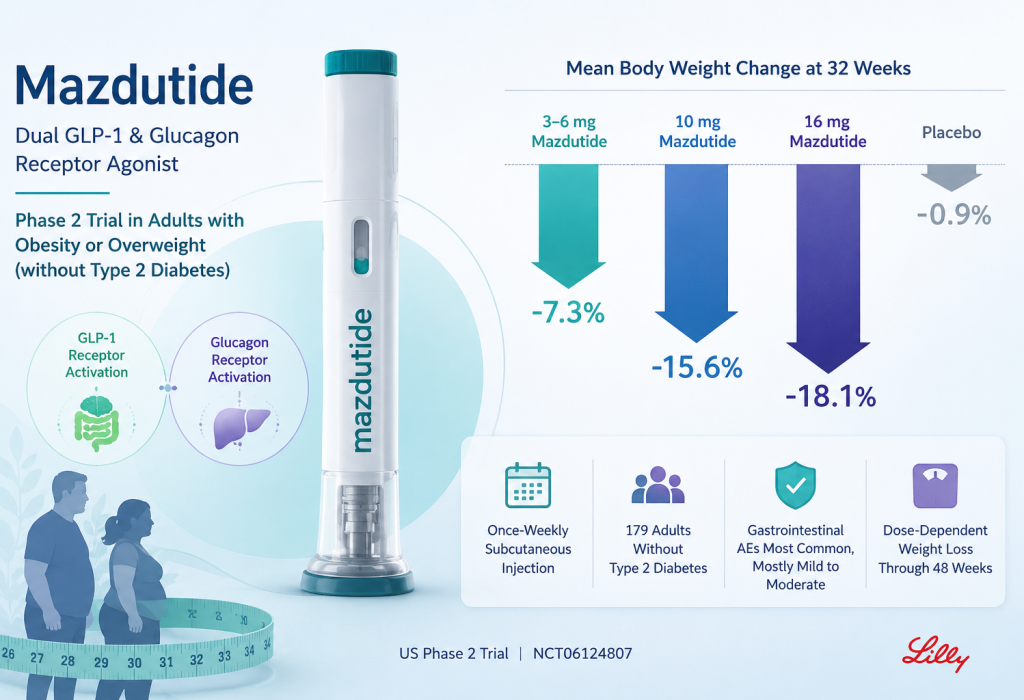
Eli Lilly’s mazdutide produced up to 18.1% weight loss at 32 weeks in a US phase 2 trial of adults with obesity or overweight without type 2 diabetes.
Written By: Mayuresh Salvi, PharmD
Reviewed By: Pharmacally Editorial Team
Eli Lilly’s once-weekly mazdutide produced dose-dependent weight loss of up to 18.1% in adults with obesity or overweight without type 2 diabetes in a US-based phase 2 trial. The randomised, placebo-controlled study, (NCT06124807), evaluated three mazdutide dosing strategies over 48 weeks and was published online August 21, 2026, in The Lancet Diabetes & Endocrinology.
Dual GLP-1 and Glucagon Receptor Activation
Mazdutide is a dual agonist of the glucagon-like peptide-1 (GLP-1) and glucagon receptors. GLP-1 receptor activation supports appetite suppression and glucose-dependent insulin secretion, while glucagon receptor activity can influence energy expenditure and hepatic metabolism. The combination provides a pharmacological approach that differs from selective GLP-1 receptor agonists and other incretin-based therapies.
Phase 2 Trial Shows Clear Dose Response
The double-blind, placebo-controlled phase 2 trial enrolled 179 adults aged 18 to 75 years across 24 centres in the US. Participants had a BMI of at least 30 kg/m², or 27 to less than 30 kg/m² with at least one weight-related comorbidity. None had type 2 diabetes.
Participants were randomly assigned to once-weekly subcutaneous mazdutide at 3–6 mg, 10 mg, or 16 mg, or placebo. The primary endpoint was percentage change in bodyweight from baseline at week 32.
At week 32, least-squares mean bodyweight changes were:
- 3–6 mg mazdutide: −7.3%
- 10 mg mazdutide: −15.6%
- 16 mg mazdutide: −18.1%
- Placebo: −0.9%
Treatment differences versus placebo ranged from −6.5% to −17.2%, with all comparisons reaching p<0.0001.
Weight reduction continued through week 48, suggesting that the treatment effect was maintained and, at higher doses, continued to increase beyond the primary efficacy assessment.
Higher Doses Increased Both Efficacy and Discontinuation
Gastrointestinal adverse events were the most frequently reported events with mazdutide and were generally mild to moderate. Treatment discontinuation because of adverse events occurred most often with the 16 mg dose, affecting 20% of participants, primarily because of gastrointestinal disorders.
The safety findings highlight the dose-response trade-off observed in the study. The 10 mg and 16 mg regimens produced substantially greater weight reduction than the 3–6 mg regimen, but the highest dose was also associated with more treatment discontinuations.
Findings Extend an Expanding Mazdutide Development Program
The US findings add to an established clinical development program for mazdutide. Earlier studies in China have included the phase 3 GLORY-1 trial in adults with overweight or obesity and GLORY-2, which evaluated the 9 mg dose in adults with moderate-to-severe obesity. More recent development has expanded into type 2 diabetes, metabolic dysfunction-associated fatty liver disease, obstructive sleep apnea, hypertension, and adolescent obesity.
The new US phase 2 data therefore provide evidence for mazdutide at substantially higher doses in a US population and define the relationship between dose, weight reduction, and tolerability. Lilly’s continued development will need to determine how these findings translate into later-stage studies and the optimal dose for long-term weight management.
Reference

About the Writer
Mayuresh Sunil Salvi (Linkedin) is a PharmD professional and healthcare writer with a strong interest in pharmacovigilance, drug safety, and emerging medical research. He is passionate about exploring new drug discoveries, clinical research, and advances in evidence-based medicine. His interests also include ward rounds, prescription audits, and treatment analysis to support rational pharmacotherapy and improved patient care.