
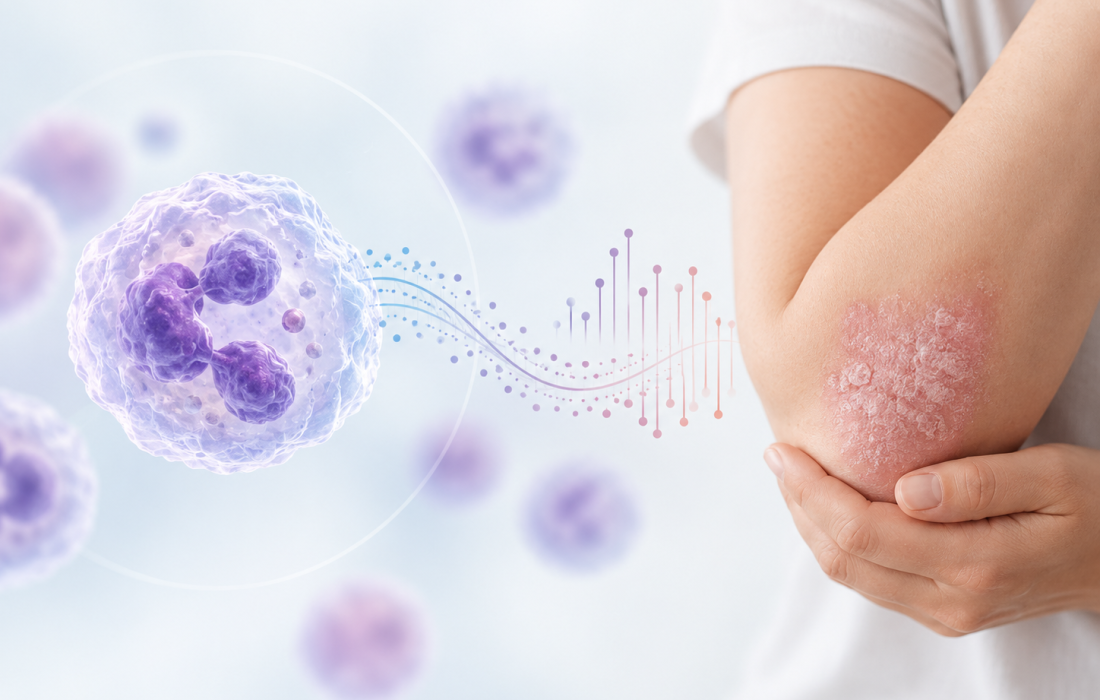
Lilly’s Phase 3b TOGETHER-PsO analysis links neutrophil-associated biomarkers to part of the additional psoriasis response with Taltz plus Zepbound.
Written By: Saniya Katakdhond, PharmD
Reviewed By: Pharmacally Editorial Team
Eli Lilly and Company reported exploratory biomarker findings from its Phase 3b TOGETHER-PsO trial (NCT06588283), evaluating Taltz (ixekizumab) plus Zepbound (tirzepatide) against Taltz alone in adults with moderate-to-severe plaque psoriasis and obesity or overweight accompanied by at least one additional weight-related comorbidity.
Presented at the 2026 Fall Clinical Dermatology Conference, the prespecified analysis examined circulating proteins and blood gene expression to investigate the biological changes associated with combination treatment. The findings showed broader biomarker changes as early as Week 12.
By Week 36, the combination group had substantially more differentially expressed proteins and genes than the Taltz-alone group. Changes in a subset of neutrophil-associated markers also mediated part of the additional Psoriasis Area and Severity Index (PASI) response observed with combination treatment.
Combination Treatment Produces Broader Molecular Changes
At Week 36, the combination group had 482 differentially expressed proteins, compared with 140 in the Taltz-alone group. The analysis also identified 467 differentially expressed genes with combination treatment, compared with 16 with Taltz monotherapy. Broader biomarker changes were already evident by Week 12.
The analysis covered psoriasis-specific, immune and metabolic biomarkers. In both treatment groups, the observed changes were consistent with the known biological effects of each medicine when used for its approved indications. The broader response with combination treatment suggests that addressing psoriasis and excess weight together may influence a wider range of biological pathways than targeting psoriasis alone.
However, the number of differentially expressed proteins or genes does not independently establish clinical benefit. These counts also do not show that every observed change contributes to skin clearance or indicate the relative importance of individual biomarkers.
Neutrophil-Associated Markers May Explain the Additional Response
The analysis found greater reductions in inflammatory immune activity with Taltz plus Zepbound than with Taltz alone, including changes involving neutrophils, immune cells that participate in inflammatory responses.
Changes in a subset of neutrophil-associated markers mediated part of the additional PASI response observed with combination treatment. This finding provides a more specific potential link between the molecular changes associated with treatment and the additional skin response than the overall biomarker counts alone.
The results may help researchers investigate how immune and metabolic processes interact in people living with psoriasis and excess weight. However, the mediation finding does not establish that changes in these markers directly caused improved skin clearance. Nor does it establish the relative contributions of weight reduction, metabolic changes and other treatment effects to the observed response.
The identified markers have not been validated as tools for predicting treatment response or guiding treatment selection. Further analyses will be needed to determine their biological significance and potential clinical utility.
Clinical Results and Trial Design
The biomarker findings build on previously reported clinical results from TOGETHER-PsO. At Week 36, combination treatment outperformed Taltz alone on the primary endpoint, which required participants to achieve both complete skin clearance, defined as PASI 100, and at least 10% body-weight reduction.
Previously reported results also showed that 40.6% of participants receiving Taltz plus Zepbound achieved PASI 100, compared with 29.0% receiving Taltz alone, a key secondary outcome. Improvements in clinical outcomes were maintained or further improved through Week 52, and the reported safety findings were consistent with the known profiles of both medicines.
TOGETHER-PsO is a 52-week, randomized, multicenter, assessor-blinded, open-label Phase 3b study involving 274 adults. Participants were randomized to receive Taltz alone or Taltz plus Zepbound. Both medicines were administered subcutaneously, and participants in both groups received counseling on a reduced-calorie diet and increased physical activity.
Eligible participants had moderate-to-severe plaque psoriasis and a body mass index (BMI) of at least 30 kg/m², or a BMI of at least 27 but below 30 kg/m² with at least one additional weight-related comorbidity.
Taltz is a monoclonal antibody that selectively binds interleukin-17A (IL-17A), a cytokine involved in inflammatory and immune responses. Zepbound activates glucose-dependent insulinotropic polypeptide (GIP) and glucagon-like peptide-1 (GLP-1) receptors and is used for weight management. The trial investigates whether combining these distinct treatment approaches can improve outcomes in people managing both psoriasis and excess weight.
Implications for Future Research
The exploratory analysis extends the clinical findings by identifying broader molecular changes associated with combination treatment and a potential role for neutrophil-associated markers in the additional skin response. The changes observed as early as Week 12 also provide a basis for further investigation of treatment-associated immune and metabolic responses.
Further research is needed to establish the clinical significance of these biomarkers, clarify the biological pathways involved and determine whether the identified markers can help explain differences in treatment response. The available company disclosure does not establish a causal mechanism or provide validated biomarkers for predicting which patients are most likely to benefit from combination therapy.
For now, the findings offer additional insight into the potential relationship between immune and metabolic biology in psoriasis and obesity. They do not establish the individual contribution of each biological pathway to the clinical benefits observed with Taltz plus Zepbound.
Reference
New Phase 3b Data on Lilly’s Taltz (ixekizumab) and Zepbound (tirzepatide) Advance Understanding of the Interconnected Immune and Metabolic Biology in Adults with Psoriasis and Obesity, Eli Lilly and Company, October 9, 2026.
Ixekizumab Concomitantly Administered with Tirzepatide in Adults with Moderate-to-Severe Plaque Psoriasis and Obesity or Overweight (TOGETHER-PsO), ClinicalTrials.gov ID NCT06588283

About the Writer
Saniya Sanjay Katakdhond (Linkedin) is a Doctor of Pharmacy professional with hands-on experience in patient case review, clinical documentation, medical record analysis, and patient care.
Her hospital experience has strengthened her understanding of clinical conditions, treatment approaches, and multidisciplinary healthcare practices.
With ICH-GCP certification and a research-oriented approach, she brings clinical insight and attention to detail to healthcare content development.
As a healthcare writer, Saniya focuses on translating clinical knowledge and patient-care experience into clear, accurate, and evidence-informed medical content.