
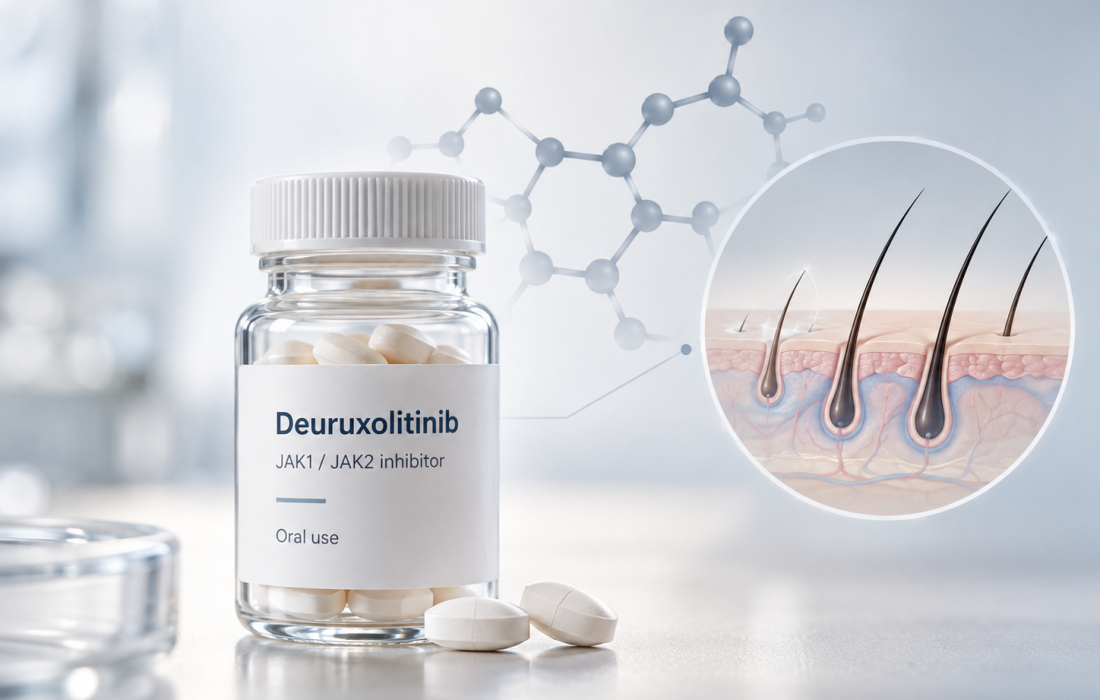
LEQSELVI (deuruxolitinib) showed sustained hair regrowth through Week 108 and a consistent safety profile in adults with severe alopecia areata.
Written By: Kirti Kumbhar, M. Pharm (QA)
Reviewed By: Pharmacally Editorial Team
Sun Pharma has reported new long-term data for LEQSELVI® (deuruxolitinib) at the 2026 European Academy of Dermatology and Venereology (EADV) Congress, including a featured oral presentation of up to two years of safety data from a European open-label extension (OLE) study in adults with severe alopecia areata (AA).
The long-term findings showed that the safety profile of LEQSELVI remained generally consistent with previous clinical experience through up to two years of open-label treatment. Most treatment-emergent adverse events were mild or moderate, treatment discontinuations because of adverse events were uncommon, and no deaths, thrombosis, or major adverse cardiovascular events (MACE) were reported among patients receiving the FDA-approved dose of 8 mg twice daily.
EADV 2026 presentations also included long-term efficacy analyses showing that scalp hair regrowth was maintained through Week 108 among patients who continued treatment in the European OLE.
Hair Regrowth Remained Durable Through Week 108
The durability analysis used the Severity of Alopecia Tool (SALT), a measure of scalp hair loss in which a score of 100 represents complete scalp hair loss and 0 represents no scalp hair loss.
Among OLE baseline treatment responders, defined as patients with a SALT score of 20 or less, who maintained their response at Week 52 and continued in the study, 93.9% maintained their response at Week 108.
The analysis also showed that some patients who were classified as baseline nonresponders, defined as those with a SALT score greater than 20, subsequently achieved a response. By Week 52, 76.6% of baseline nonresponders had achieved a response. Patients who responded at Week 52 were eligible to continue in the extension, and among these patients, 96.8% maintained their response through Week 108.
These findings provide evidence of durable clinical benefit among patients who responded to treatment and continued in the extension study. However, because only responders at Week 52 continued beyond that point, the Week 108 maintenance results should not be interpreted as representing the entire population initially treated with LEQSELVI.
Additional Analyses Broaden Understanding of LEQSELVI
Beyond the featured oral presentation and long-term efficacy poster, Sun Pharma reported additional pooled post hoc analyses of the THRIVE-AA1 and THRIVE-AA2 studies at EADV 2026.
These analyses showed consistent efficacy across clinically relevant patient subgroups, including patients with baseline eyebrow, eyelash, or nail involvement and patients with both shorter- and longer-duration disease episodes.
Together with the long-term OLE findings, these analyses add to the clinical evidence supporting deuruxolitinib in adults with severe alopecia areata.
LEQSELVI Targets JAK1 and JAK2
LEQSELVI (deuruxolitinib) is an oral selective inhibitor of Janus kinases JAK1 and JAK2. The FDA has approved LEQSELVI for the treatment of adults with severe alopecia areata.
Its clinical use requires consideration of several safety and monitoring factors because JAK inhibition can affect immune function and other physiological pathways.
Safety Remains an Important Consideration for Long-Term Treatment
LEQSELVI can increase the risk of serious infections, and patients should be evaluated for tuberculosis before treatment and monitored for tuberculosis during therapy. The prescribing information also recommends CYP2C9 genotype determination before treatment because LEQSELVI is contraindicated in CYP2C9 poor metabolizers and in patients receiving moderate or strong CYP2C9 inhibitors.
The prescribing information includes warnings for serious infections, malignancies including lymphoma, thrombosis, major adverse cardiovascular events, and gastrointestinal perforation. The MACE warning applies particularly to certain patients aged 50 years and older with cardiovascular risk factors, including current or past smoking history, and reflects the broader safety considerations associated with JAK inhibitors.
Common adverse reactions reported with LEQSELVI include acne, headache, nasopharyngitis, increased creatine phosphokinase, increased blood cholesterol, fatigue, weight gain, thrombocytosis, anemia, skin and soft tissue infections, neutropenia, lymphopenia, and herpes.
Long-Term Data Add to the Clinical Evidence
The EADV 2026 findings add longer-term clinical evidence for LEQSELVI in severe alopecia areata, with scalp hair regrowth maintained through Week 108 among patients who continued treatment in the European OLE.
The findings also indicate that patients who achieved a response by Week 52 generally maintained that response through the second year of follow-up. At the same time, the responder-enriched nature of the Week 108 analysis should be considered when interpreting the durability results.
Overall, the two-year data provide additional evidence of sustained response and a safety profile generally consistent with previous clinical experience with deuruxolitinib in adults with severe alopecia areata.
Reference
New LEQSELVI® (deuruxolitinib) Two-Year Data in Severe Alopecia Areata Showed Sustained Efficacy and Safety at EADV Congress 2026, Sun Pharma, October 01 2026

About the Writer
Kirti Kumbhar (LinkedIn) is an M.Pharm graduate with experience in Quality Assurance at Lupin Limited and a strong interest in clinical research, regulatory affairs, and Trial Master File (TMF) management. She has developed knowledge of regulatory documentation, quality systems, compliance, and healthcare research through her professional experience. Passionate about clinical development and continuous learning, Kirti is committed to supporting high-quality healthcare documentation, regulatory excellence, and research-driven healthcare advancements.