
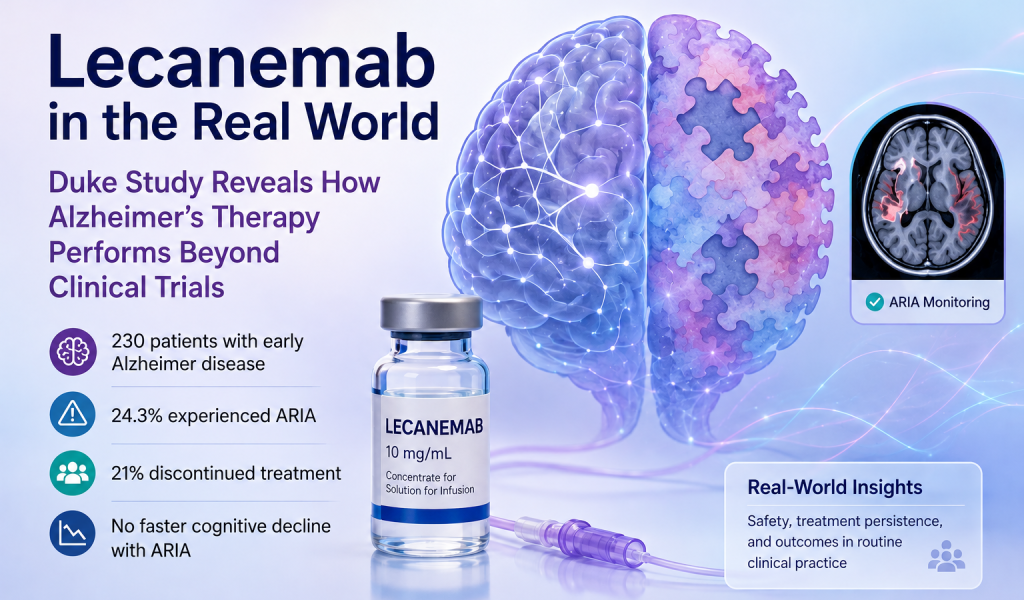
A Duke study of 230 patients provides real-world data on lecanemab, including ARIA, treatment discontinuation, adverse events, deaths and cognitive outcomes.
Written By: Anamika Koshti, PharmD
Reviewed By: Pharmacally Editorial Team
Lecanemab has become one of the most closely watched disease-modifying therapies for early Alzheimer disease, with clinical trials establishing its ability to slow disease progression. But as the treatment moves beyond controlled research settings and into routine clinical practice, an important question is emerging: how does lecanemab actually perform in the real world?
A retrospective study from Duke University, published in Neurology Open Access, provides an early look at that question. Researchers reviewed outcomes from 230 patients with mild cognitive impairment (MCI) or mild Alzheimer disease who received lecanemab between May 2023 and June 2025. Instead of focusing primarily on a controlled efficacy endpoint, the study examined what happened during routine treatment, including amyloid-related imaging abnormalities (ARIA), treatment discontinuation, clinically significant adverse events, deaths and cognitive changes.
The findings highlight the practical challenges of delivering lecanemab outside a clinical trial. ARIA occurred in 24.3% of patients, 21% discontinued treatment and 72 clinically significant adverse events were reported. Five deaths occurred, including two considered related to lecanemab. At the same time, ARIA was not associated with a significantly different rate of cognitive decline during follow-up.
A Real-World Look at Lecanemab Treatment
The study was a retrospective, single-site observational analysis conducted at Duke University. The cohort included 155 patients with MCI and 73 with mild Alzheimer disease dementia. The mean age was 73.6 years, and 50.9% of participants were women. Amyloid pathology was confirmed through cerebrospinal fluid biomarkers in 155 patients and florbetapir PET imaging in 75 patients.
Unlike a randomized clinical trial, the analysis captured the broader realities of treatment in clinical practice, including MRI surveillance, infusion monitoring, treatment interruptions and management of complications.
That makes the findings particularly relevant as lecanemab becomes increasingly integrated into specialist Alzheimer disease care.
One in Five Patients Discontinued Treatment
Treatment persistence was an important part of the Duke experience.
Overall, 49 patients, or 21%, discontinued lecanemab. ARIA was the most common reason, accounting for 19 discontinuations. Other reasons included cognitive decline, stroke, seizures, relocation, new diagnoses and individual medical or insurance-related issues.
The finding illustrates a difference between demonstrating treatment effects in a clinical trial and maintaining therapy in everyday practice. In routine care, treatment continuation can be affected by adverse events, emerging medical conditions and practical issues surrounding long-term administration.
ARIA Remains a Major Safety Concern
The most prominent safety finding was the incidence of ARIA.
Among the 230 patients, 24.3% developed ARIA, slightly higher than the 21.5% reported in the pivotal CLARITY-AD trial. The researchers suggest that the difference may partly reflect the inclusion of ARIA with superficial siderosis, more sensitive MRI sequences, longer follow-up and a more inclusive real-world treatment approach.
ARIA was not limited to the earliest stages of treatment. ARIA-E showed two peaks around weeks 10 and 25, while more severe ARIA generally appeared earlier. The study also found that radiographic resolution occurred over approximately 3 to 20 weeks.
The findings reinforce the importance of continued MRI surveillance during lecanemab treatment rather than treating ARIA monitoring as an early-treatment precaution alone.
APOE ε4 Increased Risk, but Could Not Reliably Predict ARIA
The study also examined whether baseline characteristics could identify patients most likely to develop ARIA.
APOE ε4 status was associated with increased risk. APOE ε4 homozygotes had approximately 4.8-fold higher odds of ARIA-E and 3.8-fold higher odds of ARIA-MH compared with noncarriers.
However, the broader prediction analysis produced a more important real-world finding.
Researchers assessed seven baseline variables, including age, diagnosis, sex, race, APOE ε4 allele count, CSF p-tau181/Aβ42 and Fazekas score. When these variables were combined, the prediction model had an AUC of only 0.58, indicating poor ability to distinguish patients who would develop ARIA from those who would not.
In other words, APOE ε4 can indicate increased risk, but currently available baseline measures cannot reliably tell clinicians which individual patient will develop ARIA.
Real-World Treatment Requires Intensive Monitoring
The Duke experience also demonstrates the infrastructure required to administer lecanemab safely.
The center used standardized 3T MRI protocols, including susceptibility-weighted imaging to improve detection of microhaemorrhages and superficial siderosis. MRI surveillance was performed after the fourth, sixth and 13th infusions, with additional monthly scans for patients who developed ARIA until resolution. Duke also implemented MRI assessment after the second infusion following updated FDA recommendations.
This monitoring burden is an important part of the real-world story because the clinical value of lecanemab depends not only on the drug itself, but also on the ability of healthcare systems to monitor and manage its risks.
Serious Events and Deaths Were Reported
The study recorded 72 clinically significant adverse events, including 22 falls, 10 strokes, seven cardiovascular events, seven altered mental-state events and seven severe infusion reactions. The authors note that these were events rather than necessarily unique patients, as some patients experienced more than one event.
Five deaths occurred during follow-up. Two deaths were considered related to lecanemab, including one involving intraparenchymal hemorrhage and another involving severe symptomatic ARIA-E, ARIA-MH and ARIA with superficial siderosis accompanied by electrographic seizures.
These findings underscore why real-world safety surveillance remains important as treatment expands beyond highly selected trial populations.
ARIA Was Not Linked to Faster Cognitive Decline
Despite the safety concerns surrounding ARIA, the study did not find a significant difference in cognitive decline between patients with and without ARIA.
MoCA scores declined by an estimated 0.107 points per month, but the interaction between time and ARIA status was not statistically significant. The investigators therefore found no evidence that ARIA was associated with a different rate of cognitive decline during the observed period.
What the Duke Experience Means for Lecanemab
The significance of this study lies less in producing another efficacy result and more in showing what happens when lecanemab moves from clinical trials into everyday medical practice.
The Duke experience suggests that many patients can remain on treatment, but discontinuation is not uncommon. ARIA affected nearly one in four patients, serious clinical events occurred, and two deaths were considered treatment-related. At the same time, currently available baseline clinical, genetic, imaging and CSF measures could not reliably predict which patients would develop ARIA.
As lecanemab use expands, these real-world observations may become increasingly important in understanding how the therapy can be delivered safely and sustainably outside the controlled environment of a clinical trial.
Reference
Clinical Practice Outcomes With Lecanemab for Alzheimer Disease | Neurology Open Access

About the Writer
Anamika Koshti (LinkedIn) is a PharmD professional and healthcare writer with interests in clinical research, pharmacovigilance, and evidence-based medicine. She has authored peer-reviewed publications on Alzheimer’s disease and PCOS, presented research at national conferences, and gained hands-on experience in medical content development and clinical data interpretation. She is committed to translating complex medical research into accurate, accessible content for healthcare professionals and patients.