
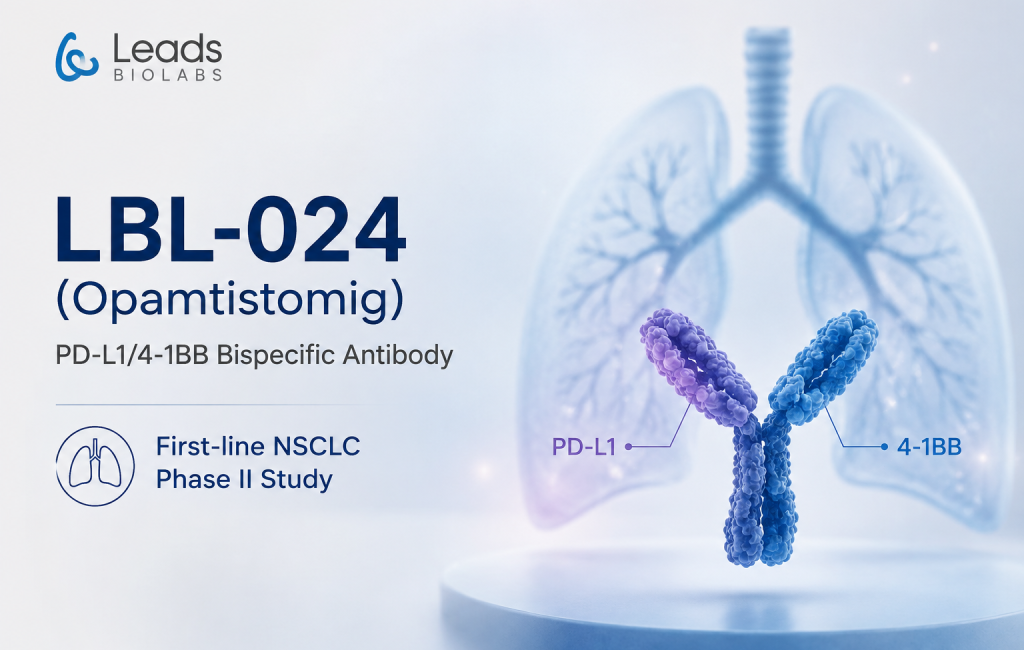
Leads Biolabs’ LBL-024 plus chemotherapy achieved a 65% ORR and 95% DCR in first-line NSCLC. Updated data will be presented at WCLC 2026.
Written By: Mayuresh Salvi, PharmD
Reviewed By: Pharmacally Editorial Team
Leads Biolabs’ investigational PD-L1/4-1BB bispecific antibody, LBL-024 (opamtistomig), produced encouraging antitumor activity when combined with chemotherapy as a first-line treatment for locally advanced or metastatic non-small cell lung cancer (NSCLC), according to data published in the World Conference on Lung Cancer (WCLC) 2026 abstract program. The open-label, multicenter Phase II trial (NCT06783647) evaluates LBL-024 combination therapy across four cohorts of patients with advanced solid tumors, including NSCLC.
Among 60 efficacy-evaluable patients, LBL-024 plus chemotherapy achieved an objective response rate (ORR) of 65.0% and a disease control rate (DCR) of 95.0%, based on a March 6, 2026 data cutoff with a median follow-up of 3.6 months. Leads Biolabs will present updated results featuring over seven months of follow-up during an oral presentation at WCLC on September 14, 2026.
Responses Observed Across NSCLC Subtypes
Activity was observed in both major histologic subgroups. Patients with squamous NSCLC had an ORR of 77.4% and DCR of 96.8%, while those with non-squamous disease had an ORR of 51.7% and DCR of 93.1%.
The short follow-up limits conclusions about response durability and progression-free survival (PFS). However, Leads Biolabs reported continued tumor shrinkage in some patients with longer treatment and follow-up, alongside an upward trend in ORR and a favorable PFS trend.
The safety profile remained manageable, with no new safety signals identified in the reported analysis.
Dual PD-L1 and 4-1BB Targeting
LBL-024 combines blockade of PD-L1 with activation of 4-1BB, a costimulatory receptor involved in T-cell activation. This dual mechanism is intended to enhance antitumor immunity while countering immune suppression within the tumor microenvironment.
The approach is particularly relevant in NSCLC, where immunotherapy combined with chemotherapy has expanded first-line treatment options but durable disease control remains difficult for many patients.
NSCLC represents about 85% of lung cancer cases. Patients with actionable alterations such as EGFR, ALK and ROS1 can receive targeted therapies, but patients without driver mutations continue to rely heavily on immunotherapy-based regimens. Squamous NSCLC presents an additional treatment challenge because targeted options are limited and several commonly used agents in non-squamous disease are unsuitable.
Updated Data Will Clarify Durability
Charles Cai, Chief Medical Officer of Leads Biolabs, said longer follow-up has shown continued tumor shrinkage in some patients and an upward trend in ORR. The September WCLC presentation will include updated ORR, the six-month PFS rate and subgroup analyses according to PD-L1 expression in squamous and non-squamous NSCLC.
LBL-024 is currently being evaluated in 11 clinical studies across multiple tumor types. The company has reported clinical activity across its first seven indications, supporting continued evaluation of the bispecific antibody beyond NSCLC.
The upcoming WCLC dataset should provide a more informative assessment of response depth, durability and early PFS outcomes. Longer follow-up will be important for determining whether the initial response signal translates into sustained clinical benefit.
Reference
About the Writer
Mayuresh Sunil Salvi (Linkedin) is a PharmD professional and healthcare writer with a strong interest in pharmacovigilance, drug safety, and emerging medical research. He is passionate about exploring new drug discoveries, clinical research, and advances in evidence-based medicine. His interests also include ward rounds, prescription audits, and treatment analysis to support rational pharmacotherapy and improved patient care.