
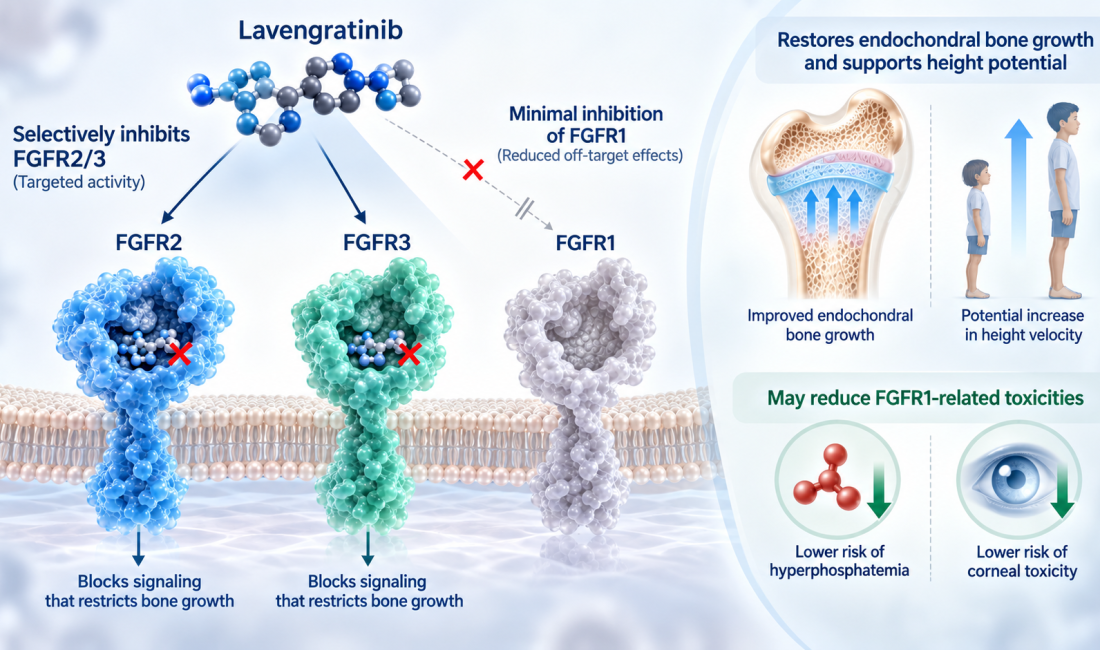
Abbisko’s lavengratinib (ABSK061) showed a 2.4 cm/year improvement in height velocity in children with achondroplasia in Phase II testing.
Written By: Siddhi Bhadekar, M. Pharm (QA)
Reviewed By: Pharmacally Editorial Team
Abbisko Therapeutics reported preliminary Phase II results for lavengratinib (ABSK061), an oral selective FGFR2/3 inhibitor, in children with achondroplasia. In the lowest dose cohort, seven children aged 6 to 12 years achieved a mean 2.4 cm/year improvement in annualized height velocity (AHV) from baseline after 27 weeks, with all seven meeting the prespecified responder threshold.
Early Growth Signal at the Lowest Dose
The findings come from ABSK061-202 (NCT07297875), a multicenter, open-label Phase II study evaluating the safety, tolerability, pharmacokinetics and efficacy of oral lavengratinib in children with achondroplasia. The trial includes children aged 3 to 12 years and uses dose escalation followed by evaluation at recommended doses.
In the first dose cohort, participants received 0.064 mg/kg once daily. All seven children aged 6 to 12 years in this cohort completed approximately six months of treatment. At Week 27, mean AHV increased by 2.4 cm/year from baseline, while the responder rate reached 100%. Abbisko defines a responder as a participant achieving at least a 25% improvement in AHV from baseline.
Higher-dose cohorts remain under treatment, so the current findings provide an early assessment of lavengratinib’s growth effect and do not yet establish a dose-response relationship.
Selective FGFR2/3 Inhibition Targets the Disease Pathway
Achondroplasia is caused primarily by activating variants in FGFR3, which disrupt signaling involved in endochondral bone growth and result in disproportionate short stature.
Lavengratinib is a highly selective small-molecule inhibitor of FGFR2 and FGFR3. Its development strategy is based on maintaining activity against FGFR2/3 while limiting FGFR1 inhibition, which has been associated with toxicities seen with broader pan-FGFR inhibitors.
This selectivity could be particularly relevant in achondroplasia, where treatment may require prolonged exposure during childhood. However, the potential clinical advantages of the selectivity profile will require confirmation through longer-term safety and efficacy follow-up.
Preliminary Safety Profile Remains Favorable
Abbisko reported no serious adverse events and no treatment discontinuations because of adverse events among the participants evaluated to date. The first three dose cohorts have completed their preliminary safety evaluation without identified safety concerns.
The company also reported no observed FGFR pathway-related safety signals, including hyperphosphatemia and corneal toxicity associated with FGFR1 or FGFR2 activity. These findings remain preliminary, and longer follow-up will be important because the planned treatment duration is 78 weeks.
Mini-Tablet Formulation Supports Pediatric Administration
Lavengratinib is being administered using a mini-tablet formulation measuring less than 3 mm in diameter, compared with conventional tablets that are typically about 8 to 10 mm. The formulation can be administered with food or beverages, potentially simplifying daily oral dosing in young children.
Six-Month Data Expected by End of 2026
The ABSK061-202 study is continuing to evaluate participants in higher-dose cohorts. Abbisko expects additional six-month efficacy and safety data by the end of 2026, which should provide a broader assessment of lavengratinib across dose levels.
Lavengratinib has received Rare Pediatric Disease Designation and Orphan Drug Designation from the FDA for achondroplasia. The ongoing Phase II program will determine whether the early improvement in growth velocity is sustained with longer treatment and whether selective FGFR2/3 inhibition can provide a durable benefit with an acceptable safety profile in children with achondroplasia.
Reference
Abbisko Therapeutics Announces Positive Preliminary Phase 2 Results with Lavengratinib (ABSK061) for the Treatment of Achondroplasia.” Abbisko Therapeutics, 21 September 2026.
ClinicalTrials.gov. A Study of ABSK061 to Assess Safety, Tolerability, Pharmacokinetics, and Efficacy in Children with Achondroplasia. ClinicalTrials.gov ID NCT07297875

About the Writer
Siddhi Rajendra Bhadekar (Linkedin) is an M.Pharm professional with expertise in medical and scientific writing, literature review, publication writing, and evidence synthesis, supported by four peer-reviewed publications.
She brings working knowledge of ICH-GCP, MedDRA, pharmacovigilance, ADR/AE reporting, clinical data management, and regulatory documentation.
With experience across pharmaceutical R&D, Quality Control, and Quality Assurance, she combines scientific research skills with strong attention to accuracy and detail.
Her background in manuscript development, publication planning, and scientific communication enables her to translate complex healthcare information into clear, reliable content.