
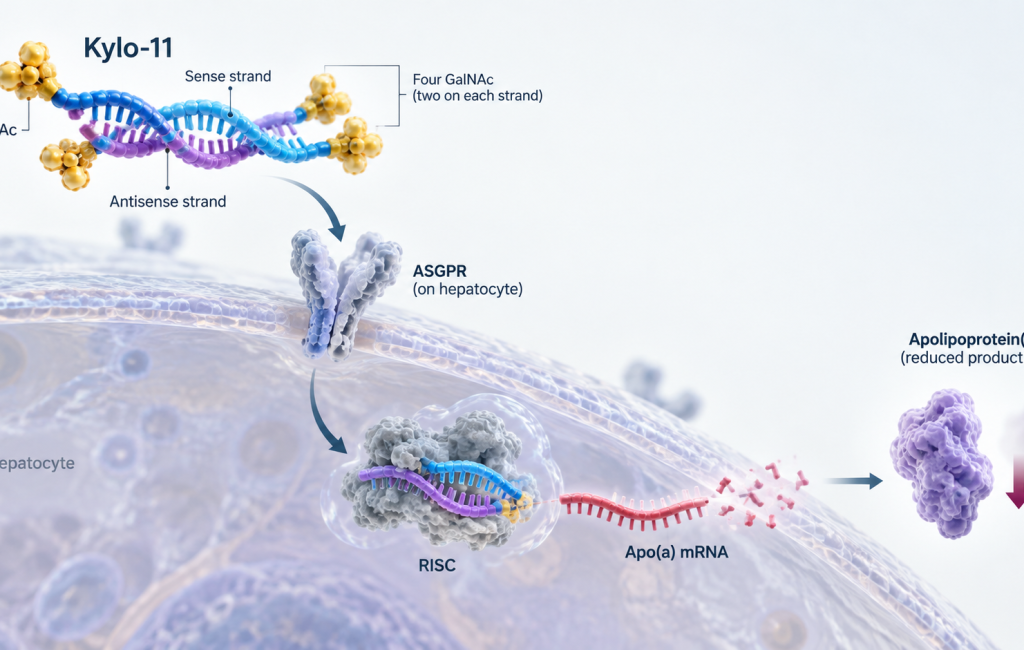
Kylo-11 cut lipoprotein(a) by up to 97% after a single dose, with effects lasting 48 weeks in a Phase 1 trial published in The Lancet.
Written By: Kirti Kumbhar, PharmD
Reviewed By: Pharmacally Editorial Team
Kylonova Biopharma’s investigational Kylo-11 produced deep and durable reductions in lipoprotein(a) [Lp(a)] after a single subcutaneous injection in a Phase 1 study of adults with elevated Lp(a). At doses of 225 mg or higher, the treatment maintained reductions of about 95% or more through 48 weeks, while no drug-related serious adverse events or deaths were reported.
The results were presented in a late-breaking science session at the European Society of Cardiology (ESC) Congress 2026 in Munich and simultaneously published in The Lancet, providing peer-reviewed evidence for Kylo-11’s long-duration pharmacodynamic profile.
Targeting a Genetically Determined Cardiovascular Risk Factor
Lp(a) is produced primarily in the liver and is strongly associated with atherosclerotic cardiovascular disease (ASCVD). Its concentration is largely genetically determined, while lifestyle interventions have little effect. Despite its cardiovascular relevance, no pharmacological therapy is currently approved specifically to lower Lp(a) and reduce cardiovascular events independently of LDL cholesterol lowering.
Kylo-11 uses RNA interference to silence production of apolipoprotein(a), a key structural component of the Lp(a) particle. Its delivery architecture distinguishes it from conventional GalNAc-conjugated siRNAs. Kylo-11 carries four GalNAc moieties, two on each siRNA strand, a dual-site configuration thought to enhance hepatic uptake and contribute to prolonged activity.
Phase 1 Trial Shows Dose-Dependent Activity
The randomized, double-blind, placebo-controlled first-in-human study enrolled 71 healthy adults aged 18–55 years at a single site in China. Participants received a single dose of Kylo-11 at 9, 30, 75, 225, 450, or 600 mg, or placebo. A separate 225 mg cohort included participants with baseline Lp(a) concentrations above 200 nmol/L.
At 48 weeks, median Lp(a) reductions ranged from 53.2% with 9 mg to 97.0% with 600 mg. The 225 mg dose produced a 94.6% median reduction, while the high-baseline Lp(a) cohort receiving 225 mg achieved a 96% median reduction.
Kylo-11 was generally well tolerated. Adverse events occurred in 37 of 70 dosed participants through 24 weeks, predominantly grade 1 or 2. There were no injection-site reactions, serious adverse events, drug-related adverse events, or deaths. Three grade 3 or higher events across the Kylo-11 and placebo groups were judged unrelated to study treatment.
Cleveland Clinic Leads Academic Analysis
Kylonova sponsored the study, while Cleveland Clinic’s C5Research served as the academic research organization. C5Research investigators contributed to trial design and interpretation and conducted independent statistical analysis of the study data. Kylonova Biopharma is a subsidiary of Hygieia Pharma, an SBP Group company.
Phase 2 Moves Kylo-11 Into ASCVD
The program has already advanced into a multicenter Phase 2 trial (NCT07327840) enrolling patients with established ASCVD and elevated Lp(a). The randomized, double-blind, placebo-controlled study is evaluating three Kylo-11 dose strengths and includes sites in the US and China.
The Phase 2 program will test whether the striking pharmacodynamic durability seen in healthy volunteers can be reproduced in patients with cardiovascular disease and establish an appropriate dosing strategy. The potential for six-month or annual administration is one of the key development questions, but cardiovascular outcome studies will ultimately be required to determine whether profound Lp(a) lowering translates into fewer heart attacks, strokes, or other ASCVD events.
Reference

About the Writer
Kirti Kumbhar (LinkedIn) is an M.Pharm graduate with experience in Quality Assurance at Lupin Limited and a strong interest in clinical research, regulatory affairs, and Trial Master File (TMF) management. She has developed knowledge of regulatory documentation, quality systems, compliance, and healthcare research through her professional experience. Passionate about clinical development and continuous learning, Kirti is committed to supporting high-quality healthcare documentation, regulatory excellence, and research-driven healthcare advancements.