
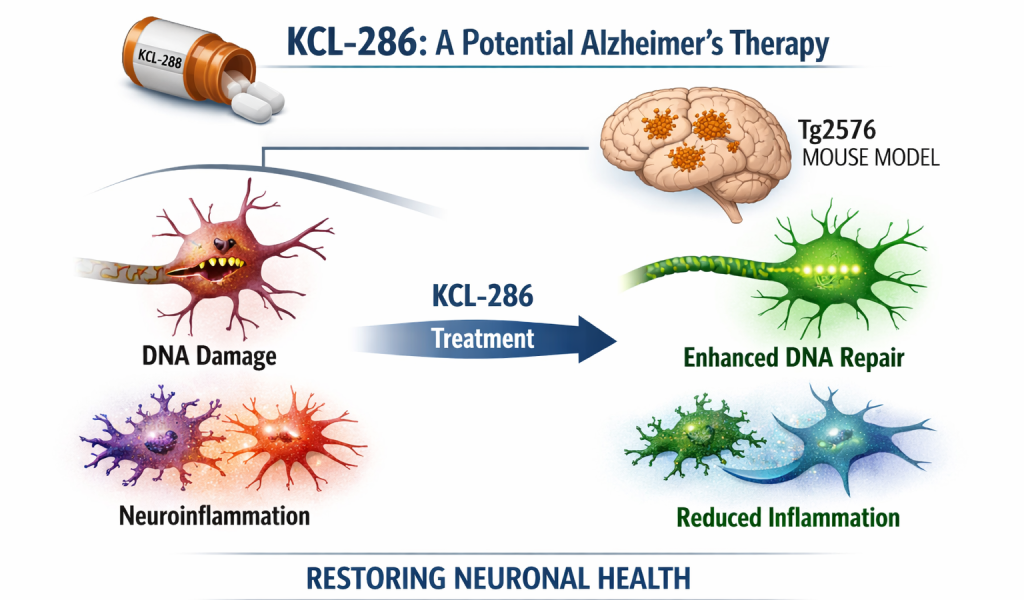
KCL-286, a selective RARβ agonist, reduced neuronal DNA damage and neuroinflammation in an Alzheimer’s mouse model, supporting further clinical investigation.
Written By: Mayuresh Salvi, PharmD
Reviewed By: Pharmacally Editorial Team
A preclinical study has identified KCL-286, a first-in-class selective retinoic acid receptor-β (RARβ) agonist, as a promising investigational therapy for Alzheimer’s disease (AD). In the Tg2576 transgenic mouse model, the compound reduced neuronal DNA damage, attenuated neuroinflammation, and enhanced endogenous DNA repair pathways, highlighting a novel disease-modifying strategy beyond amyloid-targeted therapies. These findings are limited to animal studies, and KCL-286 has not been evaluated in patients with Alzheimer’s disease.
Background
Despite recent advances in anti-amyloid therapies, Alzheimer’s disease remains a major unmet medical challenge, with available treatments providing only modest clinical benefit. Increasing evidence suggests that accumulation of neuronal DNA double-strand breaks (DSBs) contributes to neurodegeneration, chronic inflammation, and disease progression, making restoration of DNA repair an emerging therapeutic target.
KCL-286 is a first-in-class, orally bioavailable, selective RARβ agonist developed to activate neuronal repair pathways. Although previous Phase 1 studies (ISRCTN12424734) in healthy male volunteers demonstrated favourable safety, tolerability, and pharmacokinetic profiles during its development for spinal cord injury, no clinical study has investigated the compound in Alzheimer’s disease.
Preclinical Study Design
Researchers evaluated KCL-286 in the Tg2576 mouse model of Alzheimer’s disease, which develops age-related amyloid pathology and neuronal injury. Mice received KCL-286 (1 mg/kg) or vehicle by intraperitoneal injection three times weekly between 15 and 18 months of age, while age-matched wild-type mice served as controls.
The investigators assessed neuronal DNA damage using γH2AX, DNA repair through BRCA1 expression, and neuroinflammation using Iba1 and GFAP immunostaining. Blinded image analysis was performed to minimise observer bias, with three mice included in each experimental group.
Mechanism of Action
Rather than targeting amyloid deposition directly, KCL-286 enhances endogenous neuronal repair mechanisms through selective activation of RARβ signalling. Treatment increased BRCA1 expression, appears to contribute to enhanced DNA repair of neuronal DNA double-strand breaks. Restoration of genomic stability was accompanied by reduced activation of microglia and astrocytes, suggesting that improved neuronal DNA repair may help suppress downstream neuroinflammatory processes associated with Alzheimer’s disease.
Key Findings
KCL-286 treatment produced significant improvements across multiple neuropathological markers in Tg2576 mice. Compared with vehicle-treated animals, the compound significantly reduced γH2AX immunoreactivity, indicating fewer persistent neuronal DNA double-strand breaks, while increasing BRCA1 expression, consistent with enhanced endogenous DNA repair.
The investigational therapy also attenuated neuroinflammation. Immunohistochemical analysis demonstrated significantly lower Iba1-positive microglial activation, particularly within the hippocampal CA1 region, together with restoration of microglial morphology towards that observed in healthy wild-type mice. Similarly, KCL-286 reduced reactive astrocytic hypertrophy, with decreased astrocytic process thickness despite only modest changes in overall GFAP expression. Collectively, these findings suggest that the compound protects neuronal integrity while preserving physiological glial function.
Clinical Significance
The study identifies neuronal DNA repair as a promising therapeutic target that may complement existing amyloid-directed approaches in Alzheimer’s disease. By simultaneously reducing neuronal DNA damage and neuroinflammation, KCL-286 offers a mechanistically distinct strategy aimed at slowing neurodegenerative processes rather than directly removing amyloid plaques.
These findings are derived exclusively from a preclinical mouse model. Although KCL-286 previously demonstrated favourable safety and tolerability in a Phase 1 study involving healthy male volunteers, its efficacy and safety have not been evaluated in patients with Alzheimer’s disease. Therefore, it remains unknown whether the biological improvements observed in mice will translate into meaningful cognitive or clinical benefits in humans.
Study Limitations
The authors acknowledge that the study was conducted exclusively in Tg2576 mice, which do not fully replicate the complexity of human Alzheimer’s disease. The relatively small sample size (n = 3 per group) and emphasis on histological and molecular endpoints also limit direct clinical interpretation. Additional studies are required to evaluate long-term efficacy, optimal dosing, and therapeutic potential before clinical application can be considered.
What This Means and What Comes Next?
The findings provide compelling preclinical proof-of-concept that selective RARβ agonism may represent a novel disease-modifying strategy for Alzheimer’s disease by restoring neuronal DNA repair and reducing neuroinflammation. Future studies should validate these observations in additional preclinical models before progressing to clinical evaluation.
While the previous Phase 1 study in healthy volunteers supports continued development of KCL-286, no human clinical trial has been conducted in Alzheimer’s disease. Future clinical studies will determine whether these encouraging preclinical findings translate into meaningful benefits for patients.
References

About the Writer
Mayuresh Sunil Salvi (Linkedin) is a PharmD professional and healthcare writer with a strong interest in pharmacovigilance, drug safety, and emerging medical research. He is passionate about exploring new drug discoveries, clinical research, and advances in evidence-based medicine. His interests also include ward rounds, prescription audits, and treatment analysis to support rational pharmacotherapy and improved patient care.