
Johnson & Johnson’s JNJ-6143 achieved a 75% confirmed tumor response rate in 16 evaluable patients with advanced prostate cancer in a Phase 1 study.
Written By: Mayuri Vaja, PharmD
Reviewed By: Pharmacally Editorial Team
Johnson & Johnson has reported Phase 1 results for JNJ-6143 (NCT06800313), an investigational oral therapy designed to trigger cancer cell death through a targeted dual-protein mechanism, in patients with advanced prostate cancer. Among 16 patients receiving the 50 mg dose who had measurable disease, 12 achieved a confirmed complete or partial tumor response, corresponding to a 75% response rate. Separately, among 38 patients receiving the same once-daily dose, 77% achieved a confirmed prostate-specific antigen (PSA) reduction of at least 50%.
Presented at the European Society for Medical Oncology (ESMO) Congress 2026, the findings support further evaluation of JNJ-6143, formerly known as HLD-0915. It is the first investigational molecule from Johnson & Johnson’s Regulated Induced Proximity Targeting Chimera (RIPTAC) platform to enter clinical studies.
Antitumor Activity in Heavily Pretreated Patients
In addition to the 75% confirmed tumor response rate among patients with measurable disease, 48% of the 38 patients receiving 50 mg once daily achieved a confirmed PSA reduction of at least 90%. PSA is a blood biomarker used to monitor prostate cancer, but a decline in PSA is distinct from an objective tumor response assessed through imaging.
The patients had received a median of four previous therapies, including chemotherapy and PSMA-targeted radioligand therapy. PSA reductions were also observed in patients with high-risk molecular features associated with difficult-to-treat disease. At the time of analysis, 71% of patients receiving the 50 mg dose remained on treatment, with a median follow-up of 5.6 months.
The Phase 1 study, evaluated once-daily doses ranging from 12.5 mg to 150 mg during dose escalation, followed by dose expansion comparing 25 mg and 50 mg. Johnson & Johnson selected 50 mg once daily as the preliminary optimal dose based on clinical activity, safety and pharmacokinetic findings.
These results are an early signal rather than evidence of established clinical benefit. The tumor response estimate comes from a small subgroup, and the available follow-up is insufficient to determine the durability of responses or any effect on overall survival.
A Novel RIPTAC Mechanism
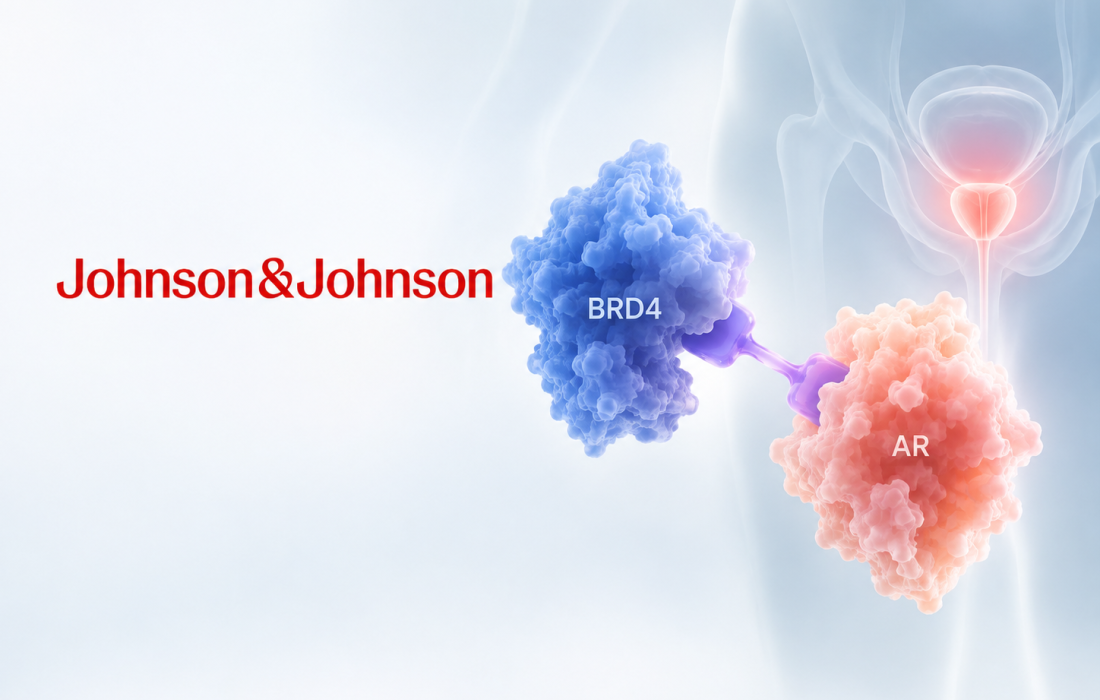
JNJ-6143 uses the RIPTAC platform to bring BRD4, an essential protein involved in cell survival, into proximity with the androgen receptor (AR), which is highly expressed in prostate cancer cells. This targeted dual-protein interaction is designed to disrupt essential cellular functions and trigger cancer cell death.
Unlike therapies that primarily inhibit androgen receptor signalling, the RIPTAC approach aims to exploit a tumour-associated protein to direct the effects of an essential cell-survival protein toward cancer cells. The clinical findings support investigation of this alternative mechanism, but further studies are needed to establish how the proposed mechanism translates into sustained patient benefit.
JNJ-6143 is being developed for metastatic androgen pathway modulation-resistant prostate cancer (mAPMR), also known as metastatic castration-resistant prostate cancer (mCRPC). The disease can progress despite androgen receptor pathway inhibitors, chemotherapy and other established treatments, creating a need for therapies with different mechanisms of action.
Safety Findings and Remaining Questions
Most treatment-related adverse events reported with the 50 mg dose were mild to moderate. The most common were elevated cholesterol levels (18%), nausea (16%) and elevated triglyceride levels (16%).
Four patients (11%) interrupted treatment, one (3%) required a dose reduction, and one (3%) discontinued treatment because of adverse events. These findings provide an initial view of tolerability, but the relatively short follow-up and limited clinical dataset do not establish the longer-term safety profile.
Phase 2 Study Advances Development
The 50 mg once-daily dose is advancing into further clinical development, including the Phase 2 study (NCT07832292), which is listed as enrolling. The study’s primary endpoint is overall response rate; secondary endpoints include duration of response and radiographic progression-free survival. These measures will help determine whether the early tumor activity translates into more sustained disease control.
JNJ-6143 entered Johnson & Johnson’s oncology portfolio following its acquisition of Halda Therapeutics in December 2025. The company is also exploring the RIPTAC platform as a potential source of oral targeted therapies for other tumor types.
Clinical interpretation
JNJ-6143 has demonstrated early antitumor activity in heavily pretreated patients with advanced prostate cancer, including confirmed tumor responses and substantial PSA reductions. The small response-evaluable population, short follow-up and absence of established survival data remain important limitations. The Phase 2 study will be critical in determining the reproducibility and durability of these findings and the therapy’s potential clinical role.
Reference
Johnson & Johnson reports 75% tumor response rate in advanced prostate cancer with JNJ-6143, a first-in-class RIPTAC™ molecule, Johnson and Johnson, 25 October 2026
Study of HLD-0915 (JNJ-101556143) in Patients with Metastatic Prostate Cancer, ClinicalTrials.gov ID NCT06800313

About the Writer
Mayuri Vaja (Linkedin) is a Pharm.D professional with a strong interest in clinical research, pharmacovigilance, and medical writing, supported by certifications in pharmacovigilance and academic projects exploring AI in healthcare and drug safety.
With a growing focus on evidence-based healthcare and scientific communication, she is developing expertise in clinical research and translating healthcare evidence into clear, meaningful content.
As a Pharmacally healthcare writer, Mayuri is committed to creating accurate, research-driven, and clinically relevant healthcare content while continuously strengthening her professional skills.