
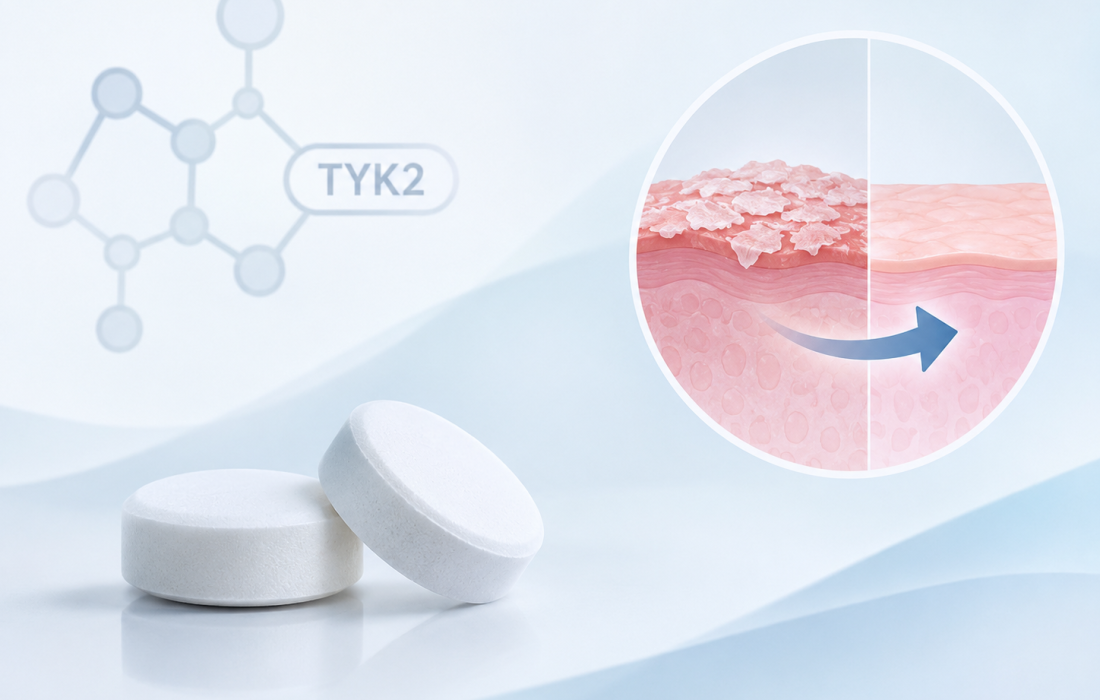
InventisBio reports positive Phase 2 results for D-2570 in plaque psoriasis, with PASI 75 responses reaching 90% and complete skin clearance reaching 50%.
Written By: Charvi Kalal, PharmD
Reviewed By: Pharmacally Editorial Team
InventisBio reported positive Phase 2 results for D-2570, an oral, selective tyrosine kinase 2 (TYK2) inhibitor, in patients with moderate-to-severe plaque psoriasis on December 3, 2024. The 12-week, placebo-controlled study demonstrated statistically significant improvements across multiple skin clearance measures, with PASI 75 responses reaching 90% in the 18 mg treatment group, compared with 12.5% with placebo.
The findings support further evaluation of D-2570 as an oral treatment targeting TYK2-mediated inflammatory signaling in autoimmune diseases.
Clinical Evidence: Phase 2 Trial Design
The randomized, multicenter, double-blind, placebo-controlled Phase 2 study (NCT06278350) enrolled 161 patients with moderate-to-severe plaque psoriasis. Participants were randomized in a 1:1:1:1 ratio to receive D-2570 at 18 mg, 27 mg or 36 mg, or placebo, once daily for 12 weeks.
The primary endpoint was the proportion of patients achieving at least a 75% improvement in the Psoriasis Area and Severity Index (PASI 75) at week 12. Secondary endpoints included PASI 90, PASI 100 and static Physician’s Global Assessment (sPGA) scores of 0 or 1. Safety and pharmacokinetic/pharmacodynamic characteristics were also evaluated.
Phase 2 Efficacy Results
Primary Endpoint: PASI 75
All three D-2570 treatment groups achieved significantly higher PASI 75 response rates than placebo at week 12 (p<0.001).
- 18 mg: 90.0%
- 27 mg: 85.4%
- 36 mg: 85.0%
- Placebo: 12.5%
The findings demonstrate substantial clinical activity across all three investigated doses.
Secondary Endpoints: PASI 90, PASI 100 and sPGA 0/1
D-2570 also demonstrated improvements across the secondary efficacy measures.
- PASI 90: Response rates were 75.0%, 70.7% and 77.5% with 18 mg, 27 mg and 36 mg, respectively, compared with 5.0% with placebo.
- PASI 100: Complete skin clearance was achieved by 40.0%, 39.0% and 50.0% of patients, respectively, versus 2.5% with placebo.
- sPGA 0/1: Response rates reached 82.5%, 80.5% and 87.5%, respectively, compared with 20.0% with placebo.
All three dose groups demonstrated statistically significant improvements over placebo across these efficacy measures.
Safety Endpoint and Tolerability
D-2570 was reported to be well tolerated during the 12-week treatment period. Most treatment-emergent adverse events were mild to moderate in intensity. The original company announcement reported no serious adverse events and identified no new safety signals.
The subsequent peer-reviewed publication also described a favorable short-term safety profile. However, the relatively small study population and limited treatment and follow-up periods restrict conclusions about long-term safety.
Mechanism of Action
D-2570 selectively inhibits the TYK2 JH2 pseudokinase domain, which regulates TYK2 activity. TYK2 participates in intracellular signaling downstream of inflammatory cytokines, including IL-12, IL-23 and type I interferons. Inhibiting these pathways may help modulate immune-mediated inflammation involved in psoriasis.
The Phase 2 publication additionally reported suppression of IL-17A levels in treated patients, providing pharmacodynamic evidence of an effect on inflammatory signaling.
Clinical Interpretation
D-2570 demonstrated substantial placebo-controlled efficacy across all three investigated doses, with PASI 75 responses ranging from 85.0% to 90.0% and PASI 100 responses reaching 50.0% at the highest dose.
Notably, the 18 mg group recorded the highest PASI 75 response, while the 36 mg group achieved the highest complete skin clearance rate. These findings indicate differences in response across efficacy measures and do not establish a consistently superior dose.
Although the results are encouraging, the study’s 161-patient population, 12-week treatment duration and absence of an active comparator limit conclusions about long-term outcomes or comparative efficacy against approved TYK2 inhibitors and biologic therapies.
Development Outlook
The Phase 2 findings were subsequently published in the Journal of the American Academy of Dermatology in January 2026, providing peer-reviewed clinical evidence for D-2570.
On November 2, 2026, InventisBio announced positive topline results from a registrational Phase 3 psoriasis study of D-2570, now referred to as nomelcitinib. The development milestone extends the clinical evidence beyond the initial Phase 2 findings, although the complete Phase 3 dataset will be important for evaluating the magnitude and durability of efficacy and the broader safety profile.
D-2570 remains investigational, and its potential role in psoriasis treatment will depend on the outcomes of further clinical evaluation and regulatory review.
References
InventisBio Announces Topline Results of a Phase III Study of Nomelcitinib (TYK2 Inhibitor), Demonstrating Promising Efficacy and Safety in Patients with Moderate to Severe Plaque Psoriasis, InventisBio, 02 November 2026
Evaluate the Efficacy and Safety of D-2570 in Participants with Moderate-to-Severe Plaque Psoriasis, ClinicalTrials.gov ID NCT06278350
Zhang J. et al, Novel TYK2 inhibitor D-2570 in moderate-to-severe plaque psoriasis: A randomized, double-blind, placebo-controlled, phase 2 trial. J Am Acad Dermatol. 2026 Jan;94(1):143-150. Epub 2025 Sep 16. PMID: 40967307, https://doi.org/10.1016/j.jaad.2025.09.036

About the Writer
Charvi Kalal (LinkedIn) is a Pharm.D intern and aspiring medical writer with hands-on experience in medical writing, clinical research, pharmacovigilance, and clinical pharmacy. She has experience in medical content writing through CliMed, along with exposure to ADR monitoring, prescription analysis, patient counselling, literature review, and research documentation. Her research focuses on ADR monitoring and reporting in breast cancer patients receiving targeted therapy. With certifications in GCP, biomedical research, scientific writing, and clinical research, she is passionate about transforming scientific evidence into accurate, engaging, and accessible healthcare content.