
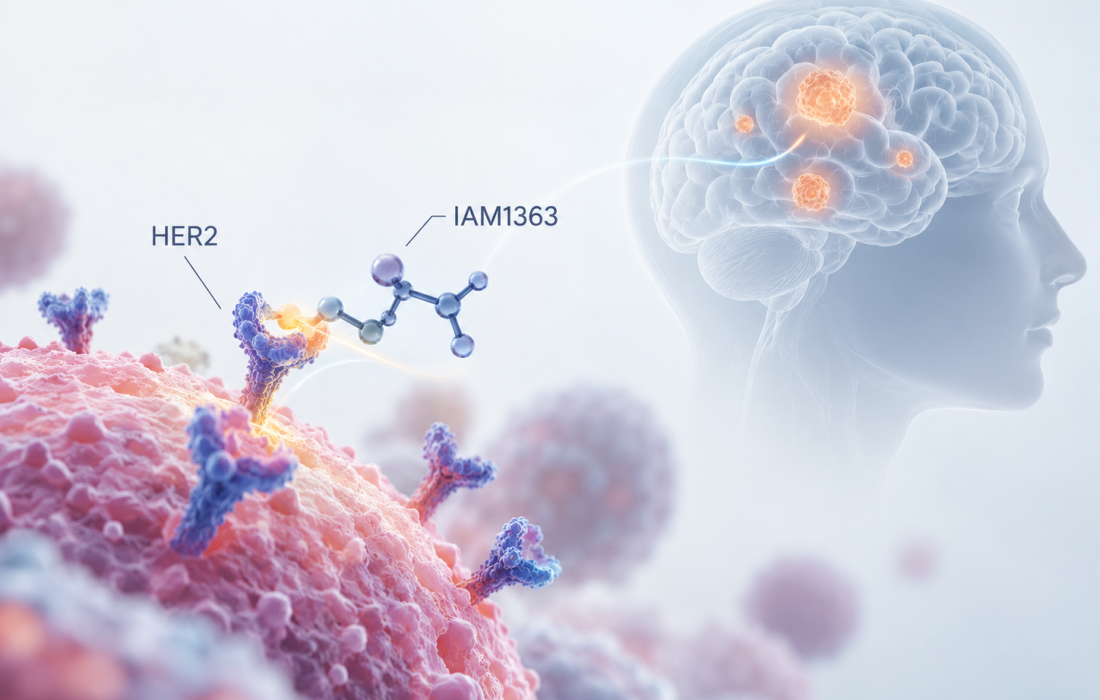
Iambic reports updated IAM1363 Phase 1/1b data showing systemic and intracranial responses in heavily pretreated patients with HER2-driven cancers.
Written By: Neha Vishwakarma, PharmD
Reviewed By: Pharmacally Editorial Team
Iambic Therapeutics reported updated Phase 1/1b clinical data for IAM1363, an investigational, brain-penetrant HER2 tyrosine kinase inhibitor (TKI), at the European Society for Medical Oncology (ESMO) Congress 2026 in Madrid. Among participants with targetable HER2 alterations treated at doses of 960 mg once daily (QD) or higher, 36% (19/53) achieved a systemic partial response, while 41% (9/22) achieved an intracranial partial response. At the recommended dose of 960 mg QD, Grade 3 treatment-related adverse events (TRAEs) occurred in 5.9% of participants. The findings remain preliminary and require confirmation in larger studies with longer follow-up.
Addressing HER2-Driven Cancers After Previous Treatment
HER2 alterations, including gene amplification, protein overexpression and activating mutations, contribute to several solid tumours, including breast cancer, non-small cell lung cancer (NSCLC) and gastroesophageal cancers. Despite available HER2-directed therapies, some patients experience disease progression following treatment with agents such as trastuzumab deruxtecan (T-DXd) and tucatinib. Brain metastases present an additional treatment challenge.
IAM1363 is designed to target HER2 while penetrating the central nervous system (CNS). Iambic developed the molecule using its AI-driven drug discovery platform. Its clinical programme is evaluating whether the inhibitor can produce systemic and intracranial responses in patients with advanced HER2-altered cancers.
Phase 1/1b Trial Includes Four Study Parts
The open-label, multicentre study (NCT06253871) evaluates IAM1363’s safety, tolerability, pharmacokinetics, pharmacodynamics and preliminary efficacy. It comprises dose escalation (Part 1), dose optimisation (Part 2), monotherapy expansion at 960 mg (Part 3) and combination cohorts (Part 4). Parts 1 and 2 are fully enrolled, while Parts 3 and 4 remain ongoing.
As of the August 31, 2026 data cutoff, 122 participants had received IAM1363. Of these, 103 received monotherapy at doses of 960 mg or higher, including 68 treated at 960 mg QD.
The population was heavily pretreated, with a median of three prior metastatic-setting regimens. Previous treatment included T-DXd in 61% and tucatinib in 36%. Breast cancer accounted for 38% of participants and NSCLC for 19%, while 44% had CNS metastases.
Systemic and Intracranial Responses Show Preliminary Activity
Among participants with targetable HER2 alterations receiving at least 960 mg QD, systemic assessment using RECIST v1.1 showed partial responses in 19 of 53 participants (36%), stable disease in 20 (38%) and progressive disease in 14 (26%).
Intracranial assessment using modified RANO-BM criteria showed partial responses in nine of 22 participants (41%), stable disease in 12 (55%) and progressive disease in one (5%).
Responses were reported across HER2-positive, HER2-mutant and HER2-amplified cancers, including breast, lung, biliary tract, gastroesophageal and renal cell cancers. Three participants with HER2-amplified cancers identified by next-generation sequencing had durable responses.
The company also reported responses ongoing beyond 12 months in two individual participants: one with HER2-mutant NSCLC previously treated with T-DXd and another with HER2-mutant renal cell cancer. A further participant with HER2-mutant NSCLC had disease control exceeding 10 months. More than half of participants receiving 960 mg QD remained on treatment at the data cutoff.
In HER2-positive breast cancer, three participants previously treated with both T-DXd and tucatinib achieved confirmed intracranial partial responses and remained on treatment. One had more than 50 brain metastases and had received seven prior HER2-directed agents.
Safety and Tolerability Findings
Among the 68 participants treated at 960 mg QD, Grade 3 TRAEs and TRAEs leading to dose modification each occurred in 5.9%. No Grade 4 or 5 TRAEs were reported in this group.
Across the 103 participants receiving at least 960 mg, the most common treatment-emergent adverse events (TEAEs) were diarrhoea (59%), nausea (53%) and vomiting (49%). No Grade 4 TEAEs or Grade 5 TRAEs were reported.
These findings indicate a relatively low observed frequency of severe treatment-related toxicity at the recommended dose. However, the gastrointestinal event rates show that treatment burden remains relevant, and cross-trial comparisons cannot establish superior tolerability over other HER2 inhibitors.
Clinical Interpretation
The intracranial responses are a notable preliminary finding because they suggest potential CNS activity in a heavily pretreated population. The three confirmed responses in HER2-positive breast cancer after T-DXd and tucatinib are clinically relevant observations, although individual cases cannot establish how broadly the benefit will apply.
The systemic response rate also suggests activity across multiple HER2-altered tumour types. However, the systemic and intracranial estimates are based on small populations of 53 and 22 participants, respectively. The results are pooled across tumour types and HER2 alteration categories, limiting conclusions about which patients are most likely to benefit.
The reported ongoing responses provide early evidence of durability, but the release does not provide median duration of response or progression-free survival. Remaining on treatment does not independently establish sustained clinical benefit. The single-arm design, absence of a comparator and limited follow-up further constrain interpretation.
Next Steps in Clinical Development
Iambic plans to continue evaluating IAM1363 as monotherapy and in combination with other therapies. Larger studies with tumour-specific cohorts, longer follow-up and clearly reported response outcomes will be needed to determine its clinical value.
IAM1363 remains investigational, and its safety and efficacy have not been established.
Reference
Iambic Presents Updated IAM1363 Clinical Data at ESMO 2026, Showing Durable Responses with a Favorable Tolerability Profile in Heavily Pretreated Participants with HER2-Driven Cancers, Lambic, 26 October 2026
A Phase 1/1b Study of IAM1363 in HER2 Cancers, ClinicalTrials.gov ID NCT06253871

About the Writer
Neha Vishwakarma (LinkedIn) is a Pharm.D professional with experience in clinical pharmacy, pharmacovigilance, and clinical research. She has hands-on experience in ADR assessment, ICSR processing, medication safety, and clinical data evaluation. Her research background in surgical site infections and antibiotic use supports her focus on evidence-based healthcare writing.