
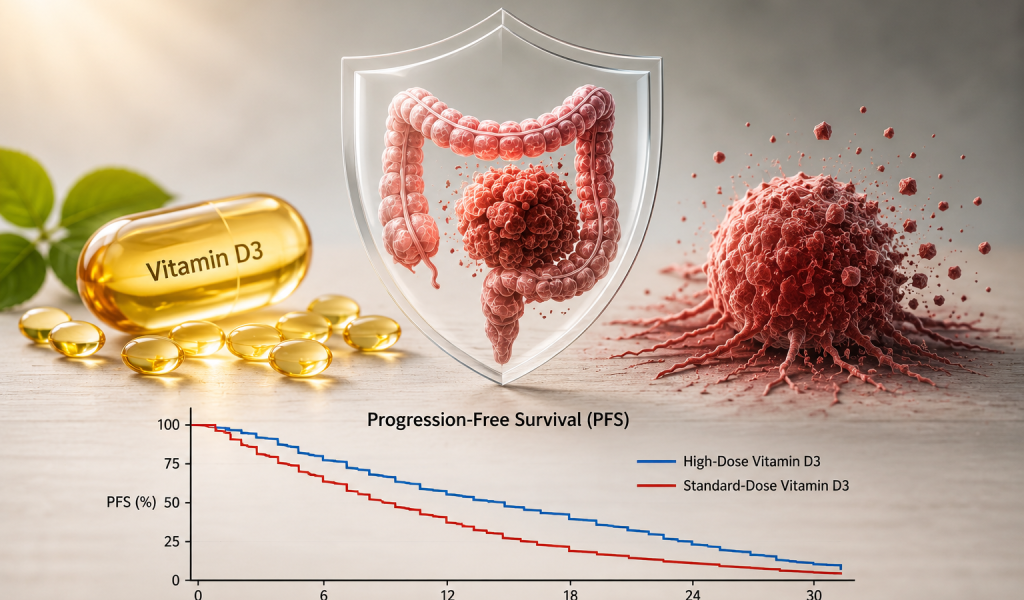
The Phase 3 SOLARIS trial found high-dose vitamin D3 did not improve progression-free survival versus standard-dose vitamin D3 in metastatic colorectal cancer.
Written By: Amit Kumar Bharati, BPharm
Reviewed By: Pharmacally Editorial Team
High-dose vitamin D3 added to first-line chemotherapy and bevacizumab did not significantly improve progression-free survival (PFS) compared with standard-dose vitamin D3 in patients with previously untreated metastatic colorectal cancer (mCRC), according to final results from the Phase 3 SOLARIS trial (NCT04094688) published in JAMA.
The multicenter, double-blind randomized trial included 455 patients and showed median PFS of 11.8 months with high-dose vitamin D3 versus 10.3 months with standard-dose supplementation. The difference was not statistically significant, and high-dose vitamin D3 also failed to improve overall survival or objective response rate.
SOLARIS tested a Phase 2 vitamin D signal
The SOLARIS study followed the earlier Phase 2 SUNSHINE trial (NCT01516216), which evaluated high-dose vitamin D3 with standard chemotherapy in metastatic CRC. SUNSHINE reported median PFS of 13.0 months with high-dose vitamin D3 versus 11.0 months with standard-dose supplementation. Although the primary PFS comparison did not reach conventional statistical significance, a supportive multivariable analysis showed a hazard ratio of 0.64, providing the rationale for a larger confirmatory trial.
SOLARIS was conducted through the Alliance for Clinical Trials in Oncology and enrolled patients with previously untreated metastatic colorectal adenocarcinoma. The trial excluded patients with known mismatch repair-deficient or MSI-high disease and required measurable disease by RECIST 1.1. The actual enrolment was 455 patients, with primary data collection completed on July 15, 2024.
High-dose vitamin D3 added to standard first-line therapy
Patients received modified FOLFOX6 or FOLFIRI plus bevacizumab every two weeks and were randomized to high-dose vitamin D3 or standard-dose vitamin D3. The high-dose regimen used an 8,000-IU daily loading dose for 14 days followed by 4,000 IU daily, while the control group received 400 IU daily. Treatment continued until disease progression, intolerable toxicity, or withdrawal of consent.
The primary endpoint was PFS. Secondary endpoints included objective response rate, overall survival, and toxicity. The protocol also incorporated exploratory analyses of baseline 25-hydroxyvitamin D [25(OH)D], highest achieved 25(OH)D levels, body mass index, physical activity, diet, and other lifestyle factors.
No significant improvement in PFS or overall survival
Among 228 patients assigned to high-dose vitamin D3 and 227 assigned to standard-dose supplementation, median PFS was 11.8 months (95% CI, 10.3-13.3) versus 10.3 months (95% CI, 9.4-12.2). The one-sided log-rank P value was 0.25, indicating that the trial did not meet its primary endpoint.
Objective response rate was 51% with high-dose vitamin D3 versus 44% with standard-dose supplementation (P=.12). Median overall survival was 25.6 versus 27.0 months, respectively (P=.66). Thus, the numerical PFS difference did not translate into a significant survival advantage.
Safety remained comparable
High-dose vitamin D3 did not produce clinically meaningful increases in major grade 3 or higher adverse events. Neutropenia occurred in 32% of patients receiving high-dose vitamin D3 versus 30% with standard-dose supplementation, while hypertension occurred in 20% versus 23%, respectively. Vitamin D-associated toxicities also did not differ meaningfully between groups.
Left-sided disease signal requires confirmation
Prespecified subgroup analyses identified a potential PFS signal among patients with left-sided primary tumors. Investigators characterized this finding as hypothesis-generating and requiring further investigation rather than evidence for changing clinical practice.
SOLARIS does not support high-dose vitamin D3 as anticancer therapy
The Phase 3 findings do not support adding pharmacologic-dose vitamin D3 to standard first-line chemotherapy and bevacizumab with the expectation of improving PFS or overall survival in an unselected population of patients with previously untreated mCRC. The trial does not address the separate clinical question of treating vitamin D deficiency for established medical indications.
The results also illustrate the importance of confirming promising Phase 2 signals in adequately powered randomized trials. SUNSHINE provided the initial efficacy signal; SOLARIS, with more than three times as many participants, did not reproduce a significant PFS benefit.
Future analyses of the SOLARIS dataset may clarify whether baseline or achieved 25(OH)D levels, tumor characteristics, or lifestyle factors identify subgroups with different outcomes.
Reference

About the Writer
Amit Kumar Bharti (LinkedIn) is a pharmacy graduate from DPSRU, Delhi and healthcare writer with a strong interest in pharmaceutical research, medical writing, and evidence-based healthcare communication. He is passionate about translating complex scientific and medical information into clear, accurate, and engaging content for healthcare professionals and the pharmaceutical industry. His focus includes emerging therapies, clinical research, and recent advances in medicine.