
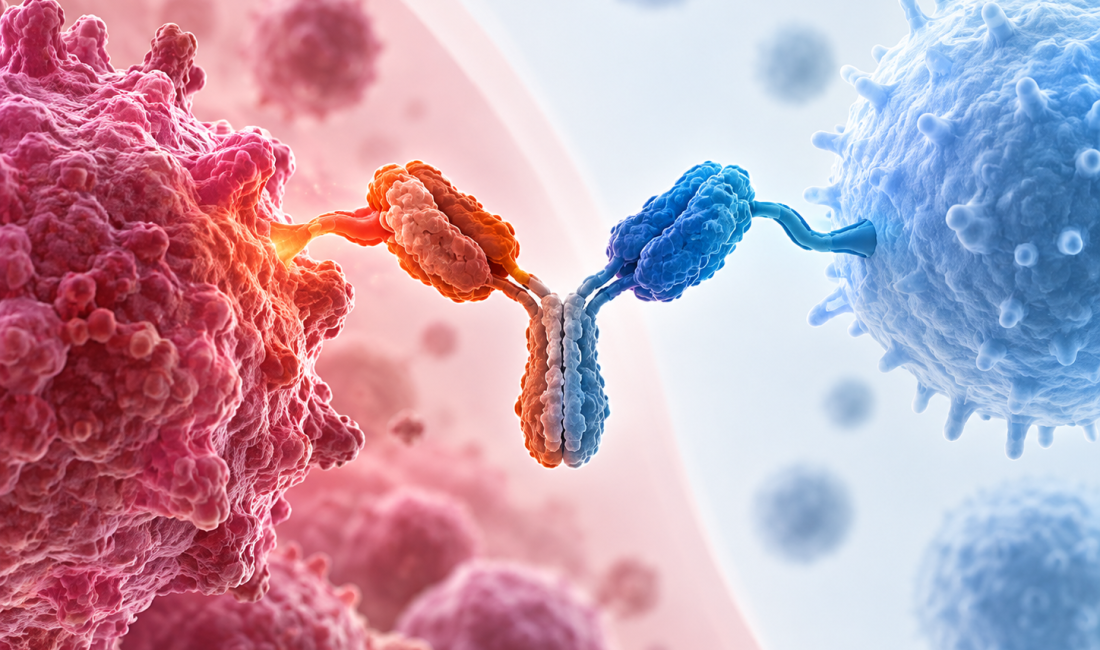
Henlius and Amberstone partner to develop tumor-activated T-cell engagers against up to two tumor-associated antigens for solid tumors.
Written By: Rishabh Sonawane, BPharm
Reviewed By: Pharmacally Editorial Team
Shanghai Henlius Biotech has entered a global collaboration and licensing agreement with U.S.-based Amberstone Biosciences to develop conditionally activated T-cell engagers (TCEs) against up to two tumor-associated antigens (TAAs) for solid tumors. The partnership combines Henlius’ antibody development capabilities with Amberstone’s pH-sensitive T-MATE™ platform, which activates therapeutic molecules within the acidic tumor microenvironment.
Addressing TCE Safety Challenges in Solid Tumors
TCEs simultaneously bind tumor-associated targets and T cells, enabling direct immune-mediated killing of cancer cells. The modality has demonstrated clinical value in hematologic malignancies and has recently expanded into solid tumors.
However, many solid-tumor targets are also expressed at lower levels in normal tissues. Conventional TCEs can therefore produce on-target, off-tumor toxicity when they engage these antigens outside tumors. This safety limitation has restricted the number of solid-tumor targets that can be pursued with conventional TCE approaches.
T-MATE Platform Enables Tumor-Dependent Activation
Amberstone’s T-MATE™ (Tumour Microenvironment Activated ThErapeutics) platform addresses this challenge by exploiting the acidic microenvironment found in many solid tumors.
The technology incorporates a pH-sensitive switch into therapeutic molecules. Under the neutral conditions present in most normal tissues, the molecules remain inactive. In the more acidic tumor microenvironment (TME), the switch permits therapeutic activation.
For TCEs, this creates an additional activation requirement beyond target recognition. The molecule must encounter both the selected tumor antigen and an acidic TME before becoming fully active. This approach could reduce systemic immune activation and on-target, off-tumor toxicity while expanding the range of TAAs that can be evaluated as TCE targets.
Henlius to Lead Subsequent Development
Under the agreement, Henlius will receive exclusive global licenses to develop next-generation TCEs against up to two TAAs designated by Henlius. Amberstone will apply its T-MATE™ platform to generate preclinical candidates (PCCs).
Henlius will lead subsequent research, development, manufacturing and commercialization, drawing on its capabilities in translational medicine, clinical development and global commercialization.
The collaboration also expands Henlius’ existing immune-cell engager (ICE) portfolio, which includes TCEs, natural killer cell engagers (NKCEs) and myeloid cell engagers (MCEs). The company is also developing approaches that incorporate co-stimulatory signals and selective activation mechanisms to enhance immune-cell activity and potentially reduce cytokine release syndrome (CRS).
Clinical Development Potential
The partnership is currently at the preclinical stage, with Amberstone responsible for generating PCCs using the T-MATE™ platform and Henlius responsible for subsequent development. The agreement covers up to two designated TAAs, although the companies have not disclosed the specific targets, candidate molecules, development timelines or planned clinical trial dates.
Amberstone will receive an upfront payment and research fees, along with potential development and regulatory milestone payments, sales milestones and single-digit royalties on commercial product sales.
The key development question will be whether TME-dependent activation can translate into a sufficiently wider therapeutic window in clinical studies. If successful, the approach could allow Henlius to investigate solid-tumor antigens whose expression in normal tissues has limited their development as conventional TCE targets.
Reference
Henlius and Amberstone Partner to Develop Next-Generation Conditionally Activated TCEs for Solid Tumours, Henlius, 23 September 2026

About the Writer
Rishabha Sonawane, B.Pharm (LinkedIn) is healthcare writer with a strong interest in medical writing, regulatory affairs, clinical research, and AI-driven drug discovery. He has completed specialized training from the NIH and ICMR in clinical pharmacology, clinical research, and scientific writing. Passionate about evidence-based healthcare communication, he focuses on translating complex scientific research into clear, accurate, and engaging medical content.