
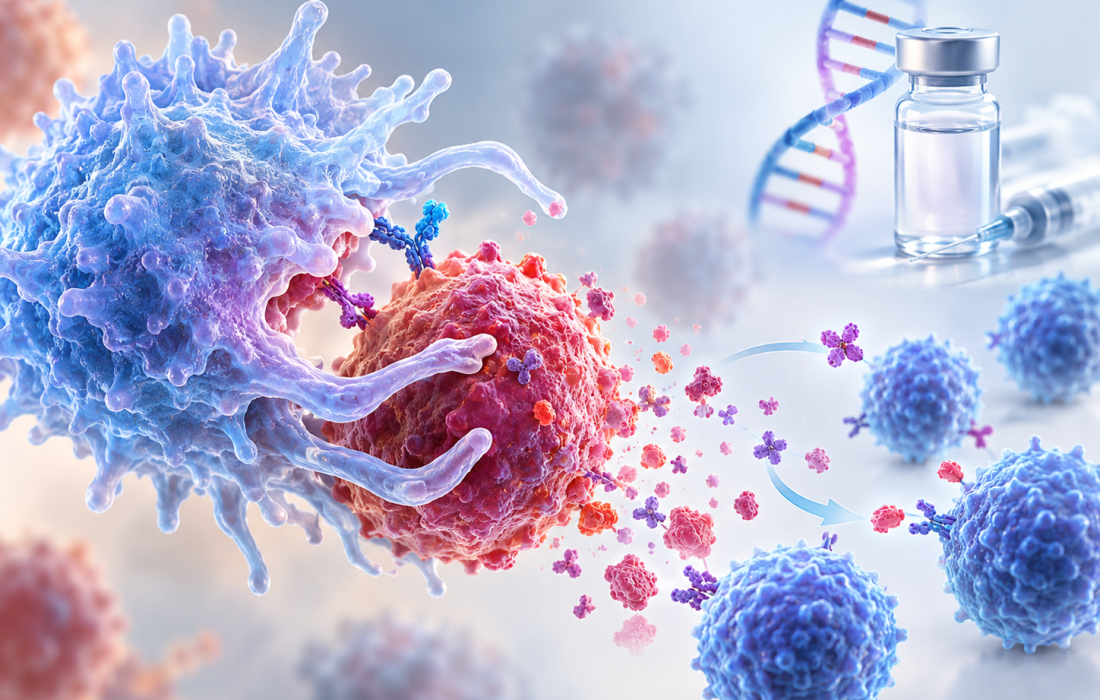
HanchorBio and Aston Sci will evaluate HCB101 with Phase 2 HER2 cancer vaccine AST-301 to explore combination immunotherapy for gastric and breast cancers.
Written By: Umesh Hanumante, M.Pharm (RA)
Reviewed by: Pharmacally Editorial Team
HanchorBio and Aston Sci have entered a research collaboration to evaluate HCB101, a macrophage checkpoint inhibitor, with AST-301, a Phase 2 HER2-directed DNA cancer vaccine. The partnership will initially focus on gastric and breast cancers, testing whether complementary innate and adaptive immune mechanisms can improve antitumor activity.
Combining Macrophage Activation With T-Cell Immunity
The collaboration will investigate whether combining macrophage-mediated tumor clearance with vaccine-induced T-cell responses can strengthen antitumor immunity and promote antigen spreading, a process in which immune responses expand to recognize additional tumor antigens.
AST-301, also known as pNGVL3-hICD, is an investigational plasmid DNA vaccine that encodes the intracellular domain of human epidermal growth factor receptor 2 (HER2). It stimulates HER2-specific T-cell immunity and is being developed for HER2-expressing gastric and breast cancers.
HCB101 is an engineered SIRPα–IgG4 Fc fusion protein developed using HanchorBio’s FBDB platform. It blocks the CD47–SIRPα signaling pathway, which tumors use to inhibit macrophage-mediated phagocytosis. Blocking this signal may enable macrophages to engulf cancer cells and release tumor antigens that support further immune activation.
The companies will evaluate whether these mechanisms complement each other. While AST-301 promotes antigen-specific adaptive immunity, HCB101 targets an innate immune checkpoint that can limit tumor clearance.
Preclinical Studies to Assess Combination Potential
Initial studies will examine antitumor activity, macrophage reactivation, T-cell responses and epitope spreading beyond HER2. The collaboration will also explore combinations involving Aston Sci’s investigational PD-L1 therapeutic cancer vaccine, extending the research beyond a single vaccine approach.
AST-301 is being evaluated in the Phase 2 CornerStone-003 study (NCT05771584), which investigates its safety, immunogenicity and preliminary efficacy in 24 patients with HER2-expressing gastric cancer following curative resection and standard adjuvant systemic treatment.
HCB101 is undergoing Phase 1 monotherapy evaluation (NCT05892718) and Phase 1b/2a combination studies (NCT06771622).
Both candidates have received US Food and Drug Administration (FDA) Orphan Drug Designation for gastric cancer. AST-301 has also received Fast Track Designation for the indication. These designations provide regulatory development incentives but do not establish clinical efficacy or guarantee approval.
No combination efficacy or safety results have been reported from the collaboration. The initial research will therefore need to establish whether the proposed mechanisms translate into meaningful antitumor activity.
Clinical Development and Partnering Strategy
HanchorBio and Aston Sci will prioritize HER2-expressing gastric, gastroesophageal junction and breast cancers, while considering colorectal cancer for future development. The companies also identified consolidation and maintenance treatment settings as potential areas of interest, where durable disease control and reduced reliance on chemotherapy could be clinically relevant objectives.
HanchorBio founder and CEO Scott Liu said the collaboration seeks to connect vaccine-driven immune recognition with macrophage-mediated tumor clearance. Aston Sci Chief Scientific Officer Wonil Kim highlighted the potential complementarity between AST-301-induced T-cell activation and HCB101-mediated macrophage checkpoint blockade.
The companies plan to use the research findings to inform potential joint clinical development and global pharmaceutical partnerships. Their leadership teams also expect to discuss the scientific rationale and partnering opportunities at BIO-Europe 2026 in Cologne, Germany, from November 9 to 11.
The central question is whether combining these approaches can produce broader and more durable immune responses than either mechanism alone. Translational evidence on safety, immune activation and tumor control will be necessary before the combination can advance into clinical testing.
Reference
HanchorBio and Aston Sci Join Forces to Unlock the Potential of Next-Generation Immunotherapy Through Cancer Vaccine Combinations, HanchorBio, 22 October 2026

About the Writer
Umesh Hanumante (M.Pharm) (LinkedIn) is a pharmacy professional and healthcare writer with a background in Regulatory Affairs, pharmaceutical innovation, and clinical research. He has around two years of industry experience as an Executive PMT at Troikaa Pharmaceuticals Ltd and qualified GPAT 2024. His areas of interest include regulatory compliance, dossier preparation, clinical trials, emerging therapies, and advancements in the global pharmaceutical and healthcare sector.