
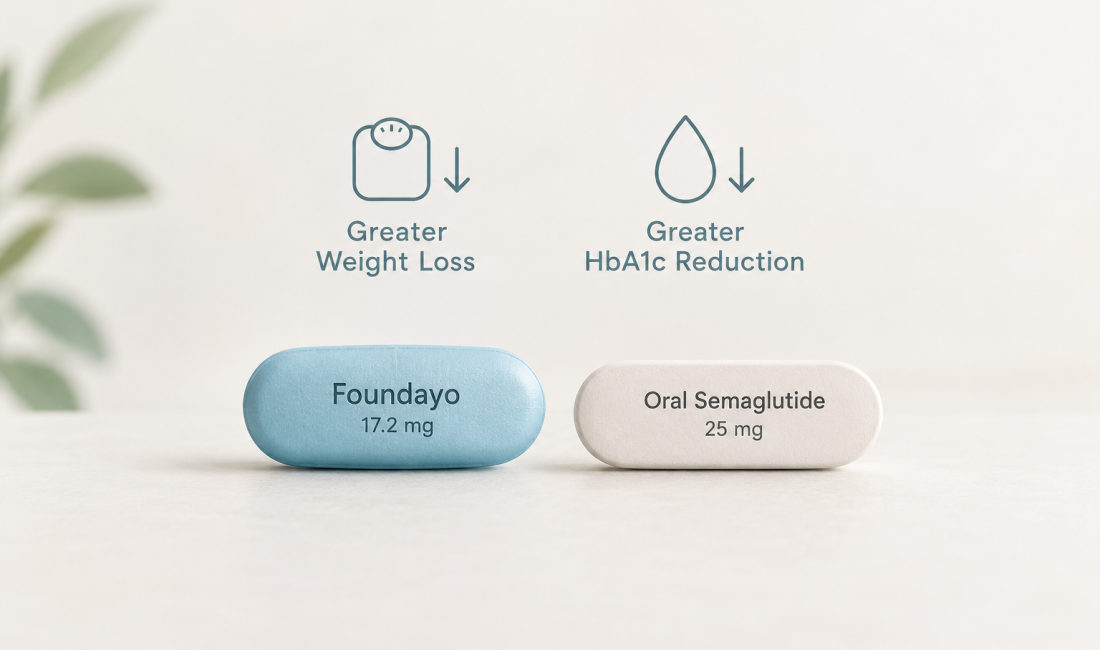
Lilly reports greater weight loss and HbA1c reduction with Foundayo 17.2 mg versus oral semaglutide 25 mg in an indirect comparison using ACHIEVE-3 and PIONEER PLUS data.
Written by: Anamika Koshti, PharmD
Reviewed By: Pharmacally Editorial Team
Eli Lilly reported new indirect treatment comparison (ITC) data at the 62nd Annual Meeting of the European Association for the Study of Diabetes (EASD) in Milan, comparing Foundayo (orforglipron) 17.2 mg with the investigational 25 mg dose of oral semaglutide in adults with type 2 diabetes (T2D). At 52 weeks, the analysis found greater reductions in body weight and HbA1c with orforglipron 17.2 mg.
Because the two treatments have not been evaluated against each other in a randomized head-to-head trial, Lilly used data from separate Phase 3 studies, ACHIEVE-3 and PIONEER PLUS, to estimate their relative treatment effects.
Indirect Comparison Shows Greater Weight and HbA1c Reduction
In the primary covariate-adjusted analysis, which accounted for sex, age, baseline HbA1c and baseline body weight, orforglipron 17.2 mg was associated with 1.5% greater weight loss than oral semaglutide 25 mg at 52 weeks. The 95% confidence interval was −2.7% to −0.2%.
The analysis also showed a 0.3 percentage-point greater reduction in HbA1c with orforglipron, with a 95% confidence interval of −0.6% to −0.1%.
Additional analyses using alternative statistical methods produced consistent findings. Across these methods, orforglipron was associated with 1.5% to 2.4% greater weight loss and 0.3 to 0.6 percentage-point greater HbA1c reduction compared with oral semaglutide 25 mg.
However, these findings should be interpreted as an indirect estimate rather than evidence from a direct comparison. Differences between the underlying studies can affect cross-trial comparisons, and randomized head-to-head trials provide a more direct assessment of comparative efficacy.
ACHIEVE-3 Provides the Orforglipron Data
The analysis used efficacy data from ACHIEVE-3 (NCT06045221), a Phase 3, 52-week, randomized, open-label trial in adults with T2D inadequately controlled on metformin.
The study included 1,698 participants and evaluated once-daily orforglipron at 9 mg and 17.2 mg against oral semaglutide at 7 mg and 14 mg. At 52 weeks, HbA1c reductions were 1.9% with orforglipron 9 mg and 2.2% with 17.2 mg, compared with 1.1% and 1.4% with oral semaglutide 7 mg and 14 mg, respectively.
Body-weight reductions were 14.6 lb (6.7%) with orforglipron 9 mg and 19.7 lb (9.2%) with 17.2 mg, compared with 7.9 lb (3.7%) and 11.0 lb (5.3%) with oral semaglutide 7 mg and 14 mg.
PIONEER PLUS Provides the 25 mg Semaglutide Data
The oral semaglutide 25 mg data were derived from PIONEER PLUS (NCT04707469), a 68-week, randomized, double-blind, Phase 3b trial that evaluated oral semaglutide 25 mg and 50 mg against the approved 14 mg dose in adults with inadequately controlled T2D receiving background oral glucose-lowering therapy.
At 52 weeks, oral semaglutide 25 mg reduced HbA1c by 1.8 percentage points compared with 1.5 percentage points with the 14 mg dose. The 25 mg dose also produced significantly greater body-weight reduction than 14 mg. Lilly used these reported 25 mg efficacy data as part of its indirect comparison with orforglipron 17.2 mg.
Clinical and Company Perspective
Deborah Horn, DO, director of the Center for Obesity Medicine at McGovern Medical School at UTHealth Houston, noted that comparative data can help clinicians consider treatment options based on individual patient needs.
Rachel Batterham, senior vice president of medical innovation and external engagement for Lilly Cardiometabolic Health, said the findings suggest orforglipron may provide HbA1c and weight reductions comparable to oral semaglutide 25 mg, while its once-daily administration without food or water restrictions may offer an additional practical consideration.
Regulatory Status of Foundayo
Foundayo (orforglipron) is FDA-approved for chronic weight management in adults with obesity or adults with overweight and at least one weight-related comorbid condition. Its use for T2D remains investigational in the United States.
Orforglipron is a once-daily, non-peptide oral GLP-1 receptor agonist that can be taken without food or water restrictions. Oral semaglutide, in contrast, is administered on an empty stomach with a limited amount of water and requires a waiting period before eating, drinking or taking other oral medicines.
The reported ITC focused on efficacy outcomes and does not establish comparative safety between the two treatments. Because the analysis was indirect, the findings should not be interpreted as evidence from a randomized head-to-head trial.
Reference
Lilly’s Foundayo (orforglipron) 17.2 mg showed greater weight loss and A1C reduction than oral semaglutide 25 mg among adults with type 2 diabetes in a new indirect treatment comparison, Lilly, 29 September 2026
A Study of Orforglipron (LY3502970) Compared with Semaglutide in Participants with Type 2 Diabetes Inadequately Controlled with Metformin (ACHIEVE-3), ClinicalTrials.gov ID NCT06045221
Research Study to Compare Three Doses of Semaglutide Tablets Taken Once Daily in People with Type 2 Diabetes (PIONEER PLUS), ClinicalTrials.gov ID NCT04707469
Rosenstock J, et al, Efficacy and safety of once-daily oral orforglipron compared with oral semaglutide in adults with type 2 diabetes (ACHIEVE-3): a multinational, multicentre, non-inferiority, open-label, randomised, phase 3 trial. Lancet. 2026 Mar 21;407(10534):1147-1160. https://doi.org/10.1016/s0140-6736(26)00202-3
Aroda VR et al, Efficacy and safety of once-daily oral semaglutide 25 mg and 50 mg compared with 14 mg in adults with type 2 diabetes (PIONEER PLUS): a multicentre, randomised, phase 3b trial. Lancet. 2023 Aug 26;402(10403):693-704, https://doi.org/10.1016/s0140-6736(23)01127-3

About the Writer
Anamika Koshti (LinkedIn) is a PharmD professional and healthcare writer with interests in clinical research, pharmacovigilance, and evidence-based medicine. She has authored peer-reviewed publications on Alzheimer’s disease and PCOS, presented research at national conferences, and gained hands-on experience in medical content development and clinical data interpretation. She is committed to translating complex medical research into accurate, accessible content for healthcare professionals and patients.