
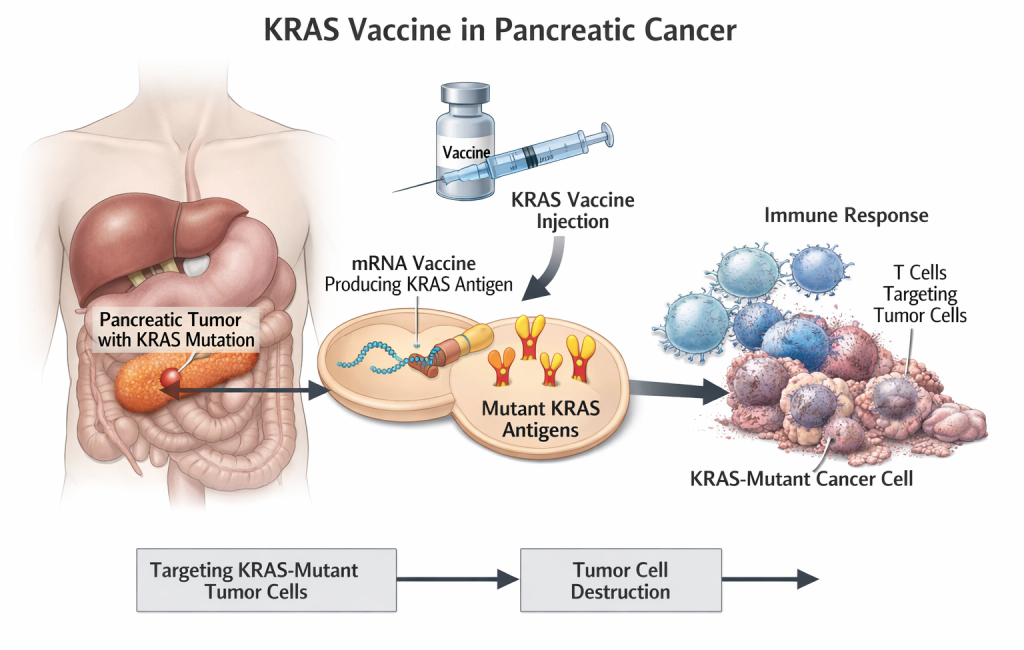
A first-in-human Phase I study finds the investigational mKRAS-VAX vaccine safely induced durable KRAS-specific immune responses in 90% of high-risk participants.
Written by: Vikas Londhe, M.Pharm (Pharmacology)
Assisted By: Anshu Gupta, PharmD
Reviewed By: Pharmacally Editorial Team
A first-in-human Phase I study (NCT05013216) published in Cancer Discovery has reported encouraging early clinical results for mKRAS-VAX, an investigational long-peptide vaccine designed to prevent pancreatic ductal adenocarcinoma (PDAC) in individuals at elevated risk of the disease. Rather than treating established cancer, the vaccine targets mutant KRAS, a genetic alteration that arises early during pancreatic tumor development, with the aim of inducing immune responses before invasive cancer develops. The study found that the vaccine was well tolerated and generated durable KRAS-specific immune responses in most participants, supporting further clinical evaluation of this cancer interception strategy.
Why KRAS Is a Target for Cancer Prevention
Pancreatic ductal adenocarcinoma is among the deadliest malignancies worldwide, largely because it is frequently diagnosed after the disease has spread beyond the pancreas. Activating mutations in the KRAS gene occur early during pancreatic carcinogenesis and are present in more than 90% of PDAC cases, making mutant KRAS an attractive target for preventive immunotherapy. The investigational mKRAS-VAX vaccine was developed to stimulate immune recognition of the six most common KRAS mutations, enabling the immune system to identify and eliminate precancerous cells before invasive cancer develops.
Phase I Trial Evaluated Safety and Immune Responses
The first-in-human, open-label Phase I study enrolled 20 individuals considered to be at substantially increased risk of pancreatic ductal adenocarcinoma because of inherited cancer predisposition syndromes and pancreatic premalignant lesions identified through surveillance. Participants received four doses of the investigational long-peptide vaccine over 13 weeks and underwent serial clinical, laboratory, and immunologic assessments to evaluate safety and characterize vaccine-induced immune responses. The primary objective was to assess safety and tolerability, while secondary analyses examined the induction and persistence of mutant KRAS-specific T-cell responses.
Vaccine Demonstrated Favorable Safety Profile
The study met its primary objective by demonstrating an acceptable safety profile. Treatment-related adverse events were predominantly Grade 1 or Grade 2 and consisted mainly of transient injection-site reactions, fatigue, chills, and flu-like symptoms commonly associated with vaccination. No dose-limiting toxicities or unexpected safety signals were reported, supporting continued clinical development of the vaccine.
Durable KRAS-Specific Immune Responses Observed
Immunogenicity analyses showed that approximately 90% of vaccinated participants developed mutant KRAS-specific T-cell responses. The vaccine induced both CD4⁺ helper and CD8⁺ cytotoxic T-cell responses, with a median 18.2-fold increase in KRAS-specific immunity following vaccination. Investigators also demonstrated the development of long-lived memory T-cell responses, with vaccine-induced KRAS-specific T-cell clones remaining detectable for up to two years, suggesting the establishment of durable immunologic memory.
Exploratory Findings Support Further Evaluation
Although the Phase I trial was not designed or powered to determine clinical efficacy, several exploratory observations supported further investigation. After a median follow-up of 16.5 months, none of the vaccinated participants developed pancreatic ductal adenocarcinoma. In addition, imaging assessments showed complete resolution of pancreatic cystic lesions in five participants and partial regression in three others, while the remaining lesions remained stable. An exploratory comparison with an unvaccinated surveillance cohort also suggested a higher proportion of cyst regression or resolution among vaccinated individuals. The investigators emphasized that these findings should be interpreted cautiously and require confirmation in larger controlled studies.
Study Limitations
The researchers acknowledged several important limitations. As an early-phase, first-in-human study involving only 20 participants, the trial was primarily designed to evaluate safety and immunogenicity rather than determine whether vaccination prevents pancreatic cancer. The follow-up period was sufficient to demonstrate durable immune responses but remains too short to establish whether vaccination reduces the long-term incidence of pancreatic ductal adenocarcinoma. Larger randomized clinical trials with longer follow-up will be required to determine whether the observed immune responses translate into meaningful clinical benefit.
Future Directions
The investigators concluded that the study provides the first clinical evidence that vaccination against mutant KRAS can safely induce sustained immune responses in individuals at increased risk of pancreatic cancer. By targeting one of the earliest molecular drivers of pancreatic tumor development, mKRAS-VAX represents a potential cancer interception strategy aimed at preventing invasive disease before it emerges.
The encouraging findings support advancement into larger clinical studies involving broader high-risk populations. Ongoing research is also evaluating the vaccine in patients undergoing pancreatic surgery to better understand how vaccine-induced immune cells interact with precancerous pancreatic tissue.
Reference
Haldar S, et al. First-in-Human Testing of a Mutant KRAS Vaccine for Pancreatic Cancer Interception in High-Risk Cohorts. Cancer Discovery. Published July 16, 2026. DOI: 10.1158/2159-8290.CD-25-2245.

About the Writer
Anshu Gupta (LinkedIn) is a PharmD professional and healthcare writer with interests in clinical research, pharmacovigilance, regulatory affairs, and medical writing. She has presented research at academic conferences and completed certifications in Good Clinical Practice (GCP), ICH-GCP, and drug safety. Passionate about clinical trials and evidence-based medicine, she is committed to translating scientific evidence into accurate, reliable, and accessible healthcare content.