
FDA approves Bayer’s Kerendia (finerenone) for CKD associated with type 1 diabetes, supported by Phase III FINE-ONE data showing a 25% UACR reduction.
Written By: Kalyani Boharapi,
M.Pharm (Reg. Affairs)
Reviewed By: Pharmacally Editorial Team
The U.S. Food and Drug Administration has approved Kerendia (finerenone) for adults with CKD associated with Type 1 Diabetes (T1D). The 10 mg and 20 mg doses are indicated to reduce urine albumin-to-creatinine ratio (UACR), a marker of kidney damage, with the reduction expected to lower the risk of sustained estimated glomerular filtration rate (eGFR) decline and end-stage kidney disease.
The decision followed the FDA’s Priority Review designation in May 2026 and expands finerenone’s U.S. label to a third indication. Kerendia was previously approved for CKD associated with type 2 diabetes and, since 2025, for symptomatic chronic heart failure with left ventricular ejection fraction (LVEF) of at least 40%.
Residual Kidney Risk Remains in Type 1 Diabetes
CKD affects approximately 30% of people with T1D in the U.S. and remains a major contributor to kidney failure and cardiovascular complications. Kidney damage often begins with increased urinary albumin excretion and can progress to declining kidney function and end-stage kidney disease.
Insulin therapy and control of blood glucose remain central to T1D management. ACE inhibitors and angiotensin receptor blockers are also used when appropriate, but substantial residual kidney risk remains. Bayer cited evidence indicating that up to one-quarter of patients with CKD and T1D may progress to end-stage kidney disease.
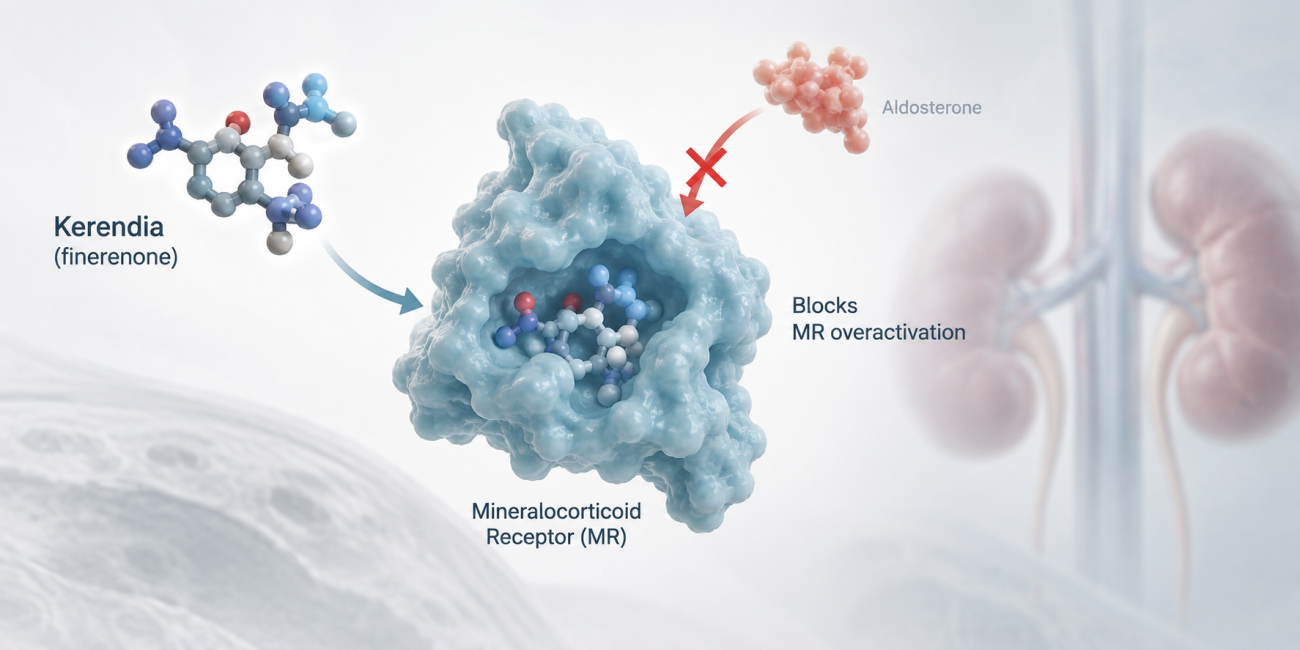
Finerenone is a selective, non-steroidal mineralocorticoid receptor antagonist (nsMRA). It blocks overactivation of the mineralocorticoid receptor, a pathway implicated in kidney and cardiovascular injury through inflammatory, fibrotic and metabolic processes.
FINE-ONE Demonstrated a 25% UACR Reduction
The FDA approval was supported primarily by the Phase III FINE-ONE study, a randomized, double-blind, placebo-controlled, multicenter trial involving 242 participants across more than 80 sites in nine countries.
Participants with CKD and T1D received once daily finerenone or placebo in addition to standard care. Finerenone produced a statistically significant reduction in the primary endpoint, relative change in UACR, with a 25% reduction over six months compared with placebo.
The treatment effect increased over time, with UACR reductions of 22% at Month 3 and 28% at Month 6 versus placebo. At least a 30% reduction in UACR occurred at any point after baseline in 68.1% of participants receiving finerenone, compared with 46.6% in the placebo group.
The safety profile in FINE-ONE was largely consistent with previous clinical experience with finerenone in CKD associated with type 2 diabetes.
Evidence Connects UACR Reduction with Kidney Benefit
The regulatory decision also incorporates evidence from the Phase III FIDELIO-DKD and FIGARO-DKD trials in CKD associated with T2D. Pooled analyses indicated that more than 80% of finerenone’s observed kidney benefit was explained by reductions in UACR.
FINE-ONE results were published in the New England Journal of Medicine in March 2026 after presentation during the American Society of Nephrology Kidney Week in November 2025.
Dr. Janet McGill of Washington University School of Medicine said the approval provides a new option for addressing kidney disease progression in T1D, where treatment options have remained limited for decades. Bayer executive Christine Roth said the decision extends finerenone’s application across additional populations with kidney and cardiovascular disease.
Third U.S. Indication for Finerenone
The approval gives the U.S. a distinct regulatory position for finerenone in T1D-associated CKD. Bayer said the indication is not currently approved in other countries.
Finerenone has been studied in more than 20,000 patients across CKD and heart failure populations. Bayer has also submitted applications for finerenone in non-diabetic CKD in China and Japan, although the drug is not currently approved for that indication.
Reference
U.S. FDA approves finerenone for new indication in patients with chronic kidney disease associated with type 1 diabetes, Bayer, 17 September 2026
A Study to Learn How Well the Study Treatment Finerenone Works and How Safe it is in People with Long-term Decrease in the Kidneys’ Ability to Work Properly (chronic kidney disease) Together with Type 1 Diabetes (FINE-ONE), ClinicalTrials.gov ID NCT05901831
Efficacy and Safety of Finerenone in Subjects with Type 2 Diabetes Mellitus and Diabetic Kidney Disease (FIDELIO-DKD), ClinicalTrials.gov ID NCT02540993

About the Writer
Kalyani Boharapi (LinkedIn) is a pharmacy professional and healthcare writer currently pursuing an M.Pharm in Regulatory Affairs at Dr. D. Y. Patil College of Pharmacy, with interests in pharmaceutical regulations, drug development, and healthcare innovation. She has academic exposure to dossier preparation, scientific writing, and regulatory documentation. Kalyani has also completed certification courses in Generative AI, AI in Pharma, and Bioinformatics, and actively participates in pharmaceutical conferences to stay updated with emerging trends and advancements in the healthcare and pharmaceutical industry.