
The FDA fully approves Inluriyo plus Verzenio for ESR1-mutated ER-positive, HER2-negative metastatic breast cancer after endocrine therapy.
Written By: Anamika Koshti, PharmD
Reviewed By: Pharmacally Editorial Team
The FDA has fully approved Eli Lilly’s Inluriyo (imlunestrant) in combination with Verzenio (abemaciclib) for adults with ER-positive, HER2-negative, ESR1-mutated locally advanced or metastatic breast cancer after progression on at least one line of endocrine therapy. The decision is supported by Phase 3 EMBER-3 data showing median progression-free survival of 11.1 months with the combination versus 5.5 months with Inluriyo alone.
FDA Approval Expands Inluriyo’s Role in ESR1-Mutated Disease
The September 18, 2026 FDA decision marks the second U.S. approval for Inluriyo in less than a year. Lilly first received approval in September 2025 for Inluriyo monotherapy in adults with ER-positive, HER2-negative, ESR1-mutated metastatic breast cancer whose disease progressed after at least one line of endocrine therapy.
The new indication applies to patients whose tumors carry an ESR1 mutation confirmed by an FDA-authorized test. The approval is based on evidence supporting a treatment switch at clinical progression rather than introducing the combination earlier in the treatment sequence.
EMBER-3 Shows Longer Progression-Free Survival
The Phase 3 EMBER-3 analysis included 159 patients with ESR1-mutated metastatic breast cancer. Patients had previously received an aromatase inhibitor, with or without a CDK4/6 inhibitor, in either the adjuvant or metastatic setting.
Among these patients, 67 received Inluriyo plus Verzenio and 92 received Inluriyo alone. Median progression-free survival reached 11.1 months with the combination compared with 5.5 months with Inluriyo monotherapy. The hazard ratio was 0.53 (95% CI, 0.35–0.80), indicating a 47% reduction in the risk of disease progression or death in the combination arm.
Dual Targeting Addresses Endocrine Resistance
ESR1 mutations can emerge during or after treatment with aromatase inhibitors and can increase estrogen receptor activity, contributing to endocrine resistance.
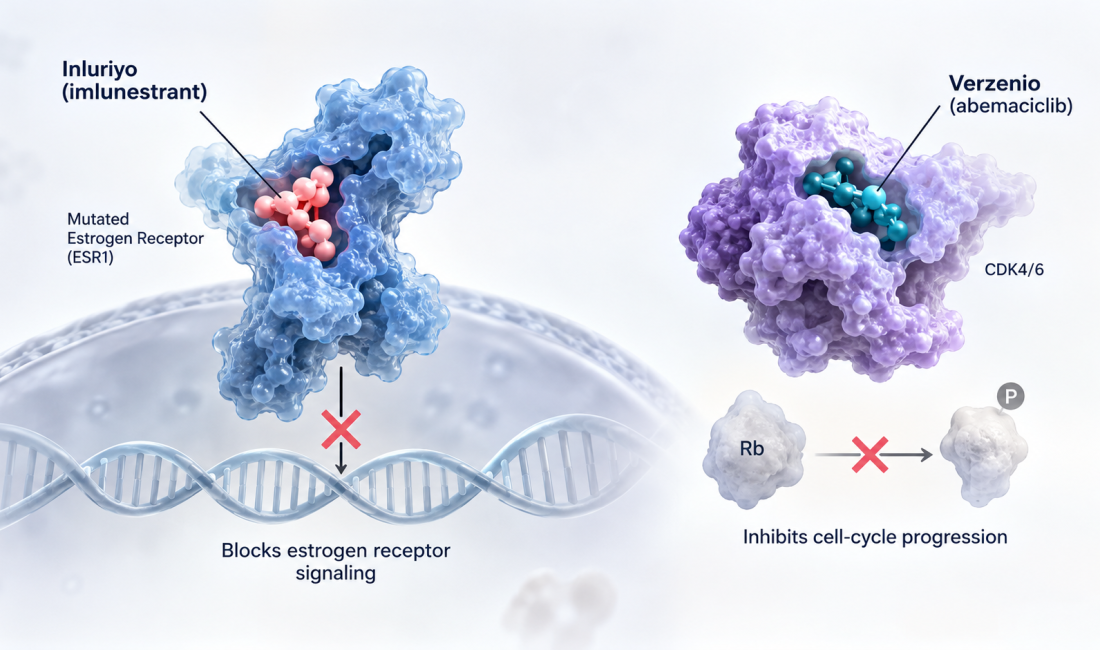
Inluriyo is an oral estrogen receptor antagonist that maintains ER inhibition, including against ESR1-mutated disease. Verzenio inhibits CDK4/6 proteins involved in cell-cycle progression. Combining the two agents therefore targets estrogen receptor signaling and cell proliferation through distinct biological pathways.
Safety Profile Remained Consistent with the Individual Agents
Most adverse events reported with the combination in EMBER-3 were Grade 1 or 2. Common adverse reactions included neutropenia, diarrhea, decreased hemoglobin and lymphocytes, nausea, thrombocytopenia, fatigue, increased liver enzymes, infections, vomiting, musculoskeletal pain and abdominal symptoms.
Permanent discontinuation of Inluriyo because of adverse reactions occurred in 1% of patients in the combination arm, while permanent discontinuation of Verzenio occurred in 3.4%. Inluriyo carries a warning for embryo-fetal toxicity, while Verzenio labeling includes warnings for severe diarrhea, neutropenia, interstitial lung disease/pneumonitis, hepatotoxicity, venous thromboembolism and embryo-fetal toxicity, among others.
Next Milestone Is Adjuvant Breast Cancer
Lilly is continuing to evaluate Inluriyo in the Phase 3 EMBER-4 trial in patients with ER-positive, HER2-negative early breast cancer who have an elevated risk of recurrence after standard endocrine therapy, including treatment with CDK4/6 inhibitors.
The trial has enrolled more than 8,000 patients across more than 650 sites in over 30 countries. Initial results are expected in 2027.
The Inluriyo-Verzenio combination is now available in the United States.
Reference
U.S. FDA approves Inluriyo (imlunestrant) in combination with Verzenio (abemaciclib) for adults with ER+, HER2-, ESR1-mutated advanced or metastatic breast cancer, Lilly 18 September 2026
A Study of Imlunestrant, Investigator’s Choice of Endocrine Therapy, and Imlunestrant Plus Abemaciclib in Participants With ER+, HER2- Advanced Breast Cancer (EMBER-3), ClinicalTrials.gov ID NCT04975308

About the Writer
Anamika Koshti (LinkedIn) is a PharmD professional and healthcare writer with interests in clinical research, pharmacovigilance, and evidence-based medicine. She has authored peer-reviewed publications on Alzheimer’s disease and PCOS, presented research at national conferences, and gained hands-on experience in medical content development and clinical data interpretation. She is committed to translating complex medical research into accurate, accessible content for healthcare professionals and patients.