
FDA approves Biofrontera’s Ameluz PDT for superficial basal cell carcinoma, making it the only topical PDT approved in the U.S. for skin cancer.
Written By: Kalyani Boharapi,
M.Pharm (Reg. Affairs)
Reviewed By: Pharmacally Editorial Team
Biofrontera’s Ameluz (aminolevulinic acid hydrochloride) topical gel 10% has received U.S. Food and Drug Administration approval in combination with the BF-RhodoLED lamp series for treating superficial basal cell carcinoma (sBCC) in adults. The decision makes Ameluz the first and only photodynamic therapy (PDT) drug approved by the FDA for a skin cancer and the only topical PDT in the U.S. indicated for both actinic keratosis (AK), a precancerous skin condition, and a non-melanoma skin cancer.
Phase 3 Trial Supported the Expanded Indication
The approval was supported by a multicenter, randomized, double-blind, vehicle-controlled Phase 3 trial involving 187 adults with histologically confirmed sBCC.
The primary endpoint required both clinical and histological complete response of a main target lesion 12 weeks after the start of the last PDT cycle. The protocol allowed assessment after the final treatment cycle, making the endpoint a measure of both visible clinical clearance and histological eradication rather than clinical appearance alone.
Ameluz PDT produced a complete response in 66% of patients, or 95 of 145, compared with 5%, or 2 of 42, with placebo PDT. Histological clearance of the main target lesion reached 76% with Ameluz versus 19% with placebo, while complete clinical clearance of all target lesions occurred in 83% of Ameluz-treated patients compared with 21% of those receiving placebo PDT.
Red-Light PDT Targets Tumor Tissue
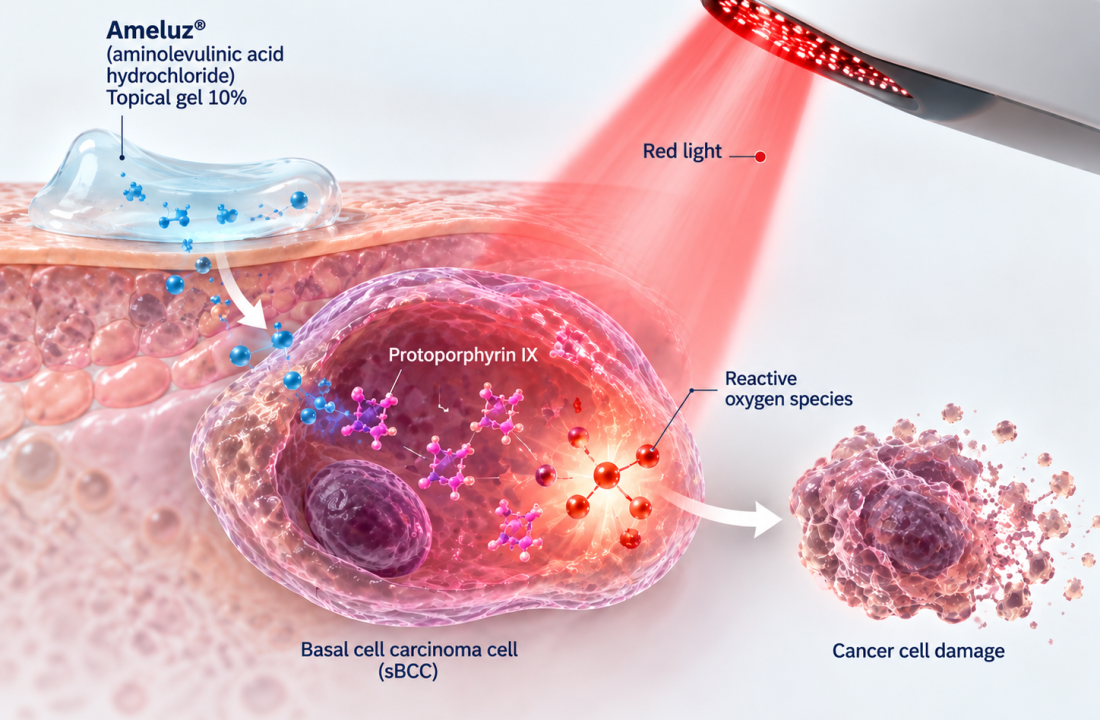
Ameluz contains aminolevulinic acid, a precursor that is converted intracellularly to protoporphyrin IX. When exposed to red light from the BF-RhodoLED system, the accumulated photosensitizer generates reactive oxygen species that damage treated cells.
This localized mechanism provides a tissue-sparing treatment approach for superficial BCC. The same Ameluz formulation and red-light device are already used for the company’s AK indication, allowing dermatology practices with an existing RhodoLED system to potentially adopt the new sBCC indication without introducing a separate drug-device platform.
Expanding Non-Surgical Options for sBCC
BCC is the most common skin cancer in the U.S., with approximately 3.6 million cases diagnosed annually, according to the Skin Cancer Foundation. Published estimates suggest that superficial BCC accounts for approximately 15% to 20% of cases, corresponding to an estimated 540,000 to 720,000 sBCC cases annually in the U.S.
Superficial BCC frequently occurs on the trunk and extremities and can present as multiple lesions. While surgery remains an important treatment option, non-surgical, tissue-sparing approaches can be clinically relevant for patients with multiple lesions or those for whom surgery is not preferred.
The most common adverse reactions reported with Ameluz PDT were application-site reactions consistent with its established safety profile, including reactions such as erythema, pain or burning, and edema. These local reactions reflect the treatment response associated with topical PDT and should be considered when counseling patients about treatment tolerability.
FDA Approval Adds a Distinct PDT Position
The regulatory decision gives Ameluz a differentiated position in U.S. dermatology. It is now the only topical PDT approved for both a precancerous skin condition and a skin cancer, extending the platform from AK treatment into superficial BCC.
Biofrontera CEO and Chairman Hermann Luebbert said the approval represents an important expansion of the company’s red-light PDT platform and provides dermatologists with a non-surgical treatment option for a common skin cancer.
Commercial Launch Planned for Late 2026 to Early 2027
Biofrontera plans to launch the sBCC indication from late fourth quarter 2026 through the first quarter of 2027 using its existing commercial organization and installed BF-RhodoLED lamp base.
The company expects existing Ameluz customers to be able to adopt the indication using their current drug-device infrastructure. The new indication could also provide a clinical rationale for additional dermatology practices to acquire RhodoLED systems and begin using Ameluz PDT.
For Biofrontera, the approval expands the clinical utility of an established PDT platform while opening Ameluz to a substantially larger treatment population that includes patients with superficial basal cell carcinoma.
Reference
Biofrontera Announces FDA Approval of Ameluz® Red Light PDT for the Treatment of Superficial Basal Cell Carcinoma, Biofrontera, 14 September 2026

About the Writer
Kalyani Boharapi (LinkedIn) is a pharmacy professional and healthcare writer currently pursuing an M.Pharm in Regulatory Affairs at Dr. D. Y. Patil College of Pharmacy, with interests in pharmaceutical regulations, drug development, and healthcare innovation. She has academic exposure to dossier preparation, scientific writing, and regulatory documentation. Kalyani has also completed certification courses in Generative AI, AI in Pharma, and Bioinformatics, and actively participates in pharmaceutical conferences to stay updated with emerging trends and advancements in the healthcare and pharmaceutical industry.