
FDA accepts Nanoscope Therapeutics’ BLA for MOGENRY, an optogenetic gene therapy for severe retinitis pigmentosa, supported by RESTORE and REMAIN data.
Written By: Dishali Desai, PharmD
Reviewed By: Pharmacally Editorial Team
Nanoscope Therapeutics has cleared a key regulatory hurdle for MOGENRY (sonpiretigene isteparvovec, MCO-010), with the FDA accepting and filing its Biologics License Application (BLA) for adults with retinitis pigmentosa (RP) and severe vision loss. If approved, MOGENRY could become the first gene-agnostic therapy to improve vision in this population.
BLA Supported by Phase 2b/3 RESTORE Data
The BLA includes efficacy and safety evidence from a Phase 1/2a study (NCT04919473) and the multicenter, randomized, double-masked, sham-controlled Phase 2b/3 RESTORE trial (NCT04945772).
RESTORE met its primary and key secondary endpoints, with MOGENRY producing improvements in visual acuity at weeks 52 and 76. The treatment was well tolerated, with no treatment-related serious adverse events reported.
Most patients who received MOGENRY in RESTORE subsequently entered the REMAIN long-term follow-up study. Data from REMAIN provide additional evidence supporting the durability of the visual benefit and form part of the BLA package.
The company did not disclose detailed numerical efficacy results or statistical values in the regulatory announcement.
Optogenetic Approach Bypasses Photoreceptor Loss
RP comprises a large group of inherited retinal disorders characterized by progressive degeneration of photoreceptors, eventually causing severe visual impairment and blindness. More than 100 genes and over 1,000 mutations have been linked to RP, creating a major challenge for mutation-specific therapies.
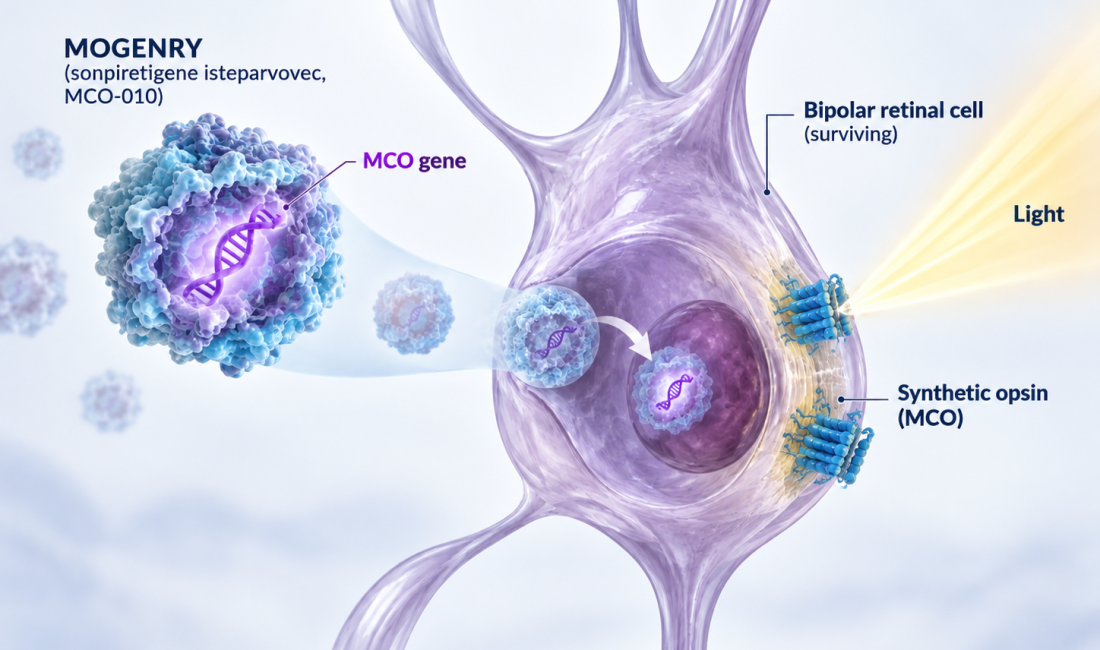
MOGENRY takes a different approach. The intravitreal therapy delivers Nanoscope’s multi-characteristic opsin (MCO) gene to surviving bipolar retinal cells. The resulting synthetic opsin makes these cells directly sensitive to light, allowing them to use residual retinal circuitry after photoreceptor loss.
The MCO platform incorporates a genetically engineered opsin with broad-spectrum light sensitivity and rapid kinetics. Because the approach acts downstream of the defective photoreceptors, treatment does not require identification of the patient’s underlying mutation.
The therapy is administered once by intravitreal injection in an office-based setting, without invasive retinal surgery or repeat dosing.
Large Unmet Need in Severe RP
Nanoscope estimates that more than 100,000 people in the US live with RP, including more than 25,000 who are legally blind. Vision loss progresses at different rates depending on the underlying mutation, but patients lose approximately 0.03 LogMAR, or about 1.5 letters, per year on average.
For patients with advanced disease, treatment options remain limited. A gene-agnostic approach could therefore extend treatment beyond the relatively small populations eligible for mutation-specific therapies.
Regulatory Review Moves MOGENRY Toward Potential Launch
Nanoscope CEO Sulagna Bhattacharya said the RESTORE results and long-term REMAIN follow-up provide the basis for advancing MOGENRY through FDA review.
Allen C. Ho, MD, professor of ophthalmology at Thomas Jefferson University and director of Retina Research at Wills Eye Hospital, highlighted two potential practical advantages: the therapy does not require genetic testing and can be administered without a surgical suite. These characteristics could allow treatment through community retina practices rather than limiting access to tertiary academic centers.
The FDA’s acceptance and filing of the BLA begins the formal regulatory review. If approved, MOGENRY would establish a gene-agnostic treatment option for patients with severe vision loss from RP and represent a new application of optogenetic therapy in retinal disease.
Reference
Nanoscope Therapeutics Announces U.S. Food and Drug Administration Acceptance of Biologics License Application for MOGENRY for the Treatment of Retinitis Pigmentosa with Severe Vision Loss, Nanoscope Therapeutics, 09 September 2026

About the Writer
Dishali Desai (LinkedIn) is a PharmD professional with expertise in clinical pharmacy, evidence-based healthcare writing, and published work on Brugada syndrome and ADR reporting.
Her interests include guideline integration, multimodal therapy, pharmacogenomics, and antibiogram utilization, with a focus on clinical evidence and treatment decisions.
As a healthcare writer, she translates complex clinical information into clear, accurate, and evidence-informed medical content.