
Evommune’s EVO756 failed the Phase 2b atopic dermatitis trial, while IL-18BP fusion protein EVO301 advances toward Phase 2b development in 2027.
Written By: Saniya Katakdhond, PharmD
Reviewed By: Pharmacally Editorial Team
Evommune’s oral MRGPRX2 antagonist EVO756 failed to improve atopic dermatitis severity in a Phase 2b trial, marking the second indication discontinued for the drug after its chronic spontaneous urticaria program ended in June 2026. The company will instead advance IL-18BP fusion protein EVO301 in atopic dermatitis while continuing EVO756 development in migraine prophylaxis.
EVO756 Misses EASI Endpoint in Atopic Dermatitis
Evommune’s Phase 2b trial of EVO756 in adults with moderate-to-severe atopic dermatitis (AD) failed to meet its primary endpoint, with the oral MRGPRX2 antagonist showing no meaningful benefit across the doses tested. The company will not advance EVO756 in AD following the negative results.
The randomized, double-blind, placebo-controlled dose-ranging study enrolled 121 adults and evaluated treatment over 12 weeks, with follow-up through Week 14. EVO756 failed to meet both the primary and secondary efficacy endpoints at all doses studied.
The primary endpoint was the percent change from baseline in the Eczema Area and Severity Index (EASI) score at Week 12, a widely used measure of AD severity that assesses the extent and intensity of skin lesions.
Targeting MRGPRX2 in Chronic Inflammation
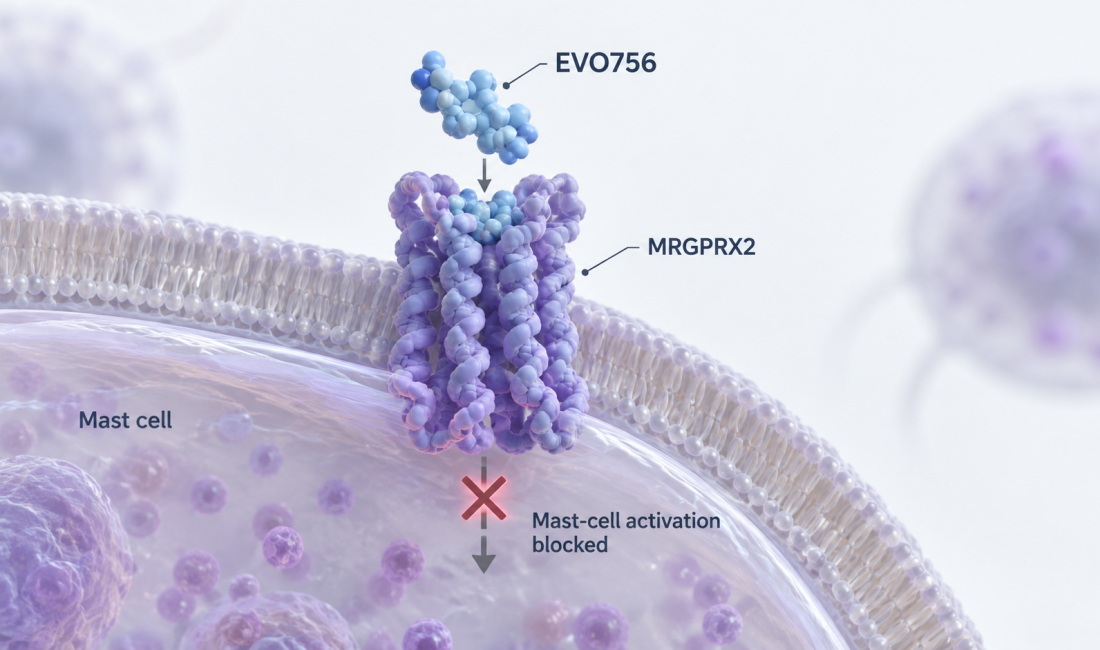
EVO756 is a potent, selective oral antagonist of Mas-related G protein-coupled receptor X2 (MRGPRX2), a receptor expressed predominantly on mast cells and peripheral sensory neurons.
MRGPRX2 contributes to mast-cell activation and inflammatory signaling. By blocking the receptor, EVO756 was being developed as a potential oral approach to modulate pathways implicated in chronic inflammatory disease.
Despite the biological rationale, the Phase 2b findings did not translate into clinical efficacy in AD. The company reported that EVO756 was generally well tolerated, with a safety profile consistent with earlier studies.
EVO301 Takes Lead in Atopic Dermatitis Pipeline
The setback shifts Evommune’s AD development strategy toward EVO301, its long-acting injectable IL-18 binding protein (IL-18BP) fusion protein.
EVO301 neutralizes excess IL-18 activity, an inflammatory pathway implicated in chronic immune-mediated diseases. The molecule incorporates native human IL-18BP with high binding affinity and specificity, alongside serum albumin binding to extend its half-life and support sustained IL-18 neutralization.
The company plans to move EVO301 into a Phase 2b trial in mid-2027, following positive Phase 2a proof-of-concept results.
EVO756 Development Continues in Migraine
Although its AD program will end, Evommune plans to continue developing EVO756 for migraine prophylaxis. The drug’s favorable tolerability profile provides support for further clinical evaluation in that setting, although efficacy in migraine remains to be established in future studies.
Evommune Chief Medical Officer Eugene Bauer acknowledged the disappointing AD outcome while emphasizing that the safety findings support continued investigation of EVO756 in migraine.
Chief Executive Officer Luis Peña said the company remains focused on advancing treatments for chronic inflammatory diseases, with EVO301 now positioned as its lead AD program.
Second Indication Discontinued
The AD failure follows Evommune’s decision in June 2026 to discontinue EVO756 development in chronic spontaneous urticaria. Together, the decisions remove two inflammatory disease indications from the drug’s development program and leave migraine prophylaxis as the company’s continuing clinical focus for EVO756.
The repeated setbacks also increase the importance of EVO301 for Evommune’s AD strategy. Its Phase 2b study, planned for mid-2027, will provide the next major clinical test of the company’s approach to targeting inflammatory pathways in AD.
Next Development Milestones
The immediate priority is EVO301’s transition into Phase 2b development, currently expected in mid-2027. For EVO756, further clinical development will focus on migraine prophylaxis rather than AD.
The Phase 2b failure highlights the challenge of translating mechanistic rationale into clinical benefit in atopic dermatitis, while EVO301’s upcoming study will provide the next major test of Evommune’s inflammatory-pathway strategy. The company said its balance sheet supports operations into 2029, providing financial runway for continued development of its clinical portfolio.
Reference
Evommune Announces Top-line Results from EVO756 Phase 2b Trial in Moderate-to-Severe Atopic Dermatitis, Evommune, 08 September 2026

About the Writer
Saniya Sanjay Katakdhond (Linkedin) is a Doctor of Pharmacy professional with hands-on experience in patient case review, clinical documentation, medical record analysis, and patient care.
Her hospital experience has strengthened her understanding of clinical conditions, treatment approaches, and multidisciplinary healthcare practices.
With ICH-GCP certification and a research-oriented approach, she brings clinical insight and attention to detail to healthcare content development.
As a healthcare writer, Saniya focuses on translating clinical knowledge and patient-care experience into clear, accurate, and evidence-informed medical content.