
iECURE reports a 74% reduction in hyperammonemic crises with ECUR-506 in infants with neonatal-onset OTC deficiency, with evidence of targeted liver editing.
Written By: Mayuri Vaja, PharmD
Reviewed By: Pharmacally Editorial Team
iECURE reported updated clinical data from its ongoing OTC-HOPE Phase 1/2 trial (NCT06255782) of investigational gene-editing therapy ECUR-506 in male infants with neonatal-onset ornithine transcarbamylase (OTC) deficiency. In the low-dose cohort, ECUR-506 reduced the annualized rate of hyperammonemic events (HAEs) which include episodes of elevated blood ammonia by 57%, while the more severe hyperammonemic crises (HACs), characterized by elevated ammonia accompanied by neurologic symptoms, fell 74% versus pretreatment rates.
The findings, presented at the 2026 Annual Symposium of the Society for the Study of Inborn Errors of Metabolism (SSIEM) in Helsinki, also provide evidence of targeted hepatic editing and improved metabolic control. Dosing is now complete across all three trial cohorts, although participant evaluations remain ongoing.
ECUR-506 Targets the Liver’s PCSK9 Locus
OTC deficiency results from impaired activity of the hepatic OTC enzyme, which normally converts ammonia into urea for excretion. Severe neonatal-onset disease can cause rapidly escalating ammonia levels, leading to seizures, coma, irreversible neurologic injury, and death.
Current standard treatment relies on strict protein restriction and daily ammonia-scavenging medications. While these approaches manage systemic ammonia levels, they do not correct the underlying genetic defect.
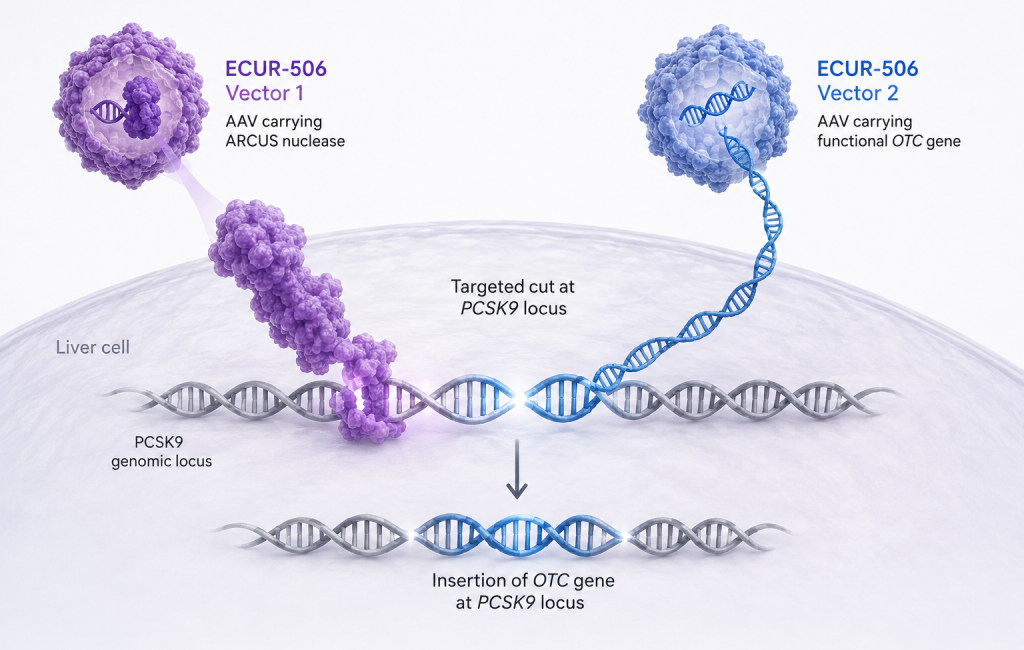
ECUR-506 utilizes two adeno-associated virus (AAV) vectors to insert a functional copy of the OTC gene directly into the PCSK9 locus of liver cells:
- Vector 1: Delivers an ARCUS nuclease (licensed from Precision BioSciences) that generates the targeted genomic insertion site.
- Vector 2: Carries the functional OTC gene for insertion.
Low-Dose Cohort Demonstrates Clinical Activity
Nine infants received a single intravenous dose across three cohorts:
- Low-dose cohort: 1.3 × 10¹³ genome copies (GC)/kg (n=3)
- Intermediate-dose cohort: 2.4 × 10¹³ GC/kg (n=3)
- High-dose cohort: 4.0 × 10¹³ GC/kg (n=3)
Among the three low-dose participants:
- HAE Reduction: Annualized rate of hyperammonemic events fell 57% ().
- HAC Reduction: Severe hyperammonemic crises fell 74% (). This reduction updates the previously reported 65% figure following an updated medical history review that identified an additional baseline crisis.
Individual Patient Outcomes
Clinical responses varied despite identical dosing, highlighting the role of baseline disease burden:
- Complete Clinical Response: One infant with an initial peak ammonia level of achieved full clinical stability and successfully discontinued all ammonia-scavenger therapy and protein dietary restrictions.
- Partial Responses: Two infants with initial peak ammonia levels of at least showed improvements consistent with lower overall disease burden. One participant was successfully weaned off one of their two baseline ammonia-scavenger medications.
These differing responses suggest that baseline disease severity and residual OTC enzyme activity influence the threshold of gene restoration required to establish long-term metabolic stability.
Biopsy Data Provide Direct Evidence of Hepatic Editing
- Direct Biopsy Evidence: 24-week liver biopsies from two of the three low-dose participants provided direct histology evidence of targeted hepatic gene editing. (The third participant did not undergo a biopsy due to lack of parental consent.)
- Systemic Biomarker: Statistically significant reductions in serum PCSK9 levels across the low-dose cohort served as an indirect systemic biomarker, further supporting site-specific editing at the PCSK9 locus.
- Pending Data: Liver biopsy analyses from the intermediate- and high-dose cohorts remain pending maturity.
Favorable Safety and Tolerability Profile
As of July 28, 2026, ECUR-506 was generally well tolerated across all nine treated participants, with no unexpected treatment-related safety events reported:
- No TMA or Infusion Reactions: Zero cases of thrombotic microangiopathy (TMA) or infusion-related reactions occurred.
- Transaminitis Management: Transient, asymptomatic Grade 2–3 transaminitis occurred in eight participants. Seven cases resolved following reactive immunosuppression, while one participant received prophylactic corticosteroids per study protocol.
- Mortality Context: One participant died after experiencing hypoxemic respiratory failure. Trial investigators determined the event was unrelated to ECUR-506 and attributable to complications from underlying OTC deficiency progression.
Higher-Dose Evaluation and Trial Architecture
The completion of dosing across all three cohorts provides iECURE with a broader dataset to evaluate the relationship between targeted gene editing, OTC enzyme restoration, and clinical stabilization.
- Study Scope: The OTC-HOPE trial enrolls eligible male infants up to seven months of age with genetically confirmed severe neonatal-onset OTC deficiency.
- Trial Pipeline: The main protocol comprises screening, stabilization, dosing eligibility, single-dose administration, and a 6-month primary evaluation period. Following completion, participants transition into a 14.5-year long-term follow-up study (ECUR-LTFU).
The low-dose proof-of-concept data support ongoing evaluation of higher dose levels, particularly for infants presenting with the most profound baseline OTC deficiency. Ongoing long-term follow-up will determine the ultimate durability of hepatic editing and sustained metabolic benefit.
Reference

About the Writer
Mayuri Vaja (Linkedin) is a Pharm.D professional with a strong interest in clinical research, pharmacovigilance, and medical writing, supported by certifications in pharmacovigilance and academic projects exploring AI in healthcare and drug safety.
With a growing focus on evidence-based healthcare and scientific communication, she is developing expertise in clinical research and translating healthcare evidence into clear, meaningful content.
As a Pharmacally healthcare writer, Mayuri is committed to creating accurate, research-driven, and clinically relevant healthcare content while continuously strengthening her professional skills.