
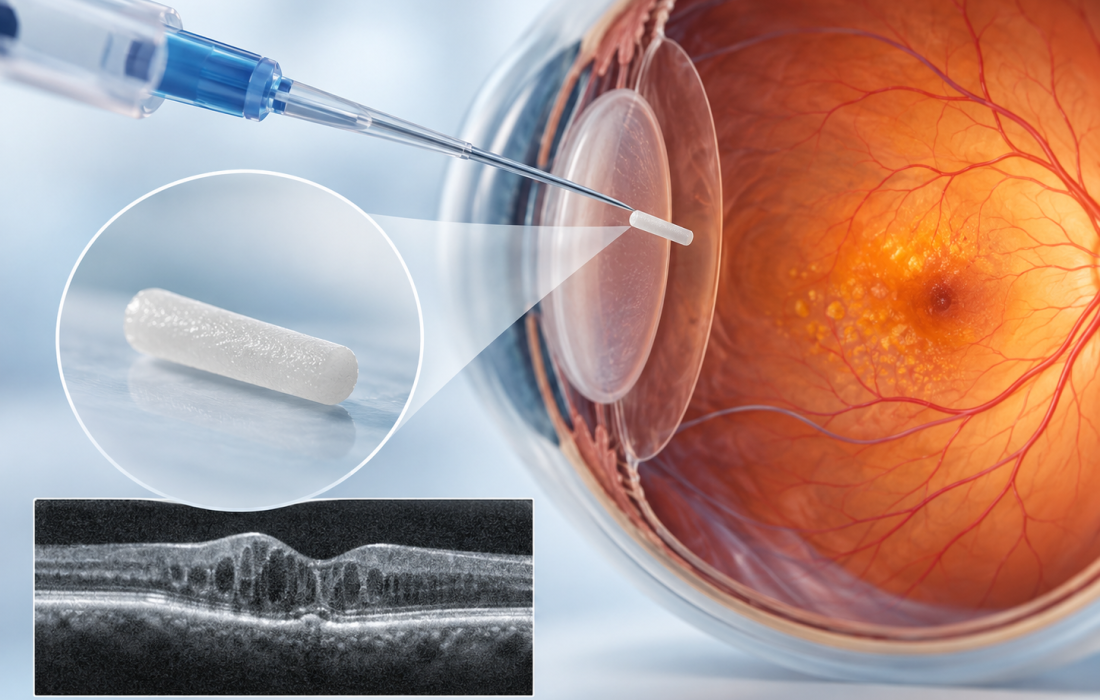
Eclipse Life Sciences reports Phase 2 BETTIS-1 results for EC-104, showing sustained retinal thickness reduction and visual improvement in diabetic macular edema.
Written By: Mayuri Vaja, PharmD
Reviewed By: Pharmacally Editorial Team
Eclipse Life Sciences reported positive topline results from its Phase 2 BETTIS-1 trial of EC-104, a biodegradable intravitreal fluocinolone acetonide implant, in diabetic macular edema (DME). The investigational corticosteroid demonstrated sustained anatomical improvements through 24 weeks compared with Ozurdex, although detailed efficacy data and statistical analyses have not yet been disclosed.
EC-104 Targets Persistent Disease After Anti-VEGF Treatment
DME is a complication of diabetic retinopathy in which fluid accumulates in the macula, the central region of the retina responsible for sharp vision. Vascular endothelial growth factor (VEGF) inhibitors are commonly used as first-line treatment, but some patients experience an inadequate response despite repeated injections.
Corticosteroids offer an alternative by suppressing inflammatory pathways that contribute to retinal vascular leakage and macular edema. However, intraocular pressure (IOP) elevation and other steroid-related adverse effects remain important considerations when selecting patients for treatment.
EC-104 is a biodegradable intravitreal implant containing fluocinolone acetonide (FA), a corticosteroid. The implant releases the drug over approximately six months, potentially extending treatment duration and reducing the frequency of repeat interventions.
BETTIS-1 Reports Safety and Anatomical Improvements at 24 Weeks
The Phase 2 BETTIS-1 study compared two EC-104 formulations with Ozurdex, an intravitreal dexamethasone implant approved for several retinal conditions, including DME. The study enrolled patients with a documented suboptimal response to previous anti-VEGF therapy, a population with persistent treatment needs.
According to the topline announcement, the trial met its primary endpoint, with both EC-104 formulations demonstrating a favorable safety profile compared with Ozurdex. Eclipse reported low rates of treatment-related adverse events and no unexpected safety signals.
Secondary endpoints showed sustained reductions in optical coherence tomography (OCT)-measured central subfield thickness (CST) through week 24. The company also reported superior, clinically meaningful improvements in best-corrected visual acuity (BCVA) and CST compared with Ozurdex.
These findings suggest that EC-104 may provide both anatomical and visual benefits in patients whose disease responds inadequately to anti-VEGF treatment. However, the announcement did not provide numerical treatment differences, confidence intervals, p-values, sample size or detailed adverse-event rates. The magnitude and statistical robustness of the reported benefits therefore remain difficult to assess independently.
Intraocular Pressure Remains an Important Safety Consideration
Eclipse reported acceptable IOP outcomes in both EC-104 groups among patients with a history of corticosteroid tolerance. This is clinically relevant because corticosteroid-associated pressure elevation can complicate long-term treatment, particularly in patients susceptible to glaucoma.
The company has not disclosed detailed IOP measurements or the incidence of clinically significant pressure increases. Full trial results will be needed to establish the comparative safety profile and identify the patient groups most likely to benefit.
Phase 3 Development Expected in 2027
Scott Cousins, MD, chief executive officer and vice president of research and development at Eclipse Life Sciences, said the findings support further development of EC-104, highlighting its sustained drug release and potential to reduce treatment burden.
The company plans to discuss Phase 3 development with regulatory authorities and expects to initiate a pivotal programme in 2027. It is also exploring partnerships to support late-stage development and potential global commercialization. Full BETTIS-1 results are expected to be presented at an upcoming ophthalmology conference and submitted for peer-reviewed publication.
If subsequent trials confirm the reported efficacy and safety findings, EC-104 could offer a longer-acting corticosteroid option for selected patients with DME who respond inadequately to anti-VEGF therapy. Its clinical positioning will depend on the magnitude and durability of visual improvement, long-term IOP outcomes, and the comparative benefit-risk profile established in larger studies.
Reference
Eclipse Life Sciences Announces Positive Topline Results from Phase 2 BETTIS-1 Study Evaluating EC-104 for Diabetic Macular Edema (DME), Eclipse Life Science, 15 October 2026
EC-104 Intravitreal Implant for the Treatment of Diabetic Macular Edema (BETTIS-1), ClinicalTrials.gov ID NCT06536491

About the Writer
Mayuri Vaja (Linkedin) is a Pharm.D professional with a strong interest in clinical research, pharmacovigilance, and medical writing, supported by certifications in pharmacovigilance and academic projects exploring AI in healthcare and drug safety.
With a growing focus on evidence-based healthcare and scientific communication, she is developing expertise in clinical research and translating healthcare evidence into clear, meaningful content.
As a Pharmacally healthcare writer, Mayuri is committed to creating accurate, research-driven, and clinically relevant healthcare content while continuously strengthening her professional skills.