
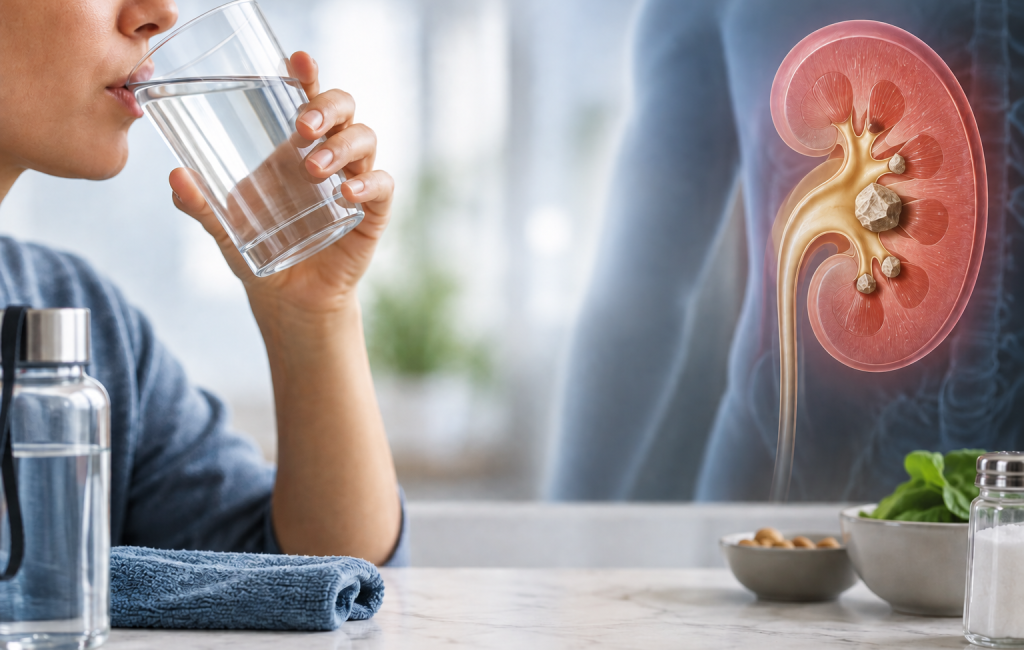
A large Lancet trial found intensive hydration increased urine volume but did not reduce recurrent kidney stone events, highlighting limits of hydration alone.
Written By: Creola Gonsalves, MS Biotech
Reviewed By: Pharmacally Editorial Team
A large Lancet trial found that an intensive programme to help people drink more fluids increased urine volume but did not reduce painful or treatment-requiring kidney stone episodes over two years. The findings do not mean hydration is unimportant, but suggest that drinking more fluid alone may not be enough to prevent stones from returning.
Why Is Drinking More Water Recommended for Kidney Stones?
If you have ever had a kidney stone, you have probably heard the advice: drink more water.
The reasoning is straightforward. Kidney stones develop when certain substances become too concentrated in urine and form crystals. Producing more urine dilutes these substances and can make stone formation less likely.
But maintaining a high fluid intake every day can be difficult. People may forget to drink, have limited access to water, dislike frequent trips to the bathroom, or simply struggle to turn the recommendation into a lasting habit.
The new trial asked an important question: If people receive intensive help to drink more, will they actually have fewer kidney stones?
The Study Went Beyond Simply Telling People to Drink More
The randomised trial enrolled 1,658 people aged 12 years and older with a history of urinary stones and relatively low urine volumes. Participants were treated at six academic medical centres in the US and randomly assigned to either an intensive hydration programme or usual guideline-based care.
The intervention group received an individual fluid prescription based on how much urine they were producing. For most adults, the goal was to increase fluid intake enough to produce at least 2.5 litres of urine per day.
The programme also used a Bluetooth-enabled smart water bottle to track the prescribed fluid intake. Participants could receive a $1.50 daily financial incentive for meeting their target during the early phase of the study. Those who repeatedly struggled to meet their targets received health coaching to identify practical barriers and find solutions. Later in the programme, participants could use lower-intensity support such as text reminders or a support partner.
The control group continued to receive standard medical advice to increase fluid intake.
Did More Fluid Mean Fewer Kidney Stones?
Surprisingly, no.
After a median follow-up of about two years, symptomatic stone events occurred in 18.6% of participants in the intervention group, compared with 19.8% in the control group.
The difference was not statistically significant. The hazard ratio was 0.96 (95% CI 0.77–1.20).
The intensive programme did accomplish one of its immediate goals: participants produced more urine. At six months, urine volume had increased by about 600 mL per day from baseline in the intervention group, compared with about 360 mL per day in the control group. However, that difference became smaller over time.
There was also no significant difference in the development of new stones or growth of existing stones on imaging.
If More Urine Did Not Prevent Stones, What Actually Causes Them?
Kidney stones are not caused by low urine volume alone. They form when the chemical balance of urine allows substances such as calcium, oxalate or uric acid to become concentrated enough to form crystals, which can then grow and join together into a stone.
More urine can dilute these substances and make crystal formation less likely, but it does not remove other factors that contribute to stones. High urinary calcium or oxalate, low citrate, abnormal urine acidity, dietary factors, medications and individual metabolic differences can all influence a person’s risk.
This helps put the trial findings into perspective. The intervention successfully increased urine volume, but changing this one factor did not significantly reduce symptomatic stone events. The results therefore do not show that urine volume is unimportant. Rather, they suggest that hydration addresses only one part of a much more complex stone-forming process.
So, Should People with Kidney Stones Stop Drinking More Water?
No.
This Lancet study does not show that hydration is useless or that people with a history of kidney stones should drink less.
Instead, it raises an important distinction between improving a risk factor and preventing a clinical event.
The intervention successfully increased urine volume, which is an established goal of stone prevention. But that improvement did not translate into fewer symptomatic stone episodes during the two-year study.
People can also develop stones for different reasons. The type of stone, diet, salt intake, metabolic factors, medications and other individual characteristics can influence risk.
What Does This Mean for Patients?
For someone who has had a kidney stone, the practical message is not to abandon hydration. Drinking enough fluid remains an important part of standard stone-prevention care.
But hydration should not necessarily be viewed as the whole prevention strategy.
For people with recurrent stones, understanding why the stones are forming may be just as important. Doctors may use stone analysis, urine testing, dietary assessment and other evaluations to determine whether additional measures are needed.
The PUSH trial (NCT03244189) ultimately delivers a useful lesson: getting people to drink more can increase urine volume, but more urine does not automatically mean fewer stones. The findings suggest that effective long-term prevention may require strategies that go beyond hydration alone.
Reference

About the Writer
Creola Gonsalves (Linkedin) is an M.S. Biotechnology postgraduate with a strong interest in clinical research, evidence interpretation, and healthcare writing, with a focus on translating life-science knowledge into meaningful real-world insights.
She is trained in Good Clinical Practice (GCP), clinical research principles, and critical interpretation of randomized clinical trials, with certifications from NIH and Stanford University.
Her research background in biotechnological applications and microbial research strengthens her ability to understand scientific evidence and develop clear, accurate, and research-driven healthcare content.