
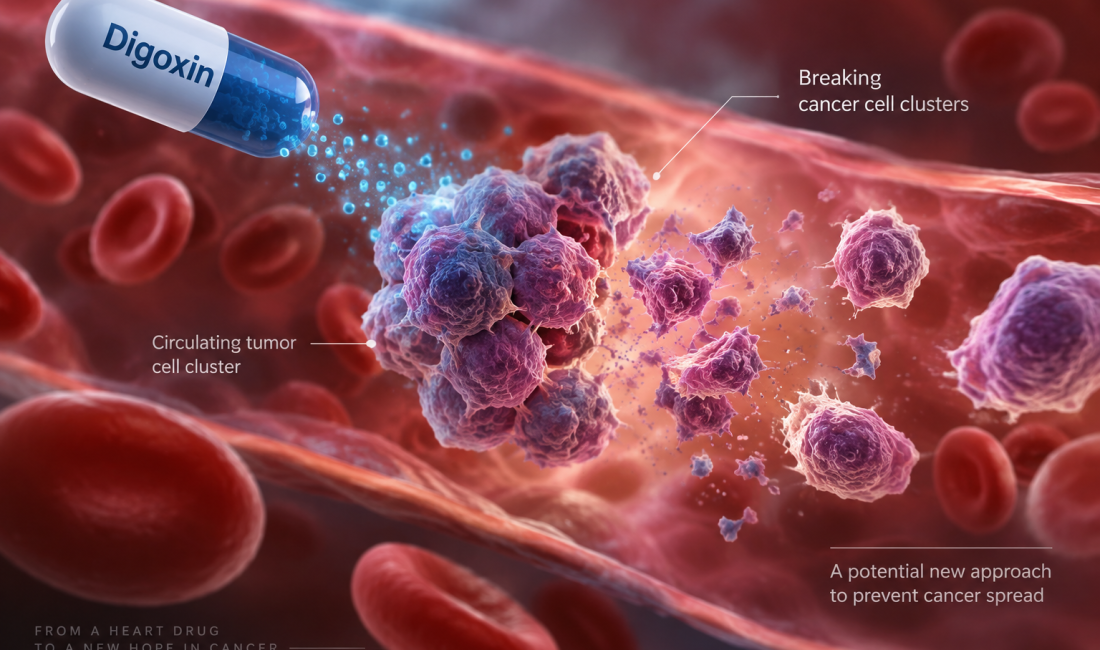
A Nature Medicine study found that digoxin reduced circulating tumor cell cluster size in metastatic breast cancer, supporting further metastasis research.
Written By: Anamika Koshti, PharmD
Reviewed By: Pharmacally Editorial Team
For patients with metastatic breast cancer, preventing cancer cells from spreading and establishing new tumors remains a major challenge. A study published in Nature Medicine suggests that digoxin, a long-used cardiac drug, may interfere with one of the structures that help cancer cells travel through the bloodstream: circulating tumor cell (CTC) clusters. In the first-in-human proof-of-concept study, seven days of digoxin treatment partially dissolved these clusters in patients with metastatic breast cancer, providing early clinical evidence for a potential metastasis-targeted strategy.
Why Cancer Cells Traveling in Clusters Matter
When breast cancer spreads, tumor cells can detach from primary or metastatic tumors and enter the bloodstream. These circulating tumor cells can travel individually, but some remain connected in multicellular clusters.
That distinction may matter. Previous studies have shown that CTC clusters have greater metastatic capacity than individual tumor cells and are associated with poorer outcomes. Their ability to maintain cell-cell connections also appears to support biological programs linked to proliferation and stem-like behavior.
This has led researchers to explore an alternative approach to cancer treatment: rather than only killing tumor cells, could therapy interfere with the mechanisms that allow them to spread?
Digoxin Offers an Unexpected Route to the Cancer Cell Clusters
The DICCT trial tested whether digoxin could disrupt CTC clusters in patients with metastatic breast cancer. Digoxin inhibits the Na⁺/K⁺ ATPase, a membrane protein best known clinically for its role in treating heart failure and cardiac arrhythmias.
Preclinical research had suggested that inhibiting this target with cardiac glycosides could weaken the cell-cell interactions that hold CTC clusters together. In breast cancer models, cluster disruption was associated with reduced metastatic activity. The DICCT study moved this concept into humans for the first time.
Seven Days of Treatment Reduced Cluster Size
The investigator-initiated phase 1 study screened 58 patients with locoregionally recurrent or metastatic breast cancer. Eleven patients had detectable CTC clusters and entered the treatment phase. Nine reached the prespecified serum digoxin exposure and completed the per-protocol analysis. Another nine patients with CTC clusters were followed as untreated, nonrandomized controls.
Patients received 0.125 or 0.25 mg of digoxin once daily for seven days, with dosing based on renal function and a target serum concentration of at least 0.7 ng/ml. Researchers collected blood samples before treatment and during therapy and used the Parsortix Cell Separation System to identify individual CTCs and homotypic and heterotypic clusters.
The primary endpoint was met. Average CTC cluster size decreased by 2.2 cells per cluster after treatment, with a one-sided paired t-test showing P=0.0032. The reduction occurred in treated patients and was not observed in the untreated control cohort.
However, digoxin did not significantly change the overall proportion of CTCs occurring as clusters. The researchers also observed a numerical relationship between higher serum digoxin concentrations and greater cluster-size reduction, although this association was not statistically significant (P=0.14).
Molecular Changes Strengthen the Biological Signal
The researchers also examined how digoxin exposure altered the molecular characteristics of CTCs. Longitudinal RNA sequencing from one patient identified 708 differentially expressed genes, including 685 that were downregulated following treatment.
Pathway analysis showed reduced activity in genes involved in cell-cycle regulation and cell-cell adhesion. These changes were consistent with the proposed mechanism in which Na⁺/K⁺ ATPase inhibition weakens the biological properties that maintain CTC clusters.
Animal experiments provided additional context. CTC clusters containing at least four cells demonstrated greater metastatic potential than smaller clusters in mice, supporting the biological relevance of disrupting larger tumor-cell aggregates.
What the Study Does Not Yet Prove
The findings do not establish that digoxin prevents breast cancer metastasis, slows disease progression, shrinks tumors, or improves survival. The study was small, short and primarily focused on a biological endpoint rather than clinical outcomes.
The researchers also described substantial variability in CTC numbers between patients and blood samples. Because relatively small blood volumes were analyzed, sampling variability could have affected the measurements. The observed cluster-dissolution effect was significant but modest.
A New Direction for Metastatic Breast Cancer Research
The significance of the DICCT study lies in what it changes about the therapeutic question. Instead of asking only whether a drug can kill cancer cells, researchers are testing whether it can interfere with the cellular organization that helps cancer spread.
Future studies will need to evaluate longer treatment durations, more intensive monitoring of digoxin exposure and potentially more potent or selective Na⁺/K⁺ ATPase inhibitors. Most importantly, researchers plan to determine whether disrupting CTC clusters can translate into fewer new metastases or other meaningful clinical benefits.
For now, digoxin remains an investigational approach for this cancer application. But the first-in-human findings provide a clinically measurable signal that breaking apart cancer cells as they travel through the bloodstream may represent a distinct strategy for targeting metastatic disease
Reference
Kurzeder, C., Nguyen-Sträuli, B.D., Krol, I. et al. Digoxin for reduction of circulating tumor cell cluster size in metastatic breast cancer: a proof-of-concept trial. Nat Med 31, 1120–1124 (2025). https://doi.org/10.1038/s41591-024-03486-6
Digoxin Induced Dissolution of CTC Clusters, ClinicalTrials.gov ID NCT03928210

About the Writer
Anamika Koshti (LinkedIn) is a PharmD professional and healthcare writer with interests in clinical research, pharmacovigilance, and evidence-based medicine. She has authored peer-reviewed publications on Alzheimer’s disease and PCOS, presented research at national conferences, and gained hands-on experience in medical content development and clinical data interpretation. She is committed to translating complex medical research into accurate, accessible content for healthcare professionals and patients.