
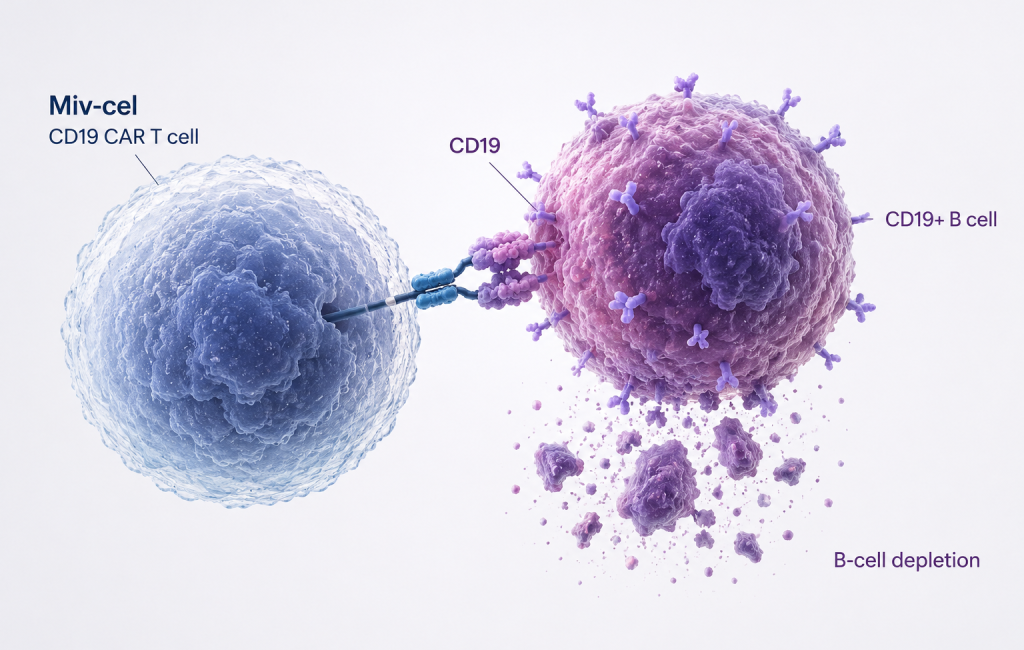
Miv-cel CD19 CAR T therapy showed deep B-cell depletion, reduced autoantibodies and clinical improvement in treatment-refractory rheumatoid arthritis.
Written By: Anamika Koshti, PharmD
Reviewed By: Pharmacally Editorial Team
A phase 1 study of mivocabtagene autoleucel (miv-cel) in severe, ACPA-positive rheumatoid arthritis produced deep B-cell depletion, falling autoantibody levels and sustained clinical improvement after a single infusion. The findings support further evaluation of CAR T-cell therapy as a potential disease-modifying approach for patients who have exhausted multiple treatment options.
Miv-cel Delivers Clinical Activity in Highly Refractory RA
Kyverna Therapeutics’ mivocabtagene autoleucel (miv-cel), an autologous, fully human CD19 CAR T-cell therapy, showed an acceptable short-term safety profile and meaningful biological and clinical activity in six patients with severe, treatment-refractory, ACPA-positive rheumatoid arthritis (RA), according to phase 1 data published in Nature Medicine.
The patients represented a particularly difficult-to-treat population, having failed a median of 6.5 prior biologic or targeted synthetic DMARDs, with prior rituximab exposure in several patients. Each received a single miv-cel infusion after stopping disease-modifying treatment and completing standard lymphodepletion.
Deep B-Cell Depletion Extends into Disease-Relevant Tissues
Miv-cel targets CD19-positive B cells, which play an important role in autoantibody production and immune activation in RA. The phase 1 study demonstrated depletion of CD19-positive B cells across blood and tissue compartments, accompanied by reductions in disease-associated autoantibodies.
Updated analyses presented at EULAR 2026 provided evidence of deep depletion of autoreactive B cells and plasmablasts in peripheral and tissue compartments, including bone marrow and inflamed joints.
The biological response also persisted as B cells returned. Between weeks 36 and 52, repopulating B cells were predominantly naïve and transitional cells, rather than memory B cells. CCP4-tetramer analyses further supported marked depletion of ACPA-reactive memory B cells, while long-term protective vaccine immunity was preserved. Together, these findings support the investigators’ hypothesis of an immune reset, rather than simple transient B-cell suppression.
Autoantibodies Fell as Disease Activity Improved
Autoantibody suppression accompanied the cellular changes. Four of six patients achieved seroconversion for ACPA against mutated citrullinated vimentin, while five of six achieved seroconversion for rheumatoid factor IgM.
Clinical activity also improved despite discontinuation of immunosuppressive therapy. At 36–52 weeks of follow-up, all six patients had improved disease activity, with a median 34% reduction in DAS28-CRP. Three patients achieved both DAS28-CRP remission and an ACR70 response. Updated EULAR data also showed that three of six patients had reached ACR70 by week 36.
Safety Supported Advancement to Phase 2
CRS occurred in all six patients but remained limited to grade 1 or 2. No ICANS or serious adverse events occurred. One dose-limiting toxicity, grade 3 transaminase elevation, resolved without sequelae. The primary safety endpoint was therefore met, supporting progression into phase 2.
The small cohort limits conclusions about uncommon toxicities, but the absence of severe CRS or ICANS provides an encouraging early safety signal in an autoimmune population.
Phase 2 Puts Miv-cel Against Rituximab
The randomized phase 2 portion of COMPARE (NCT06475495) has been initiated and fully enrolled, comparing miv-cel with rituximab in patients with active, ACPA-positive, treatment-refractory RA. The comparator arm receives rituximab 1,000 mg intravenously twice, while the miv-cel arm receives a single infusion. The study will assess safety and ACPA seroconversion alongside clinical outcomes.
That head-to-head comparison will be critical. Phase 1 establishes a compelling biological signal, but a randomized trial must determine whether the depth and durability of B-cell depletion translate into clinically meaningful advantages over established B-cell depletion with rituximab.
Reference

About the Writer
Anamika Koshti (LinkedIn) is a PharmD professional and healthcare writer with interests in clinical research, pharmacovigilance, and evidence-based medicine. She has authored peer-reviewed publications on Alzheimer’s disease and PCOS, presented research at national conferences, and gained hands-on experience in medical content development and clinical data interpretation. She is committed to translating complex medical research into accurate, accessible content for healthcare professionals and patients.