
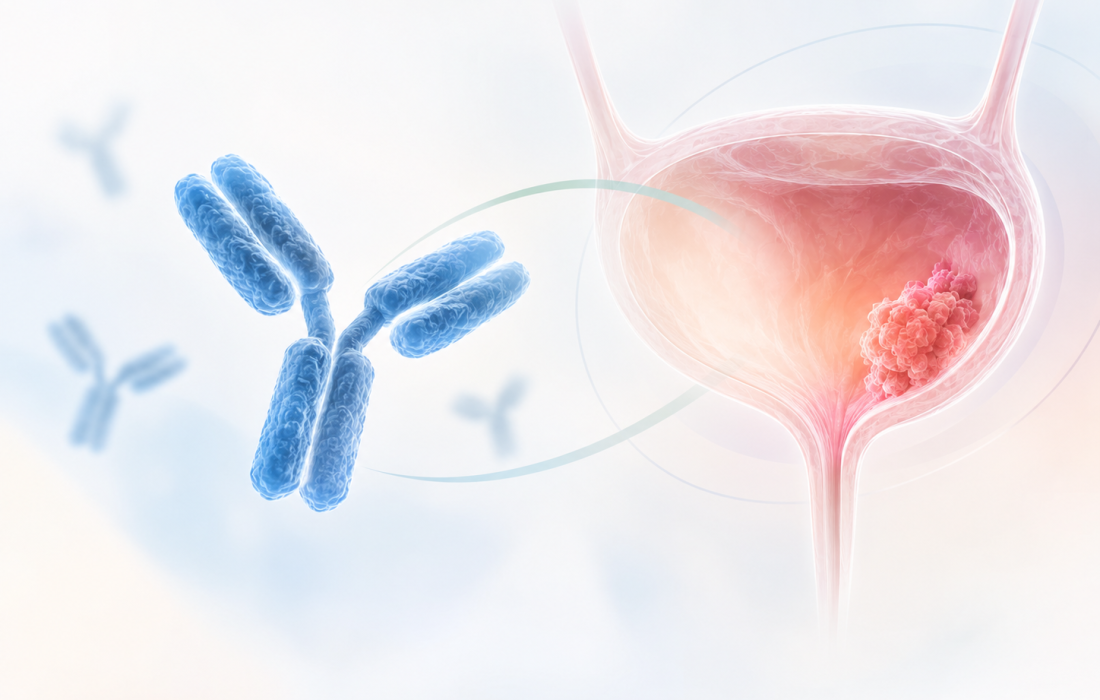
CatalYm’s Phase 2a GDFATHER-NEO study found higher pathological and radiographic response rates with visugromab plus nivolumab in muscle-invasive bladder cancer.
Written By: Siddhi Bhadekar, M.Pharm (QA)
Reviewed By: Pharmacally Editorial Team
CatalYm reported final results from its Phase 2a GDFATHER-NEO trial (NCT06059547) at the European Society for Medical Oncology (ESMO) Congress 2026, with findings published simultaneously in Nature Medicine on October 24. The study evaluated visugromab, an investigational antibody targeting growth differentiation factor 15 (GDF-15), alongside the PD-1 inhibitor nivolumab in patients with newly diagnosed, non-metastatic muscle-invasive bladder cancer (MIBC) who were ineligible for or declined cisplatin.
Visugromab and GDF-15 Neutralization
Visugromab is a humanized monoclonal antibody designed to neutralize GDF-15, a cytokine implicated in tumour-associated immune suppression and resistance to PD-(L)1 blockade. GDF-15 can also activate the GFRAL pathway in the brainstem, contributing to appetite suppression and weight loss in cancer-associated cachexia.
By blocking GDF-15, visugromab is intended to support immune-cell activation and improve the activity of checkpoint inhibitors. Earlier clinical studies investigated the antibody in checkpoint-inhibitor-refractory metastatic cancers. GDFATHER-NEO extended this approach to previously untreated, non-metastatic disease.
GDFATHER-NEO Trial Design
The exploratory, stratified, placebo-controlled, single-blinded Phase 2a trial enrolled 31 patients with MIBC at clinical stages T2–T4aN0M0. Participants were stratified by tumour stage and PD-L1 combined positive score (CPS), then allocated sequentially to receive nivolumab plus visugromab (16 patients) or nivolumab plus placebo (15 patients).
Treatment consisted of nivolumab 480 mg and visugromab 20 mg/kg, or matching placebo, every four weeks for three cycles. Patients subsequently underwent radical cystectomy or repeat transurethral resection of the bladder tumour (re-TURBT).
At the July 15, 2026 data cut-off, 15 patients in the combination arm and 13 in the control arm were evaluable for the locally assessed primary endpoints. Median follow-up was 15.7 months.
Higher Pathological and Radiographic Response Rates
The combination arm showed higher observed response rates across all three reported measures:
- Pathological complete response (pCR): 33% (5/15; 95% confidence interval [CI], 12–62%) with visugromab plus nivolumab versus 8% (1/13; 95% CI, 0–36%) with nivolumab plus placebo.
- Major pathological response (MPR): 60% (95% CI, 32–84%) versus 23% (95% CI, 5–54%).
- Radiographic objective response rate (ORR): 60% (95% CI, 32–84%) versus 15% (95% CI, 2–45%).
Seven of the 15 evaluable patients in the combination arm achieved complete radiographic responses. Independent blinded central review was reported to be largely concordant with local assessments.
Although the results favour the combination across multiple endpoints, the confidence intervals are wide. The small evaluable population and nonrandomized allocation also limit the precision of between-group comparisons. The findings therefore support further investigation rather than establishing definitive comparative efficacy.
Bladder Preservation and Safety
Bladder-sparing re-TURBT was performed in a greater proportion of patients receiving visugromab plus nivolumab than in the control arm, at 37.5% versus 20.0%. Four of the five combination-arm patients who achieved pCR retained their bladder following re-TURBT alone. No recurrences were reported among patients achieving pCR in either arm during the reported follow-up.
These observations are clinically relevant but preliminary. The small number of patients achieving pCR and limited follow-up do not establish the long-term safety or durability of a bladder-preservation strategy.
Treatment-related adverse events were predominantly mild to moderate. Grade 3–4 treatment-related adverse events occurred in two patients (13%) receiving visugromab plus nivolumab and three patients (20%) receiving nivolumab plus placebo. No treatment-related discontinuations or treatment-related delays to surgery were reported.
Median event-free survival had not been reached in either arm, and follow-up was limited to one year after surgery. Higher baseline densities of total and proliferating CD8+ T cells were associated with response to the combination, but this finding requires further validation before it can guide patient selection.
Clinical Interpretation and Next Steps
GDFATHER-NEO provides an encouraging early signal that GDF-15 neutralization may enhance checkpoint inhibition in cisplatin-ineligible or cisplatin-refusing patients with MIBC. The consistency of the response findings across pathological and radiographic endpoints supports further clinical evaluation.
However, the study was exploratory and nonrandomized, and its small sample size limits conclusions about treatment benefit. Longer follow-up and larger randomized studies will be needed to establish whether the response differences translate into durable disease control, improved event-free survival or a clinically meaningful bladder-preservation benefit.
CatalYm is also advancing visugromab in Phase 2b programs investigating non-small cell lung cancer, hepatocellular carcinoma and cancer-associated cachexia. Results from these studies may help determine whether GDF-15 neutralization has a broader role in cancer treatment.
References
Necchi, A., Mercinelli, C., Maiorano, B.A. et al. Neoadjuvant nivolumab with or without visugromab in muscle-invasive bladder cancer: the phase 2a GDFATHER-NEO trial. Nat Med (2026). https://doi.org/10.1038/s41591-026-04740-9
CatalYm Presents Phase 2 Data Showing Visugromab Substantially Enhances the Clinical Benefit of PD-1 Inhibition in Neoadjuvant Bladder Cancer at ESMO 2026. CatalYm, October 24, 2026.
Neoadjuvant Immunotherapy Combined with the Anti-GDF-15 Antibody Visugromab to Treat Muscle Invasive Bladder Cancer, ClinicalTrials.gov ID NCT06059547

About the Writer
Siddhi Rajendra Bhadekar (Linkedin) is an M.Pharm professional with expertise in medical and scientific writing, literature review, publication writing, and evidence synthesis, supported by four peer-reviewed publications.
She brings working knowledge of ICH-GCP, MedDRA, pharmacovigilance, ADR/AE reporting, clinical data management, and regulatory documentation.
With experience across pharmaceutical R&D, Quality Control, and Quality Assurance, she combines scientific research skills with strong attention to accuracy and detail.
Her background in manuscript development, publication planning, and scientific communication enables her to translate complex healthcare information into clear, reliable content.