
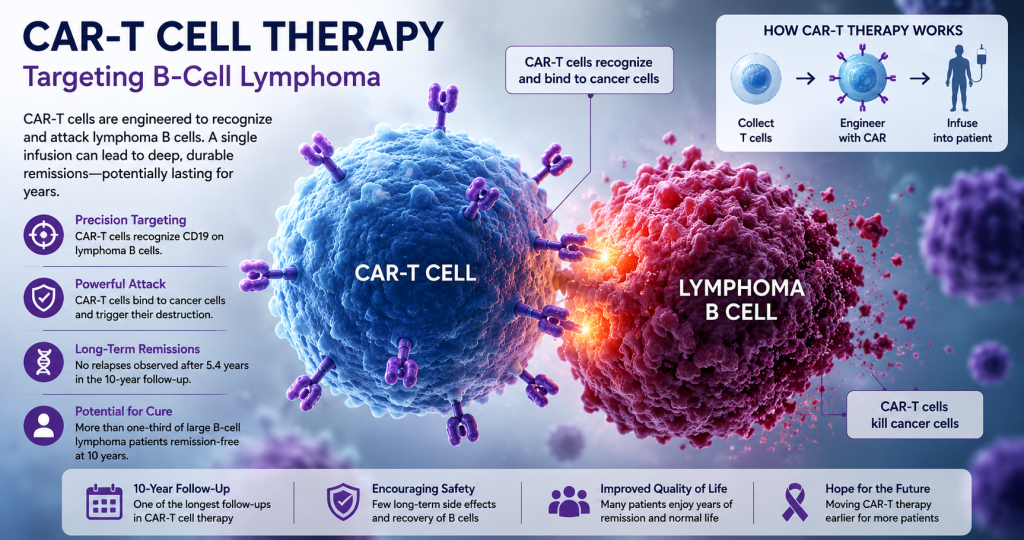
NEJM’s 10-year study confirms tisagenlecleucel CAR T-cell therapy can achieve lasting remissions and potential cures in advanced B-cell lymphomas, supporting earlier use in treatment pathways
Written By: Farha Farheen, Pharm D
Reviewed By: Pharmacally Editorial Team
A landmark 10-year follow-up study published in the New England Journal of Medicine has demonstrated the remarkable long-term success of tisagenlecleucel, the first FDA-approved CAR T-cell therapy, originally developed by Carl June, MD, and colleagues at the University of Pennsylvania. The findings provide some of the strongest evidence to date that CAR T-cell therapy can produce durable, potentially curative responses in patients with advanced B-cell lymphomas.
The study analyzed outcomes from the Phase II clinical trials (NCT02030834 and NCT01029366), including 38 patients comprising 24 with large B-cell lymphoma and 14 with follicular lymphoma. These patients had heavily pretreated, relapsed or refractory disease and had received a median of four prior therapies, including chemotherapy and autologous stem cell transplantation. After a single infusion of tisagenlecleucel, more than one-third of patients with large B-cell lymphoma and nearly half of those with follicular lymphoma remained alive and free from disease recurrence 10 years later.
A key finding was that the risk of relapse was concentrated within the first year after treatment. No patient experienced disease recurrence beyond 5.4 years following infusion. This observation suggests that patients who remain cancer-free for several years after treatment have a high likelihood of maintaining long-term remission, supporting the possibility that CAR T-cell therapy has the potential to cure a meaningful proportion of patients with B-cell lymphomas.
While oncologists traditionally use the term “cure” cautiously, senior author Stephen J. Schuster noted that the long-term outcomes increasingly support the view that CAR T-cell therapy has the potential to cure a meaningful number of patients with B-cell lymphomas. However, researchers emphasized that additional work is needed to understand why some patients do not respond or eventually relapse, with the goal of developing more effective next-generation CAR T-cell therapies.
Biological Insights
The study also provided important biological insights. Long-term remission was associated with the sustained persistence of CAR T-cells in the bloodstream during the first two years after treatment. Patients with durable responses consistently maintained detectable levels of CAR T-cells over time, suggesting that ongoing immune surveillance may be more important than a large initial expansion of the cells immediately after infusion.
Long-Term Safety
Long-term safety results were encouraging. Only two patients experienced persistent grade 2 or 3 neutropenia, while no cases of ongoing anemia or thrombocytopenia were observed. More than half of the long-term responders regained normal B-cell function without recurrence of lymphoma, indicating meaningful recovery of normal immune function.
No participants developed investigator-assessed CAR T-cell-related lymphoma during the decade-long follow-up. Although nine patients developed secondary primary cancers, including acute myeloid leukemia, prostate cancer, lung cancer, melanoma, and cutaneous T-cell lymphoma, researchers concluded that these events were consistent with the known long-term risks associated with prior intensive chemotherapy and stem cell transplantation rather than the CAR T-cell therapy itself. Notably, all three patients who developed acute myeloid leukemia had genetic features characteristic of prior therapy-related disease.
Future Directions
Encouraged by these results, lead author Marco Ruella highlighted ongoing efforts to move CAR T-cell therapy into earlier treatment settings, before patients accumulate the long-term toxicities of multiple chemotherapy regimens. Current research is also exploring whether lymphodepleting chemotherapy before CAR T-cell infusion can be reduced or avoided. The study provides compelling evidence that tisagenlecleucel can deliver durable, long-term remissions and potential cures for patients with relapsed or refractory B-cell lymphomas.
Although the findings are highly encouraging, they are based on a relatively small cohort of 38 patients. Nevertheless, the unprecedented 10-year follow-up offers some of the strongest evidence to date supporting the long-term curative potential of CAR T-cell therapy in selected patients.
What This Means for Patients
For people with relapsed or refractory B-cell lymphoma, these 10-year findings offer renewed hope that a single infusion of tisagenlecleucel CAR T-cell therapy may provide long-lasting disease control and, for some patients, the possibility of a cure. More than one-third of patients with large B-cell lymphoma and nearly half of those with follicular lymphoma were still alive without their cancer returning 10 years after treatment. Importantly, no patient experienced a relapse after 5.4 years, suggesting that patients who remain cancer-free for several years are likely to stay in remission. The treatment also showed an encouraging long-term safety profile, with few persistent side effects and recovery of normal immune function in many long-term responders. These results support the use of CAR T-cell therapy earlier in the treatment journey, giving more patients the opportunity to benefit before undergoing multiple rounds of chemotherapy and their associated long-term side effects.
Reference
Ten-Year Outcomes after CAR T-Cell Therapy for B-Cell Lymphomas | New England Journal of Medicine
10-year remissions with CAR T therapy in B-cell lymphoma | Penn Medicine

About the Writer
Farha Farheen, PharmD (LinkedIn) is a pharmacy professional with a strong interest in pharmacovigilance and clinical research. She has completed her Doctor of Pharmacy (Pharm.D) along with her internship as a Clinical Pharmacist. She has hands-on experience in adverse drug reaction (ADR) reporting, safety data documentation, and pharmacovigilance workflows, and is proficient in using VigiFlow. She is also a patent holder for an antibacterial formulation enriched with bioactive substances, granted by the German Patent and Trademark Office.