
Post hoc CARES-310 data show camrelizumab plus rivoceranib improved PFS across age groups and OS versus sorafenib in unresectable HCC.
Written By: Creola Gonsalves, MS Biotech
Reviewed By: Pharmacally Editorial Team
Elevar Therapeutics reported post hoc CARES-310 findings showing that camrelizumab plus rivoceranib improved progression-free survival across age subgroups and overall survival in patients younger than 50 years and those aged 50 years or older with unresectable hepatocellular carcinoma (HCC).
Age-Consistent Efficacy in CARES-310
The combination of the anti-PD-1 antibody camrelizumab and the VEGFR-2-targeting tyrosine kinase inhibitor rivoceranib produced longer progression-free survival (PFS) than sorafenib across age groups in the Phase 3 CARES-310 study (NCT03764293).
Among patients younger than 50 years, median PFS was 5.5 months with camrelizumab plus rivoceranib versus 2.7 months with sorafenib (HR 0.53; 95% CI, 0.37-0.77; one-sided P=0.0004). Patients aged 50 years or older had median PFS of 6.2 versus 3.7 months, respectively (HR 0.56; 95% CI, 0.45-0.72; P<0.0001).
In the smaller subgroup younger than 40 years, median PFS was 5.5 versus 2.2 months (HR 0.56; 95% CI, 0.29-1.12; one-sided P=0.0485). Although the reported one-sided P value was below 0.05, the 95% CI crossed 1.00, indicating greater uncertainty around the treatment-effect estimate in this smaller subgroup.
Overall survival (OS) also favored the combination in the two larger age groups. Median OS was 21.5 versus 15.2 months among patients younger than 50 years (HR 0.70; 95% CI, 0.47-1.06; P=0.0445) and 23.9 versus 15.2 months in patients aged 50 years or older (HR 0.60; 95% CI, 0.47-0.77; P<0.0001).
Patients younger than 40 years had a numerically longer median OS of 24.2 versus 15.2 months, although the difference was not statistically significant (HR 0.82; 95% CI, 0.40-1.72; P=0.2982). Median follow-up was 22.1 months, and all reported P values were one-sided.
Dual-Mechanism Approach in HCC
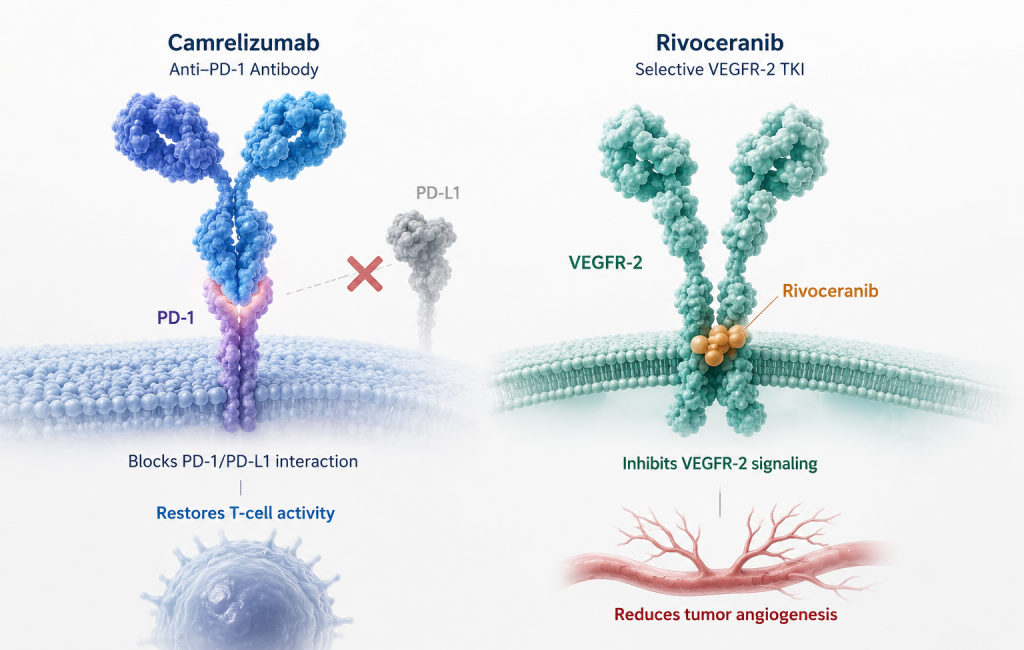
Camrelizumab is a humanized monoclonal antibody that blocks the programmed death-1 (PD-1) receptor, restoring antitumor T-cell activity by disrupting PD-1 signaling.
Rivoceranib is an oral selective vascular endothelial growth factor receptor 2 (VEGFR-2) tyrosine kinase inhibitor. VEGFR-2 blockade suppresses signaling that promotes tumor angiogenesis, providing a complementary mechanism to immune checkpoint inhibition.
HCC frequently develops in the setting of chronic liver inflammation and remains a major cause of cancer mortality worldwide, particularly when disease is unresectable and requires systemic treatment.
Safety Remained Consistent Across Age Groups
Treatment-related adverse events were similar across the analyzed age subgroups. Hypertension was the most common grade 3-4 treatment-related adverse event occurring in at least 5% of patients receiving camrelizumab plus rivoceranib, while palmar-plantar erythrodysesthesia syndrome was the corresponding event with sorafenib.
The exploratory analysis therefore showed a broadly consistent direction of PFS benefit across age groups, while the smaller younger-than-40 subgroup carried wider confidence intervals and greater statistical uncertainty.
FDA Review Remains a Key Development Milestone
The findings will be presented as poster #P-106 at the International Liver Cancer Association (ILCA) 2026 Annual Conference in Brussels. Arndt Vogel, M.D., Ph.D., scientist at the Toronto General Hospital Research Institute and medical oncologist at UHN-Princess Margaret Cancer Centre at the University of Toronto, will present the poster during the Sept. 4 Poster Tour.
The company is pursuing U.S. approval of camrelizumab plus rivoceranib for unresectable HCC. The regulatory process was delayed in July when the FDA issued a Complete Response Letter for the New Drug Application, citing deficiencies identified during an inspection of the manufacturing site.
Elevar is working with Hengrui Pharma to address the identified issues and prepare for resubmission. The CARES-310 age-subgroup analysis adds further clinical context as the companies work through that regulatory process.
Reference

About the Writer
Creola Gonsalves (Linkedin) is an M.S. Biotechnology postgraduate with a strong interest in clinical research, evidence interpretation, and healthcare writing, with a focus on translating life-science knowledge into meaningful real-world insights.
She is trained in Good Clinical Practice (GCP), clinical research principles, and critical interpretation of randomized clinical trials, with certifications from NIH and Stanford University.
Her research background in biotechnological applications and microbial research strengthens her ability to understand scientific evidence and develop clear, accurate, and research-driven healthcare content.