
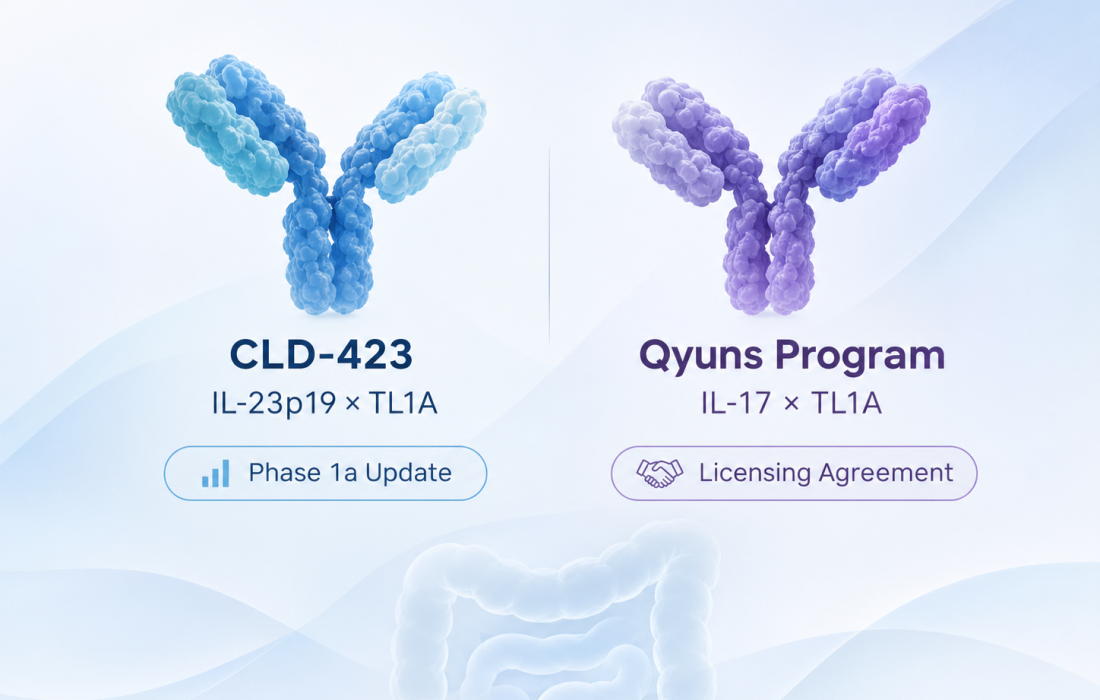
Caldera reports new CLD-423 Phase 1a results and licenses an IL-17 × TL1A bispecific antibody program from Qyuns to expand its immunology pipeline.
Written By: Mayuri Vaja, PharmD
Reviewed By: Pharmacally Editorial Team
Caldera Therapeutics has reported updated Phase 1a results for CLD-423, its investigational bispecific antibody targeting interleukin-23p19 (IL-23p19) and TL1A, supporting plans to advance the candidate into Phase 2 trials for ulcerative colitis (UC) and Crohn’s disease (CD) in 2027.
Alongside the clinical update, the company announced an exclusive worldwide development and commercialization licensing agreement with Qyuns Therapeutics for a preclinical-stage bispecific antibody program targeting IL-17 and TL1A. The agreement adds a second dual-target approach to Caldera’s immunology and inflammation (I&I) pipeline, broadening its strategy across immune-mediated diseases.
CLD-423 Phase 1a Results Show Favorable Safety and Tolerability
The first-in-human, randomized, placebo-controlled Phase 1a trial (ACTRN12625001454460) enrolled 56 healthy volunteers, including 42 participants who received CLD-423 and 14 who received placebo. Initiated in January 2026, the study evaluated intravenous (IV) and subcutaneous (SC) administration across five single ascending dose (SAD) cohorts and two multiple-dose cohorts, in which participants received two doses four weeks apart.
The latest interim analysis incorporates the fifth SAD cohort, both multiple-dose cohorts and extended follow-up. Caldera had previously reported data from the first four SAD cohorts in July 2026. Follow-up extended to 169 days in the longest SAD cohort and 85 days in the multiple-dose cohorts. Dosing has been completed, although participant follow-up continues.
CLD-423 was generally well tolerated, with no dose-limiting toxicities. Most adverse events (AEs) were mild (Grade 1) and considered unrelated to treatment. No treatment-emergent AEs above Grade 2 or deaths were reported.
Infections were uncommon and predominantly involved mild upper respiratory tract infections. One Grade 1 influenza event was considered treatment-related. A Grade 2 serious adverse event of stroke was assessed as unrelated to CLD-423 and resolved without sequelae. One participant discontinued treatment following a Grade 2 infusion-related reaction that did not meet the criteria for anaphylaxis.
Prolonged Half-Life and Sustained TL1A Inhibition Support Further Development
Pharmacokinetic assessments showed an estimated serum half-life exceeding 40 days following IV administration across the anticipated therapeutically relevant concentration range. Drug exposure increased approximately proportionally with dose, while mean estimated absolute SC bioavailability reached approximately 89%.
These findings support further evaluation of SC maintenance regimens administered every eight or twelve weeks, although such dosing schedules remain investigational.
Pharmacodynamic assessments demonstrated rapid TL1A target engagement, with free TL1A levels falling below the lower limit of quantification within two hours across evaluated dose levels and administration routes. Suppression was sustained following both single and multiple dosing.
Ex vivo whole-blood testing in two SAD cohorts also demonstrated sustained inhibition of TL1A-mediated signaling, consistent with the free TL1A findings.
Confirmed treatment-emergent anti-drug antibodies (ADAs) were detected in 8 of 42 CLD-423-treated participants. Antibody titers were borderline or low-to-moderate, with responses first detected approximately two to three months after initial dosing. No ADAs were observed while drug concentrations remained within the projected therapeutically relevant range, and no safety findings were attributed to immunogenicity.
Phase 2 Trials Planned in Ulcerative Colitis and Crohn’s Disease
Based on the Phase 1a findings, Caldera plans two Phase 2 studies in 2027.
The global Phase 2b UC trial will use a double-blind, placebo-controlled, dose-ranging design, with clinical remission at the end of induction as its primary endpoint. The company plans to submit an Investigational New Drug (IND) application to the US Food and Drug Administration in the fourth quarter of 2026, with first-patient dosing anticipated in early 2027. Induction results are expected by the end of 2028.
The Phase 2a Crohn’s disease study will be an open-label, single-arm proof-of-concept trial conducted in China. It will assess safety and preliminary efficacy, with safety and endoscopic response at the end of induction among its primary endpoints. A Phase 1a healthy-volunteer bridging study is ongoing, with first-patient dosing anticipated in early 2027 and initial results expected in late 2027.
Qyuns License Adds IL-17 × TL1A Bispecific Antibody Program
The licensing agreement with Qyuns provides Caldera with exclusive worldwide development and commercialization rights to a preclinical-stage bispecific antibody program targeting IL-17 and TL1A.
The program combines two inflammatory pathways with different levels of clinical validation. IL-17 is an established therapeutic target with multiple FDA-approved therapies, while TL1A has emerged as an investigational target supported by human genetics, disease biology and clinical findings from I&I trials.
The addition extends Caldera’s strategy of developing multi-target biologics against therapeutically relevant inflammatory pathways. While CLD-423 is progressing towards patient studies in IBD, the newly licensed IL-17 × TL1A program remains at the preclinical stage.
Caldera has not yet disclosed the candidate’s name, detailed molecular characteristics, specific indications or development milestones. Further information is expected in 2027.
Corporate Developments and Pipeline Outlook
Separately, Caldera and Synlogic, Inc. have proposed an all-stock business combination through newly formed Sonic Holdco, Inc. Following completion, the combined entity intends to operate as Caldera Therapeutics and apply for listing on the NYSE American under the proposed ticker CALD.
The transaction is supported by an upsized concurrent private placement expected to generate approximately $278 million in gross proceeds from healthcare institutional investors and mutual funds. Closing is anticipated in early 2027, subject to customary conditions, including shareholder approvals and effectiveness of the registration statement.
Together, the CLD-423 clinical update and Qyuns licensing agreement represent two complementary developments in Caldera’s bispecific antibody strategy. The Phase 1a findings provide early pharmacological evidence supporting further clinical evaluation of dual IL-23p19 and TL1A inhibition, while the Qyuns agreement broadens the pipeline through a second target combination.
Whether these approaches translate into meaningful clinical benefits across immune-mediated diseases will depend on subsequent clinical and preclinical development.
Reference
Caldera Therapeutics Reports New CLD-423 Phase 1a Data and Expands Immunology and Inflammation Pipeline with Anti IL-17 x TL1A Bispecific Antibody Program, Caldera Therapeutics, 05 November 2026

About the Writer
Mayuri Vaja (Linkedin) is a Pharm.D professional with a strong interest in clinical research, pharmacovigilance, and medical writing, supported by certifications in pharmacovigilance and academic projects exploring AI in healthcare and drug safety.
With a growing focus on evidence-based healthcare and scientific communication, she is developing expertise in clinical research and translating healthcare evidence into clear, meaningful content.
As a Pharmacally healthcare writer, Mayuri is committed to creating accurate, research-driven, and clinically relevant healthcare content while continuously strengthening her professional skills.