
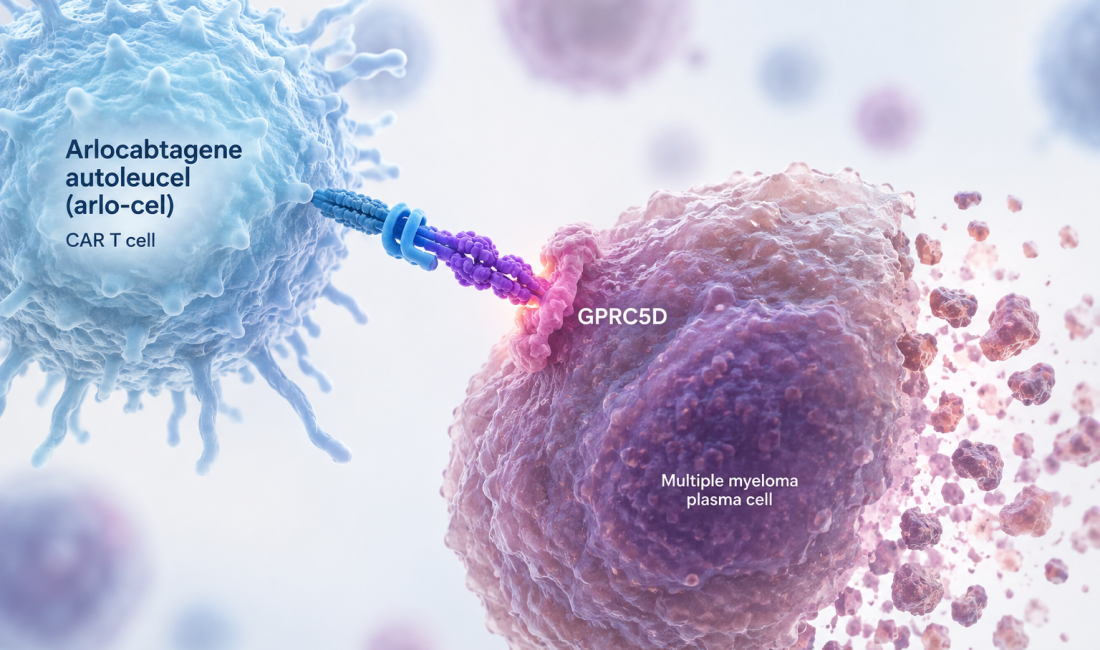
Bristol Myers Squibb’s GPRC5D CAR T therapy arlo-cel meets primary and secondary endpoints in the Phase 2 QUINTESSENTIAL trial for heavily pretreated multiple myeloma
Written By: Kirti Kumbar, M. Pharm (QA)
Reviewed By: Pharmacally Editorial Team
Bristol Myers Squibb reported positive topline results from the registrational Phase 2 QUINTESSENTIAL trial (NCT06297226) of arlocabtagene autoleucel (arlo-cel; BMS-986393), an investigational autologous GPRC5D-directed CAR T cell therapy, in heavily pretreated patients with quadruple-class exposed relapsed and refractory multiple myeloma (RRMM). The study met its primary endpoint of overall response rate (ORR) and its key secondary endpoint of complete response rate (CRR), supporting further development of a CAR T approach that targets GPRC5D after prior BCMA-directed treatment.
Targeting GPRC5D After BCMA Therapy
Multiple myeloma remains difficult to treat after patients develop resistance across several major therapeutic classes. In QUINTESSENTIAL, quadruple-class exposure included prior treatment with an immunomodulatory drug (IMiD), proteasome inhibitor (PI), anti-CD38 therapy and a BCMA-targeted therapy.
Arlo-cel targets G protein-coupled receptor class C group 5 member D (GPRC5D), a protein expressed on malignant plasma cells. Importantly, GPRC5D expression is independent of BCMA expression and can remain present after BCMA-directed treatment, providing a distinct target for patients whose disease has progressed following BCMA therapy.
The therapy uses the patient’s own T cells. Cells are collected from the blood, engineered to express a GPRC5D-directed chimeric antigen receptor, expanded during manufacturing and subsequently administered as a single CAR T cell infusion following lymphodepleting chemotherapy. Patients also receive bridging therapy when required.
QUINTESSENTIAL Meets Multiple Efficacy Endpoints
QUINTESSENTIAL is an open-label, multicenter, single-arm Phase 2 study evaluating arlo-cel in patients with quadruple-class exposed RRMM. The trial included patients who had received at least four prior lines of therapy, as well as patients treated with prior CAR T cell therapies.
The primary endpoint was ORR, defined as a partial response or better, among quadruple-class exposed patients who had received four or more prior lines of treatment. The study achieved this endpoint with a statistically significant and clinically meaningful response rate.
Arlo-cel also met the key secondary endpoint of CRR in this population. Additional key secondary endpoints, including ORR and CRR among quadruple-class exposed patients who had received three or more prior lines of therapy, were also met.
Bristol Myers Squibb reported that the safety profile was consistent with expectations for CAR T cell therapies and other GPRC5D-targeting treatments in multiple myeloma. Detailed efficacy, durability and safety data were not disclosed in the topline announcement.
Potential New Option for Heavily Pretreated Disease
Lynelle B. Hoch, president of the Cell Therapy Organization at Bristol Myers Squibb, said the increasing use of combination regimens is pushing more patients toward quadruple-class exposure and resistance earlier in their treatment journey. She highlighted GPRC5D as an alternative target to BCMA and the potential of cell therapy to address this emerging treatment gap.
Next Development Milestone
QUINTESSENTIAL is described by the company as the first pivotal trial evaluating a therapy specifically in quadruple-class exposed RRMM patients following prior BCMA-targeted treatment. Bristol Myers Squibb plans to present detailed QUINTESSENTIAL results at an upcoming medical meeting.
If supported by the full dataset and subsequent regulatory review, arlo-cel could expand the role of GPRC5D-directed CAR T therapy into a population with substantial prior treatment exposure and limited options after BCMA-targeted therapy.
Reference
Bristol Myers Squibb Announces Positive Topline Results from Registrational Phase 2 QUINTESSENTIAL Trial of the Potential First-in-Class GPRC5D-Directed CAR T Cell Therapy, Arlocabtagene Autoleucel, Bristol Myers Squibb, 08 September 2026
About the Writer
Kirti Kumbhar (LinkedIn) is an M.Pharm graduate with experience in Quality Assurance at Lupin Limited and a strong interest in clinical research, regulatory affairs, and Trial Master File (TMF) management. She has developed knowledge of regulatory documentation, quality systems, compliance, and healthcare research through her professional experience. Passionate about clinical development and continuous learning, Kirti is committed to supporting high-quality healthcare documentation, regulatory excellence, and research-driven healthcare advancements.