
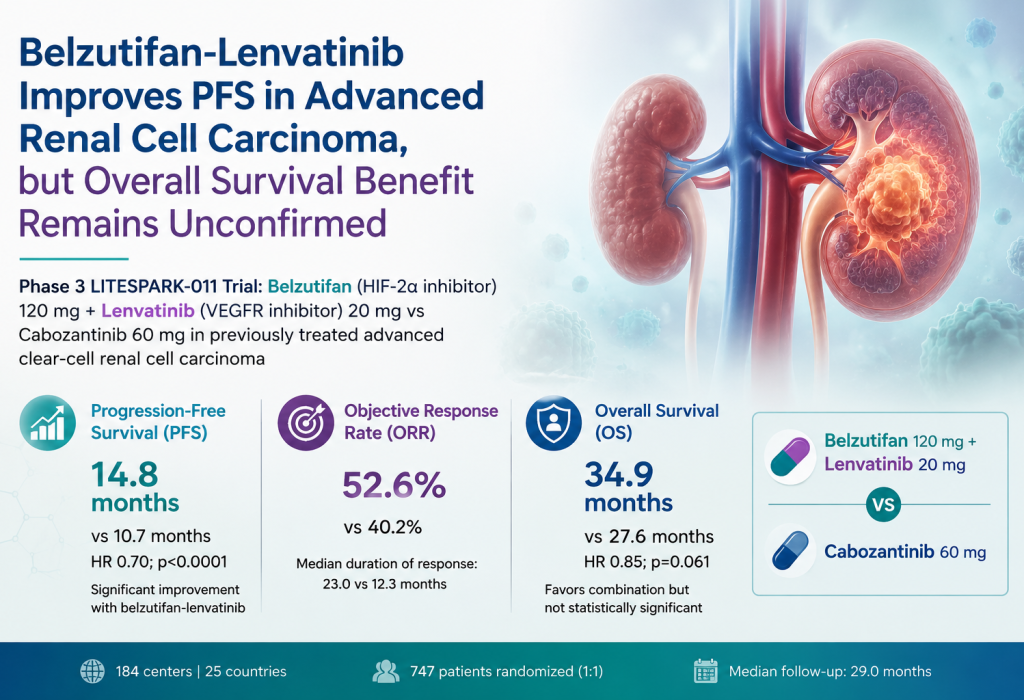
LITESPARK-011 showed belzutifan plus lenvatinib improved progression-free survival and objective response rates versus cabozantinib in advanced clear-cell renal cell carcinoma.
Written By: Shaik Yasmeen, PharmD
Reviewed By: Pharmacally Editorial Team
Belzutifan combined with lenvatinib significantly extended progression-free survival and increased objective response rates compared with cabozantinib in patients with advanced clear-cell renal cell carcinoma whose disease progressed after anti-PD-1 or anti-PD-L1 therapy. However, the combination did not produce a statistically significant overall survival benefit at the second interim analysis.
Phase 3 Trial Addresses Post-Immunotherapy Treatment Gap
Results from the phase 3 LITESPARK-011 trial (NCT04586231), published online in The Lancet on August 12, 2026, provide evidence for belzutifan plus lenvatinib in a treatment setting where the optimal approach after immune checkpoint inhibitor progression remains an unmet clinical need.
The open-label, randomised, active-controlled study enrolled adults with unresectable, locally advanced, or metastatic stage IV clear-cell renal cell carcinoma following progression on anti-PD-1 or anti-PD-L1 therapy, with or without previous VEGFR tyrosine kinase inhibitor exposure.
Investigators randomly assigned 747 patients to oral belzutifan 120 mg plus lenvatinib 20 mg once daily or cabozantinib 60 mg once daily. Treatment continued until disease progression or unacceptable adverse events. The trial was conducted at 184 medical centres across 25 countries.
Combination Improved PFS and Objective Responses
At the second interim analysis, with a median follow-up of 29.0 months, median progression-free survival was 14.8 months with belzutifan-lenvatinib versus 10.7 months with cabozantinib. The combination reduced the risk of disease progression or death by 30% (HR, 0.70; 95% CI, 0.59–0.84; one-sided P<0.0001).
The objective response rate was also higher with belzutifan-lenvatinib, reaching 52.6% compared with 40.2% with cabozantinib. The median duration of response was 23.0 months versus 12.3 months, respectively. The ORR difference was statistically significant at the first interim analysis; it was not retested at the second interim analysis under the prespecified statistical framework.
Overall survival favored the combination but did not cross the statistical significance threshold. Median overall survival was 34.9 months with belzutifan-lenvatinib versus 27.6 months with cabozantinib (HR, 0.85; 95% CI, 0.68–1.05; one-sided P=0.061). Further follow-up is ongoing.
Safety Required Frequent Dose Adjustments
Grade 3 or higher treatment-emergent adverse events occurred in 84% of patients receiving belzutifan-lenvatinib and 83% receiving cabozantinib. Hypertension was the most common grade 3 or higher adverse event, affecting 31% and 29% of patients, respectively. Treatment-related adverse events led to two deaths in the combination arm and one in the cabozantinib arm.
Dose reductions were common. Reductions occurred in 33% of patients for belzutifan and 66% for lenvatinib, compared with 77% for cabozantinib. Treatment discontinuation due to adverse events occurred in 11% of patients receiving the combination and 11% receiving cabozantinib.
HIF-2α and VEGFR Pathways Provide Complementary Activity
Belzutifan inhibits hypoxia-inducible factor 2α (HIF-2α), a transcription factor involved in tumour growth and angiogenic signalling in clear-cell renal cell carcinoma. Lenvatinib inhibits VEGFR and other receptor tyrosine kinases, providing complementary pathway inhibition.
The LITESPARK-011 findings support belzutifan-lenvatinib as a potential post-immunotherapy treatment option, particularly given its improvements in progression-free survival and tumour response. However, the absence of a statistically significant overall survival benefit means longer follow-up remains important before defining its definitive position as a new standard of care.
The trial has completed recruitment and remains ongoing for treatment and follow-up. Merck Sharp & Dohme, a subsidiary of Merck & Co., funded the study.
Reference

About the Writer
Shaik Yasmeen (LinkedIn) is a Pharm.D graduate with interests in clinical pharmacy, pharmacovigilance, and medical writing. She has gained experience through hospital clinical postings, patient case reviews, case presentations, and literature evaluation. Passionate about evidence-based healthcare, she is committed to creating accurate and engaging medical content while continuously expanding her professional knowledge.