
Bambusa Therapeutics reported positive Phase 1 data for BBT001 in moderate-to-severe atopic dermatitis, showing significant EASI improvement from Week 1, rapid itch relief, favorable safety, and potential once-every-three-month maintenance dosing.
Written By: Kirti Kumbhar, PharmD
Reviewed By: Pharmacally Editorial Team
Bambusa Therapeutics has reported encouraging preliminary Phase 1 results for its investigational bispecific antibody BBT001, showing rapid, statistically significant improvements in skin disease and itch in patients with moderate-to-severe atopic dermatitis (AD). The early clinical data also suggest a favorable safety profile, prolonged drug exposure, and the potential for maintenance dosing as infrequently as once every three months.
BBT001 Targets Two Key Drivers of Atopic Dermatitis
BBT001 is a half-life-extended bispecific antibody that simultaneously blocks interleukin-4 receptor alpha (IL-4Rα) and interleukin-31 (IL-31). IL-4Rα plays a central role in Type 2 inflammation that drives eczema, while IL-31 is strongly associated with chronic itch. By inhibiting both pathways, the therapy aims to control skin inflammation while providing rapid and durable itch relief.
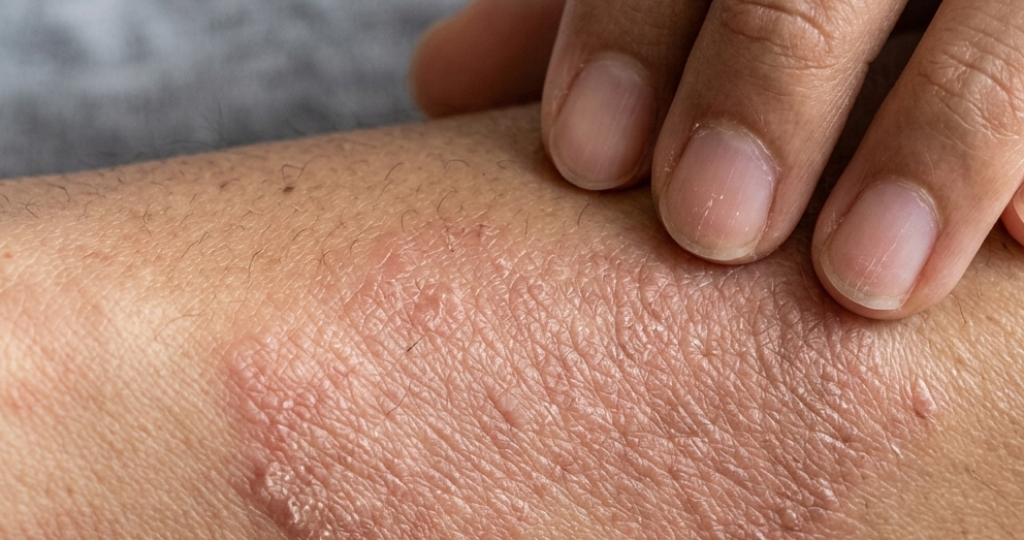
Atopic dermatitis is a chronic inflammatory skin disease characterized by persistent eczema, severe itching, and recurrent flares. Although biologic therapies have improved treatment outcomes, many patients continue to seek faster symptom relief and longer dosing intervals.
Phase 1 Trial Demonstrated Early and Durable Clinical Responses
The findings come from an ongoing global, randomized, double-blind, placebo-controlled Phase 1 study (NCT06808477) evaluating intravenous and subcutaneous formulations of BBT001 in healthy volunteers and patients with atopic dermatitis.
The proof-of-concept cohort enrolled 17 biologic-naïve adults with moderate-to-severe AD, randomized 2:1 to receive either 450 mg intravenous BBT001 every two weeks for four weeks or placebo. The primary objectives were safety and tolerability, while exploratory endpoints assessed improvements in disease severity, itch, and Type 2 inflammatory biomarkers.
As of the June 8, 2026 data cutoff, all participants were evaluable, with a median follow-up of 71 days after the first dose.
BBT001 produced highly statistically significant placebo-adjusted reductions in Eczema Area and Severity Index (EASI) scores beginning at Week 1, with responses strengthening throughout follow-up. Placebo-adjusted EASI improvements reached:
- 35.6% at Week 1 (p=0.0012)
- 61.1% at Week 2 (p<0.0001)
- 63.5% at Week 4 (p<0.0001)
- 79.0% at Week 6 (p<0.0001)
Clinical responses were accompanied by meaningful improvements in responder rates. By Week 4, placebo-adjusted EASI-50 and EASI-75 responses reached 91% and 45%, respectively, increasing to 82% and 64% by Week 6.
Patients also experienced rapid itch relief. Improvements in the Peak Pruritus Numerical Rating Scale (PP-NRS) were observed as early as Day 1 after the first dose and continued to deepen throughout treatment, remaining durable for at least eight weeks after the final infusion.
Biomarker Suppression and Safety Support Long-Acting Potential
The therapy produced sustained reductions in key Type 2 inflammatory biomarkers, including thymus and activation-regulated chemokine (TARC) and immunoglobulin E (IgE), demonstrating prolonged suppression of inflammatory activity beyond the treatment period.
Safety findings remained favorable. Investigators reported that BBT001 was generally well tolerated, with no cases of conjunctivitis, a known adverse event associated with some therapies targeting the IL-4/IL-13 pathway.
The study also demonstrated an extended elimination half-life consistent with previous healthy volunteer data, supporting maintenance dosing as infrequently as once every three months. In addition, treatment-emergent anti-drug antibodies occurred infrequently, showed low titers, and demonstrated no apparent neutralizing activity, suggesting low immunogenicity.
Investigators Highlight Speed and Depth of Response
Eric Simpson, MD, Professor of Dermatology and Director of Clinical Research at Oregon Health & Science University, said the combination of rapid efficacy, durable itch control, favorable safety findings, and infrequent dosing could address several unmet needs that remain despite advances in biologic therapy for atopic dermatitis.
Principal investigator Michael Cameron, MD, noted that the consistency and magnitude of clinical improvement observed during the short treatment period exceeded expectations, particularly given the severity of disease among enrolled patients.
Bambusa Chief Executive Officer Shanshan Xu, MD, PhD, said the findings provide early clinical validation of the company’s long-acting bispecific antibody platform and support its strategy of simultaneously targeting complementary inflammatory pathways to improve patient outcomes.
Phase 2b Development Planned
Bambusa plans to present the complete dataset at an upcoming medical conference and rapidly advance BBT001 into a Phase 2b trial in patients with moderate-to-severe atopic dermatitis, evaluating maintenance dosing intervals of up to once every three months.
The company is also continuing randomized Phase 1 and Phase 2a studies evaluating both intravenous and subcutaneous formulations in atopic dermatitis and chronic spontaneous urticaria. Additional topline data from these studies, including longer-term outcomes in biologic-naïve and biologic-experienced patients, are expected during the first half of 2027.
Reference

About the Writer
Kirti Kumbhar (LinkedIn) is an M.Pharm graduate with experience in Quality Assurance at Lupin Limited and a strong interest in clinical research, regulatory affairs, and Trial Master File (TMF) management. She has developed knowledge of regulatory documentation, quality systems, compliance, and healthcare research through her professional experience. Passionate about clinical development and continuous learning, Kirti is committed to supporting high-quality healthcare documentation, regulatory excellence, and research-driven healthcare advancements.