
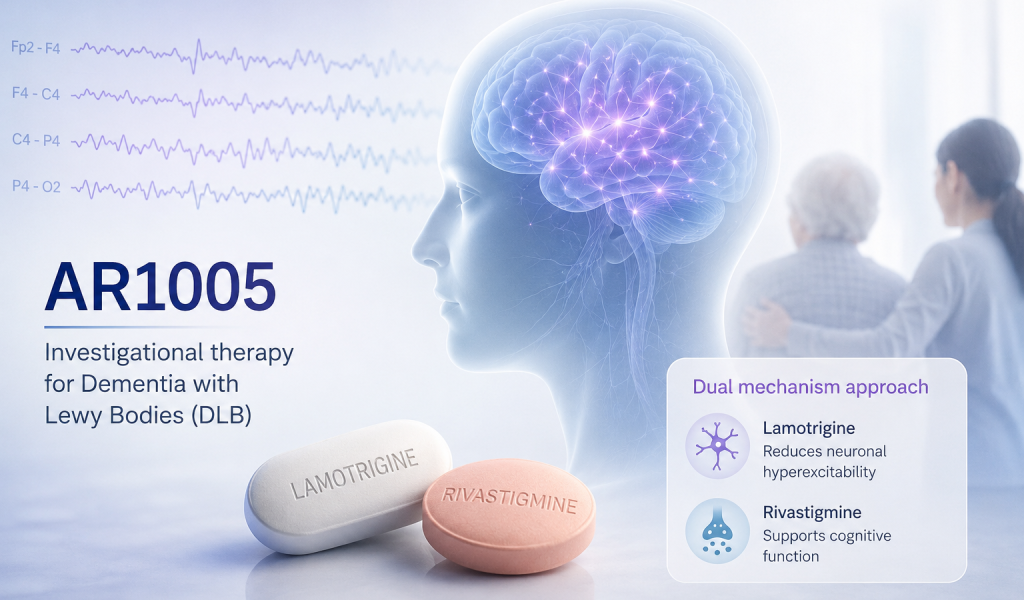
AriBio’s AR1005 significantly improved cognitive fluctuations in an interim Phase 2a DLB analysis, with favorable qEEG findings supporting further development.
Written By: Mayuri Vaja, PharmD
Reviewed By: Pharmacally Editorial Team
AriBio’s investigational AR1005 produced a statistically significant improvement in cognitive fluctuations among patients with dementia with Lewy bodies (DLB) in an interim Phase 2a analysis (NCT06537076). At Week 20, patients receiving AR1005 had a 1.15-point treatment difference on the Mayo Fluctuations Scale (MFS) versus placebo, favoring active treatment (95% CI, -2.17 to -0.12; p=0.030).
The findings, presented at the Alzheimer’s Association International Conference 2026 in London, provide early clinical evidence for targeting neuronal hyperexcitability in DLB, a neurodegenerative disorder characterized by cognitive decline, fluctuating cognition, visual hallucinations and parkinsonism.
Targeting Neuronal Hyperexcitability
AR1005 is an oral fixed-dose combination of lamotrigine and rivastigmine. Lamotrigine inhibits voltage-gated sodium channels and reduces excessive excitatory neurotransmission, while rivastigmine is an established treatment for cognitive symptoms.
The combination is being evaluated on the premise that excessive neuronal excitability contributes to cognitive and neuropsychiatric dysfunction in DLB. Cognitive fluctuations are particularly important clinically because changes in attention and alertness can substantially affect daily functioning and caregiver burden.
qEEG Findings Support Clinical Signal
The MFS result was accompanied by favorable quantitative electroencephalography (qEEG) findings. AR1005 reduced the theta-to-beta ratio (TBR), an EEG measure associated with cortical slowing in DLB.
The treatment difference in global TBR was -3.34 (p=0.039). Similar effects were observed in the central region (-3.41; p=0.042) and occipital region (-3.75; p=0.045), providing an objective electrophysiological correlate to the clinical finding.
AR1005 also showed a numerical 0.46-point advantage over placebo on the Clinical Dementia Rating-Sum of Boxes (CDR-SB) at Week 20, although this difference did not reach statistical significance. Favorable numerical trends emerged on the Korean Mini-Mental State Examination and Caregiver-Administered Neuropsychiatric Inventory.
Phase 2a Study Remains Ongoing
The randomized Phase 2a study (NCT06537076) is being conducted at Severance Hospital in South Korea and is expected to enroll 60 patients. The interim analysis included 31 participants and was performed before completion of enrollment.
The company did not report a complete safety dataset in the interim announcement. Final efficacy and safety analyses will follow completion of the study and assessment of all 60 participants.
Professor Byoung-Seok Ye, the study’s principal investigator, said the results provide early clinical support for further evaluating AR1005, particularly for cognitive fluctuations and quantitative EEG measures.
FDA Pathway Under Preparation
AriBio has begun preparing for a pre-IND meeting with the U.S. FDA. Managing Director Fred Kim said the company plans to use the complete Phase 2a dataset to inform the design and endpoints of a global Phase 2/3 program.
The final dataset will determine whether the interim signals in cognitive fluctuation and qEEG translate into a broader and clinically meaningful benefit, as well as clarify AR1005’s safety profile. For DLB, where therapeutic options remain limited, those results will be critical to determining the program’s next development step.
Reference
AriBio Reports Interim Phase 2a Results for AR1005 in Dementia with Lewy Bodies

About the Writer
Mayuri Vaja (Linkedin) is a Pharm.D professional with a strong interest in clinical research, pharmacovigilance, and medical writing, supported by certifications in pharmacovigilance and academic projects exploring AI in healthcare and drug safety.
With a growing focus on evidence-based healthcare and scientific communication, she is developing expertise in clinical research and translating healthcare evidence into clear, meaningful content.
As a Pharmacally healthcare writer, Mayuri is committed to creating accurate, research-driven, and clinically relevant healthcare content while continuously strengthening her professional skills.