
UAE approves ANKTIVA for BCG-unresponsive NMIBC and metastatic NSCLC after checkpoint inhibitor failure, expanding its regulatory footprint to 34 countries.
Written By: Nalam Karthik, PharmD
Reviewed By: Pharmacally Editorial Team
The Emirates Drug Establishment (EDE) has granted Marketing Authorization for two presentations of ANKTIVA® (nogapendekin alfa inbakicept), expanding the immunotherapy’s approved use to adults with BCG-unresponsive non-muscle invasive bladder cancer (NMIBC) and metastatic non-small cell lung cancer (NSCLC) that has progressed after checkpoint inhibitor-based treatment. The authorization marks the broadest regulatory approval for ANKTIVA to date and extends its global regulatory footprint to 34 countries.
The UAE becomes the first regulatory jurisdiction to approve ANKTIVA across the full spectrum of BCG-unresponsive NMIBC, including carcinoma in situ (CIS) with or without papillary tumors as well as papillary disease alone, a patient population with limited bladder-preserving treatment options.
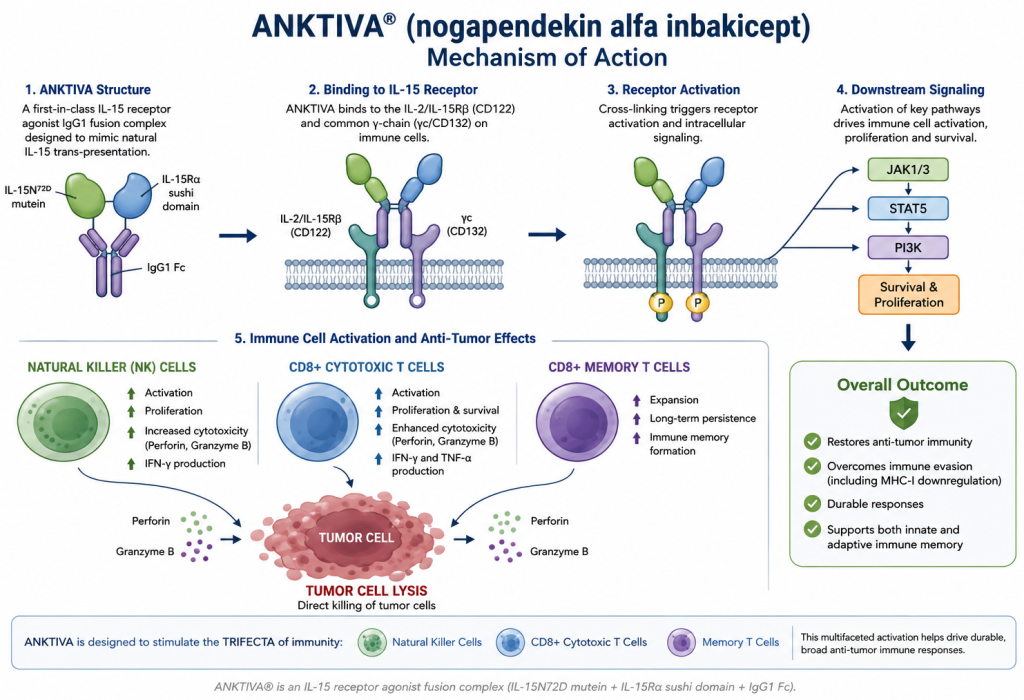
Mechanism of Action: Target Innate & Adaptive Immunity
ANKTIVA is a first-in-class IL-15 receptor agonist IgG1 fusion complex that activates natural killer (NK) cells, CD8-positive cytotoxic T cells, and memory T cells. By stimulating both innate and adaptive immune responses, the therapy aims to restore anti-tumor immunity, particularly in cancers that evade conventional T-cell-mediated immune surveillance.
Patients with BCG-unresponsive NMIBC often face radical cystectomy after failure of intravesical Bacillus Calmette-Guérin (BCG) therapy. Similarly, therapeutic options remain limited for metastatic NSCLC following progression on immune checkpoint inhibitors and chemotherapy.
Clinical Trial Foundations
NMIBC Cohorts: Registrational Phase 2/3 QUILT-3.032 Study
The NMIBC authorization is supported by the registrational Phase 2/3 QUILT-3.032 study (NCT03022825).
Among 100 patients with CIS with or without papillary tumors, ANKTIVA combined with BCG achieved a 71% complete response rate (95% CI: 61-80). Responses remained durable, with complete response durations extending beyond 54 months. At 12 months, 66% of responders maintained complete response, while 42% remained in complete response at 24 months.
In the papillary-only cohort (n=80), the combination produced a 58.2% disease-free survival rate at 12 months (95% CI: 46.6-68.2), a median disease-free survival of 25.3 months, and an 83.1% cystectomy-free rate at 36 months.
Treatment was generally well tolerated. Most treatment-related adverse events were Grade 1 or 2, Grade 3 events occurred in only 1% of patients, and no Grade 4 or Grade 5 treatment-related adverse events were reported.
Advanced NSCLC Cohort: Phase 2 QUILT-3.055 Study
The NSCLC approval is supported by the Phase 2 QUILT-3.055 study (NCT03228667), which evaluated ANKTIVA plus a checkpoint inhibitor in 79 patients with checkpoint-refractory advanced NSCLC.
The regimen achieved a median overall survival of 14.6 months (95% CI: 12.0-19.5). Patients who reached an on-treatment absolute lymphocyte count of at least 1,000 cells/µL experienced a longer median overall survival of 16.2 months compared with 11.8 months among those with lower lymphocyte counts. Common treatment-related adverse events included injection-site reactions, chills, fatigue, pyrexia, nausea, and influenza-like illness.
Leadership Highlights Broader Clinical Impact
ImmunityBio said the UAE approval reflects the growing clinical evidence supporting IL-15-based immunotherapy across multiple tumor types. Company leadership highlighted the significance of expanding bladder-preserving treatment options for patients with BCG-unresponsive NMIBC while extending the same immune activation strategy to metastatic NSCLC after checkpoint inhibitor failure.
The company also noted that both UAE approvals were supported by clinical data packages previously submitted to the U.S. Food and Drug Administration.
Authorization Details & Regional Expansion
The UAE authorization is valid through July 2031 and covers ANKTIVA 0.4 mg/0.4 mL for intravesical use with BCG in NMIBC and ANKTIVA 1.2 mg/0.6 mL for subcutaneous administration with immune checkpoint inhibitors in metastatic NSCLC. ImmunityBio plans to expand patient access across the Gulf region through its partnership with Modern Pharmaceutical Company, building on approvals already secured in the United States, United Kingdom, Saudi Arabia, the European Union, and now the United Arab Emirates.
Reference

About the Writer
Nalam Karthik (LinkedIn) is a healthcare writer and PharmD graduate with interests in pharmacovigilance, drug safety, clinical data analysis, and quality assurance. He is passionate about translating clinical and pharmaceutical knowledge into accessible healthcare content while staying engaged with advancements in drug development and patient safety initiatives.