
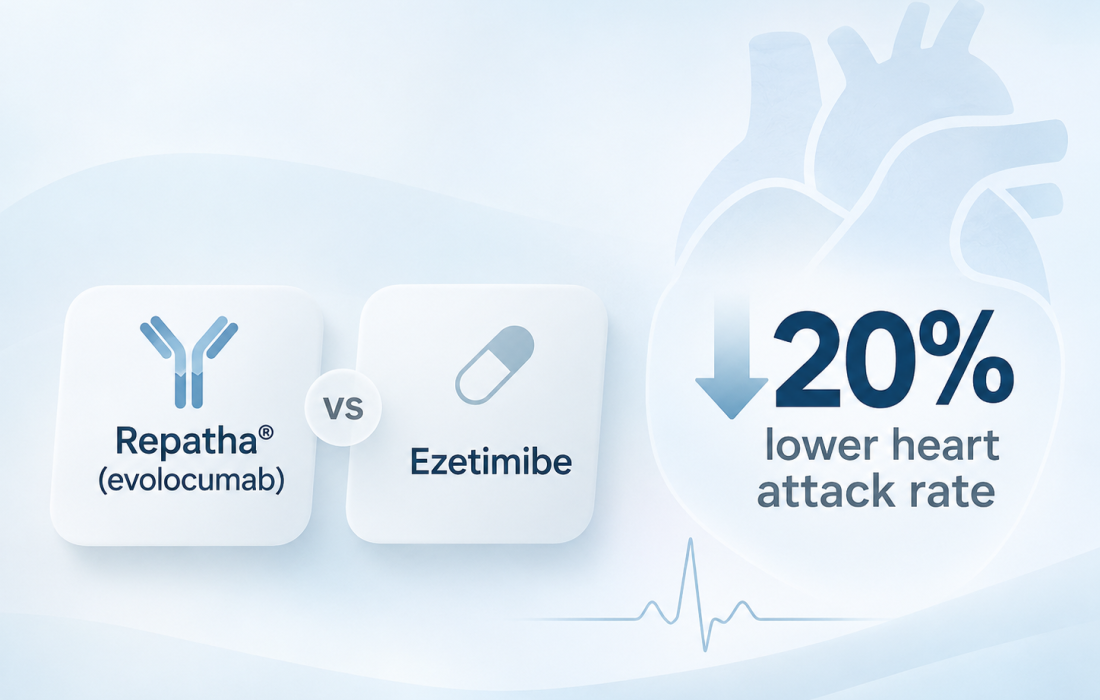
Amgen’s Repatha (evolocumab) was linked to a 20% lower heart attack rate than ezetimibe in a real-world study of 544,103 adults with ASCVD.
Amgen has announced findings from a large real-world study comparing Repatha® (evolocumab) with ezetimibe in adults with atherosclerotic cardiovascular disease (ASCVD) and a history of statin use. Published in the American Journal of Preventive Cardiology, the analysis found that patients initiating evolocumab had a 20% lower rate of fatal or nonfatal myocardial infarction (MI) than those initiating ezetimibe.
The findings provide comparative cardiovascular outcome evidence for two established non-statin lipid-lowering therapies, potentially informing treatment decisions for patients who require additional LDL cholesterol reduction.
Study Design and Patient Population
The retrospective, active-comparator, new-user cohort study used data from the US Komodo Healthcare Map database. It included 544,103 adults with ASCVD and prior statin use who initiated evolocumab or ezetimibe between 2017 and 2024.
Of these, 64,421 patients-initiated evolocumab, while 479,682 initiated ezetimibe. Researchers applied a target trial emulation framework and inverse probability weighting to balance measured baseline characteristics between the treatment groups. A calibrated estimator was also used to address incomplete availability of baseline low-density lipoprotein cholesterol (LDL-C) measurements.
The primary endpoint was fatal or nonfatal MI, with outcomes assessed over up to four years. Unlike a randomized controlled trial, treatment allocation was not randomised, leaving the possibility of residual confounding.
Evolocumab Associated With a 20% Lower MI Rate
The primary analysis showed that evolocumab initiation was associated with a 20% lower rate of fatal or nonfatal MI compared with ezetimibe (hazard ratio [HR]: 0.80; 95% confidence interval [CI]: 0.70–0.91).
Among 225,048 patients with available baseline LDL-C measurements, the weighted estimated four-year cumulative MI risk was 5.88% with evolocumab compared with 7.76% with ezetimibe. This represents an absolute difference of 1.88 percentage points.
A similar pattern emerged among the 319,055 patients without available baseline LDL-C measurements. Their weighted estimated four-year cumulative MI risks were 5.65% and 7.06%, respectively.
These estimates provide an additional perspective on the observed association. However, they are model-derived cumulative-risk estimates and should not be interpreted as directly observed event proportions over four years for every patient.
Sensitivity Analysis Supports Consistency
The association remained consistent in a prespecified sensitivity analysis that followed patients regardless of changes in background statin therapy. Evolocumab was associated with a 21% lower rate of MI than ezetimibe in this analysis (HR: 0.79; 95% CI: 0.72–0.87).
The consistency of the findings across the primary and sensitivity analyses supports the robustness of the observed association, although it does not eliminate the limitations of observational research.
Clinical Interpretation and Study Limitations
Evolocumab and ezetimibe lower LDL-C through different mechanisms. Evolocumab is a PCSK9 monoclonal antibody that increases LDL receptor availability, promoting LDL-C clearance from the circulation. Ezetimibe reduces intestinal cholesterol absorption.
The comparison is clinically relevant because it evaluates cardiovascular outcomes following initiation of two established non-statin therapies in routine clinical practice, rather than comparing evolocumab with placebo.
However, several limitations warrant consideration. The treatment groups differed substantially in size, and statistical weighting can balance measured characteristics but cannot fully account for unmeasured differences. Claims-based data may also lack information on treatment access, payer restrictions, statin intolerance, socioeconomic circumstances and patient preferences. Medication dispensing records do not necessarily confirm consistent treatment adherence.
Additionally, baseline LDL-C measurements were available for only 41.4% of the overall cohort. Although the researchers applied a calibrated estimator to address missing measurements, this remains an important consideration when interpreting the results.
Overall, the findings add real-world comparative evidence linking evolocumab initiation with a lower rate of fatal or nonfatal MI than ezetimibe in adults with established ASCVD and prior statin use. While the results may help inform non-statin treatment decisions, the observational design does not establish that evolocumab itself caused the lower MI rate or demonstrate universal treatment superiority. Further comparative evidence will be important in interpreting the clinical implications.
References
Repatha Lowers Risk of Heart Attacks by 20% Compared with Ezetimibe in a Large Real-World Study, Amgen, November 5, 2026.
Nihar Desai et al, Real-world comparative effectiveness of evolocumab versus ezetimibe in adults with atherosclerotic cardiovascular disease: an active-comparator new-user study, American Journal of Preventive Cardiology, 2026, 102577, https://doi.org/10.1016/j.ajpc.2026.102577

About the Writer
Aasritha Thippavajjala (Linkedin) is a pharm D student and aspiring medical writer with medical writing, clinical training experience and a strong interest in clinical research and patient safety She has hands-on exposure to clinical pharmacy activities including medication profile assessment, clinical case review, identification of potential drug-related problems, ADR awareness, patient counselling, and clinical documentation. She has also gained experience in medical literature review, evidence synthesis, and scientific communication through her published review article on digital twin-based patient simulation and her poster presentation at the 74th Indian Pharmaceutical Congress. Certified in ICH Good Clinical Practice (E6(R3)) and Scientific Writing in Health Research, she is passionate about applying her clinical knowledge and research skills to medical writing ,clinical research and contributing to accurate, evidence-based healthcare.