
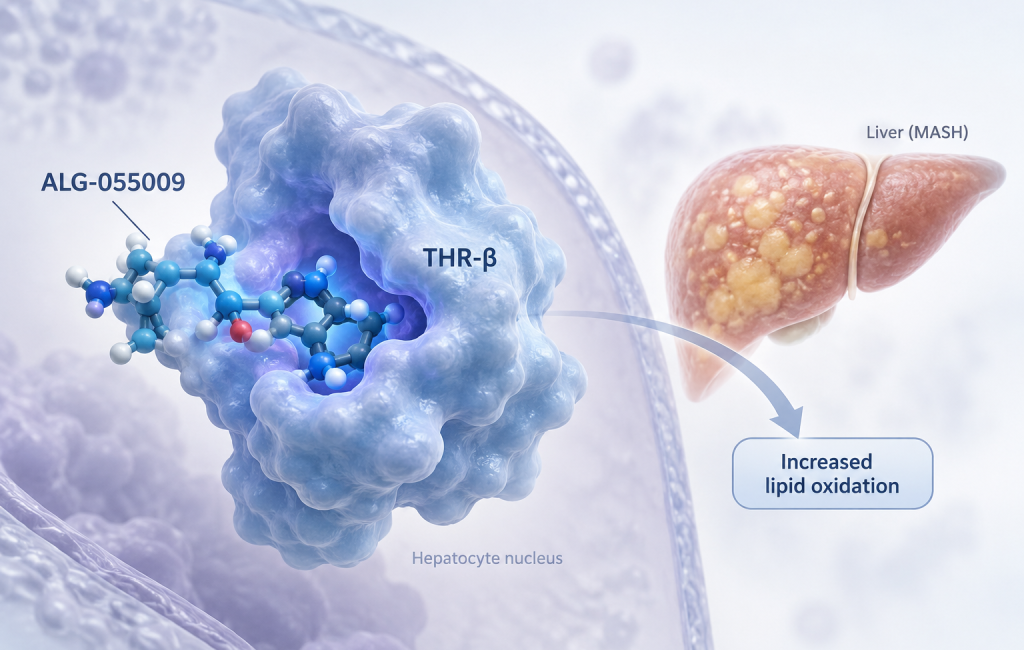
ALG-055009 significantly reduced liver fat in adults with MASH in the phase 2a HERALD trial, with strongest effects at 0.7 mg and 0.9 mg.
Written By: Mayuri Vaja, PharmD
Reviewed By: Pharmacally Editorial Team
Aligos Therapeutics’ oral THR-β agonist ALG-055009 significantly reduced liver fat in adults with non-cirrhotic metabolic dysfunction-associated steatohepatitis (MASH) in the phase 2a HERALD trial, with the strongest effects at 0.7 mg and 0.9 mg once daily. Published in The Lancet Gastroenterology & Hepatology, the 12-week study also showed reductions in atherogenic lipids and no clinically meaningful thyroid, laboratory, ECG, or other safety signals, supporting longer-duration studies focused on liver histology.
Strong liver-fat reduction at higher doses
HERALD enrolled 102 adults aged 18 to 75 years with presumed MASH and F1-F3 fibrosis across 39 US clinical sites. Participants received oral ALG-055009 at 0.3, 0.5, 0.7, or 0.9 mg, or placebo, once daily for 12 weeks. The 0.9 mg dose was restricted to participants weighing more than 85 kg to keep drug exposure within levels previously evaluated in phase 1.
The primary endpoint was relative change in liver fat measured by MRI-proton density fat fraction (MRI-PDFF). Placebo-adjusted least-squares mean reductions reached 18.5% with 0.5 mg (p=0.014), 33.2% with 0.7 mg (p<0.0001), and 31.6% with 0.9 mg (p=0.0001). The 0.3 mg dose produced a 14.3% placebo-adjusted reduction that did not reach statistical significance (p=0.067).
The 0.7 mg dose produced the clearest response: 70% of participants achieved at least a 30% reduction in liver fat, compared with 33.3% with placebo. The corresponding response rate was 58.8% with 0.9 mg. However, higher thresholds of at least 50% or 70% reduction, as well as normalization of liver fat to 5% or less, did not reach statistical significance versus placebo.
THR-β activation also improved lipid markers
ALG-055009 activates thyroid hormone receptor β, the predominant thyroid hormone receptor subtype in the liver. THR-β signaling regulates hepatic lipid metabolism and insulin sensitivity and promotes lipid oxidation. The drug showed four- to six-fold greater affinity for THR-β than THR-α in preclinical testing and was substantially more potent and selective than resmetirom in head-to-head in-vitro studies.
The trial also showed reductions in LDL cholesterol, lipoprotein(a), and apolipoprotein B, while sex hormone-binding globulin, a marker of hepatic THR-β engagement, increased in a dose-dependent manner. At 0.9 mg, SHBG increased by as much as 90% at week 12 without significant changes in measured sex hormones.
Safety Profile Supports Further Development
Treatment-emergent adverse events occurred in 45% to 65% of ALG-055009-treated participants across dose groups versus 73% with placebo. Most events were mild or moderate. Diarrhoea, fatigue, and constipation were the most common events. One serious adverse event occurred in the placebo group, and no deaths were reported. Gastrointestinal adverse-event rates were similar to placebo, with no clinically meaningful changes in laboratory tests, ECGs, vital signs, physical examinations, or thyroid function.
Histological Benefit Remains to Be Established
The study remains an early efficacy signal rather than evidence of disease modification. HERALD lasted only 12 weeks, enrolled a small population, and did not use liver biopsy to assess histological response. The authors therefore state that ALG-055009’s efficacy and safety require confirmation in larger, longer studies involving biopsy-defined MASH.
The next development step is extended dosing to determine whether the marked MRI-PDFF reductions translate into improvements in MASH activity and fibrosis on liver histology. The exposure-response relationship observed in HERALD, together with the predictable pharmacokinetic profile, supports further evaluation of the 0.7-0.9 mg dose range in longer-duration studies.
Reference
Loomba R, Wang S, Desai D et al., ALG-055009 in non-cirrhotic adults with metabolic dysfunction-associated steatohepatitis (HERALD): a randomised, double-blind, placebo-controlled, phase 2a trial, The Lancet Gastroenterology & Hepatology, 2026; 0, https://doi.org/10.1016/S2468-1253(26)00154-8

About the Writer
Mayuri Vaja (Linkedin) is a Pharm.D professional with a strong interest in clinical research, pharmacovigilance, and medical writing, supported by certifications in pharmacovigilance and academic projects exploring AI in healthcare and drug safety.
With a growing focus on evidence-based healthcare and scientific communication, she is developing expertise in clinical research and translating healthcare evidence into clear, meaningful content.
As a Pharmacally healthcare writer, Mayuri is committed to creating accurate, research-driven, and clinically relevant healthcare content while continuously strengthening her professional skills.