
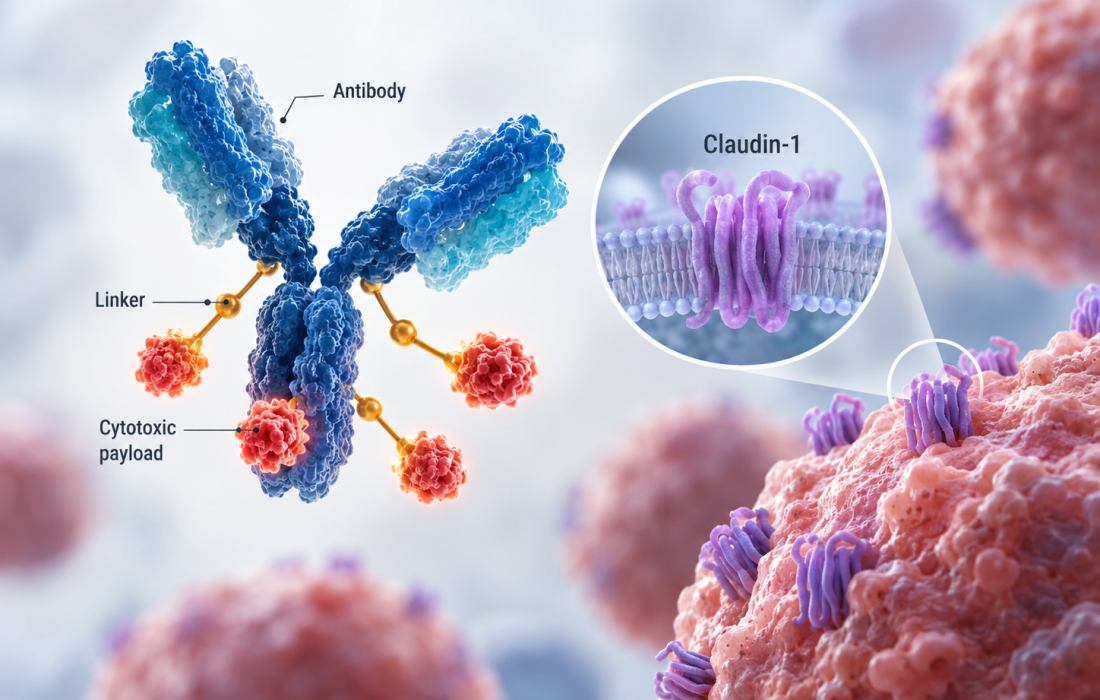
Alentis Therapeutics and PinotBio expand their collaboration to develop next-generation claudin-1-targeted ADCs using novel linker and payload technologies for cancer.
Written By: Rishabh Sonawane, BPharm
Reviewed By: Pharmacally Editorial Team
Alentis Therapeutics and PinotBio have entered a research collaboration and licensing agreement to develop next-generation antibody-drug conjugates (ADCs) targeting claudin-1, a protein overexpressed across more than 10 tumor types. The partnership combines Alentis’ clinical-stage claudin-1 antibody portfolio with PinotBio’s linker and payload technologies to explore ADC candidates that could address treatment resistance, limited responses and toxicity.
Combining Claudin-1 Targeting with ADC Technology
Claudin-1 is a cell-junction protein that can become overexpressed in several cancers, making it a potential target for antibody-based therapies. Alentis is developing claudin-1-targeted treatments across oncology and fibrosis, with two investigational ADC candidates already in Phase 1/2 clinical studies.
ADCs combine a monoclonal antibody with a cytotoxic drug through a chemical linker. The antibody helps direct the payload toward cells expressing the target, while the linker influences drug stability, release and delivery. The choice of payload also affects antitumor activity and toxicity.
PinotBio will contribute its PINOT-ADC® platform, which provides a range of linkers and payloads for ADC development. By pairing these technologies with Alentis’ antibody portfolio, the companies plan to explore new ADC constructs with different drug-delivery properties and potential activity against tumors that respond poorly to existing approaches.
Agreement Gives Alentis an Option to License Technologies
Under the agreement, Alentis will hold an exclusive option to license novel linkers and/or payloads from PinotBio for use in selected development candidates.
PinotBio will receive an upfront payment, followed by development, regulatory and commercial milestone payments, as well as royalties on net sales for each ADC candidate Alentis elects to develop. The companies did not disclose the financial terms or specify the number of candidates covered by the collaboration.
The agreement expands an existing research relationship during which the companies evaluated dozens of ADC constructs. According to Alentis CEO Dr. Mark Pruzanski, that work provided an opportunity to assess PinotBio’s scientific capabilities and execution. The expanded collaboration reflects the companies’ intention to build on those findings by exploring additional combinations of antibodies, linkers and payloads.
PinotBio CEO Dr. Doo Young Jung highlighted the platform’s flexibility in combining linker and payload technologies to address limitations associated with earlier ADC approaches, including inadequate responses, treatment resistance and toxicities.
Clinical Programs Provide a Foundation for Expansion
Alentis’ oncology portfolio includes ALE.P02, which carries a tubulin inhibitor payload, and ALE.P03, which uses a topoisomerase I inhibitor payload. Both candidates target claudin-1 and are being evaluated in Phase 1/2 studies enrolling patients with various claudin-1-expressing solid tumors.
The US Food and Drug Administration has granted Fast Track designation to ALE.P02 for advanced or metastatic claudin-1-expressing squamous cancers, regardless of the organ of origin. The designation supports development and regulatory interaction for a candidate addressing a serious condition with potential to meet an unmet medical need. It does not establish clinical efficacy or guarantee approval.
The existing programs provide a clinical foundation for the collaboration, but the source announcement does not identify specific new candidates, trial timelines or development milestones arising from the expanded agreement.
Clinical and Development Implications
The collaboration highlights a strategy for expanding ADC development beyond antibody selection alone. Optimizing the linker and payload may influence therapeutic activity, tolerability and the ability to overcome resistance, although these benefits remain to be demonstrated for any new claudin-1 candidates emerging from the partnership.
Claudin-1 expression across multiple tumor types offers a potential route to broader oncology development. However, expression alone does not establish that a tumor will respond to treatment. Future clinical studies will need to determine whether target expression predicts benefit, which patient populations are most likely to respond, and whether the resulting ADCs can achieve an acceptable balance between antitumor activity and toxicity.
Reference
Alentis and PinotBio announce collaboration to develop next-generation ADCs targeting claudin-1, Alentis Therapeutics, 14 October 2026

About the Writer
Rishabha Sonawane, B.Pharm (LinkedIn) is healthcare writer with a strong interest in medical writing, regulatory affairs, clinical research, and AI-driven drug discovery. He has completed specialized training from the NIH and ICMR in clinical pharmacology, clinical research, and scientific writing. Passionate about evidence-based healthcare communication, he focuses on translating complex scientific research into clear, accurate, and engaging medical content.