
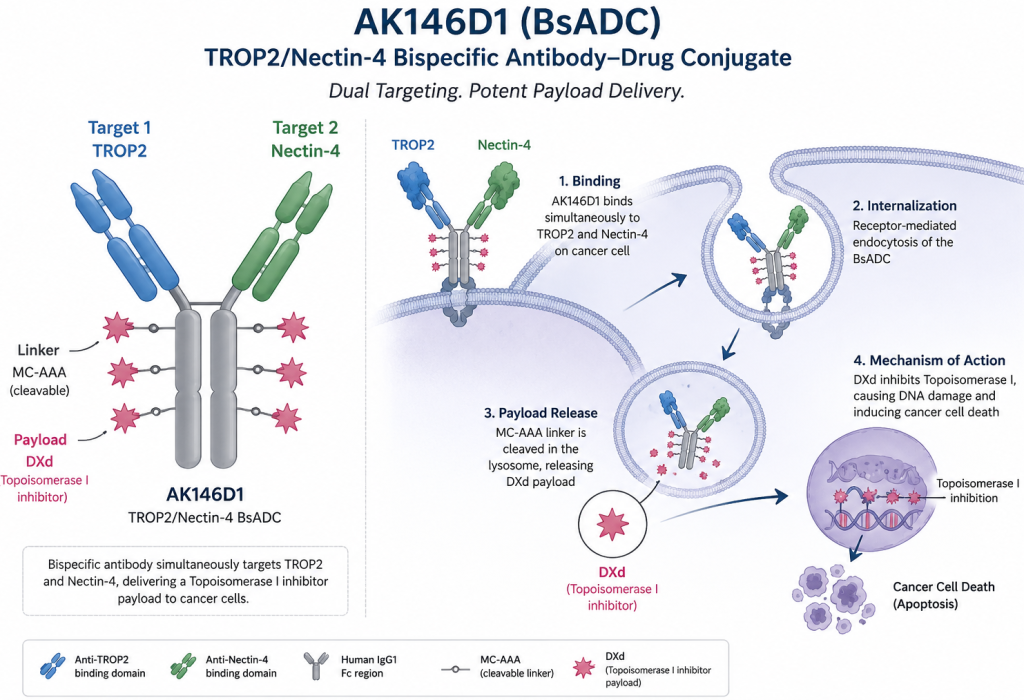
Akeso has dosed the first patient in a Phase II trial evaluating AK146D1, a TROP2/Nectin-4 bispecific ADC, with ivonescimab in advanced breast cancer.
Written By: Anshu Gupta, PharmD
Reviewed By: Pharmacally Editorial Team
Akeso has dosed the first patient in a Phase II clinical trial evaluating AK146D1, a TROP2/Nectin-4 bispecific antibody-drug conjugate (bsADC), in combination with ivonescimab, its PD-1/VEGF bispecific antibody, in patients with advanced breast cancer. The study, AK146D1-202, focuses on first-line treatment strategies for hormone receptor-positive/HER2-negative (HR+/HER2-) breast cancer and triple-negative breast cancer (TNBC).
Dual-Target ADC Enters Combination Development
AK146D1 combines simultaneous targeting of TROP2 and Nectin-4 with delivery of a topoisomerase I inhibitor payload. The bsADC utilizes a cleavable MC-AAA (maleimidocaproyl-alanine-alanine-alanine) linker to connect its bispecific antibody component to the DXd payload.
TROP2 and Nectin-4 are established therapeutic targets in breast cancer; however, resistance, tumor heterogeneity, and cumulative toxicities associated with conventional ADCs remain critical clinical challenges. Immunotherapy also demonstrates limited activity in select patient cohorts, particularly those with PD-L1-negative disease or resistance to prior PD-1-directed therapy.
Akeso is evaluating whether combining dual-antigen targeted ADC cytotoxicity with complementary immune and angiogenic pathway blockade can enhance antitumor activity while maintaining tolerability.
Phase II Study Tests “IO 2.0 + ADC 2.0” Strategy
The Phase II AK146D1-202 study (NCT07591090) assesses AK146D1 alongside ivonescimab in advanced breast cancer settings, emphasizing first-line HR+/HER2- and TNBC patient populations.
Specific enrollment targets, primary endpoints, and preliminary safety or efficacy outcomes have not yet been disclosed by Akeso. Consequently, the clinical benefit and tolerability profile of this combination remain strictly investigational.
The trial builds on early clinical data (NCT07067567) for AK146D1 demonstrating potent antitumor activity and a manageable safety profile. Ivonescimab has previously demonstrated clinical efficacy across multiple Phase III studies compared against PD-1 inhibitor-based standard care.
Broader Bispecific and ADC Pipeline Integration
The AK146D1 breast cancer program forms part of Akeso’s broader “IO 2.0 + ADC 2.0” platform, designed to combine multi-target immuno-oncology agents with next-generation ADCs.
Akeso is also evaluating AK146D1 in combination with cadonilimab (PD-1/CTLA-4 bispecific) and ivonescimab across a basket Phase II trial in solid tumors. Additionally, the company is investigating AK138D1, a next-generation HER3-directed ADC, combined with ivonescimab in a Phase Ib/II trial. Its expanding ADC pipeline—comprising AK146D1, AK138D1, AK157D1, and AK158D1 aims to overcome therapeutic window and toxicity constraints associated with conventional monovalent ADCs.
Path Forward in Advanced Breast Cancer
Akeso is advancing multiple ivonescimab-based combination therapies in breast cancer, including an ongoing Phase III trial in first-line TNBC following encouraging Phase II results.
For AK146D1, the immediate milestone will be generating clinical proof-of-concept for the TROP2/Nectin-4 bsADC plus ivonescimab in the AK146D1-202 trial. Results will determine whether simultaneous dual-antigen targeting and targeted payload delivery can synergize with dual immune checkpoint and anti-angiogenic blockade.
Reference

About the Writer
Anshu Gupta (LinkedIn) is a PharmD professional and healthcare writer with interests in clinical research, pharmacovigilance, regulatory affairs, and medical writing. She has presented research at academic conferences and completed certifications in Good Clinical Practice (GCP), ICH-GCP, and drug safety. Passionate about clinical trials and evidence-based medicine, she is committed to translating scientific evidence into accurate, reliable, and accessible healthcare content.