
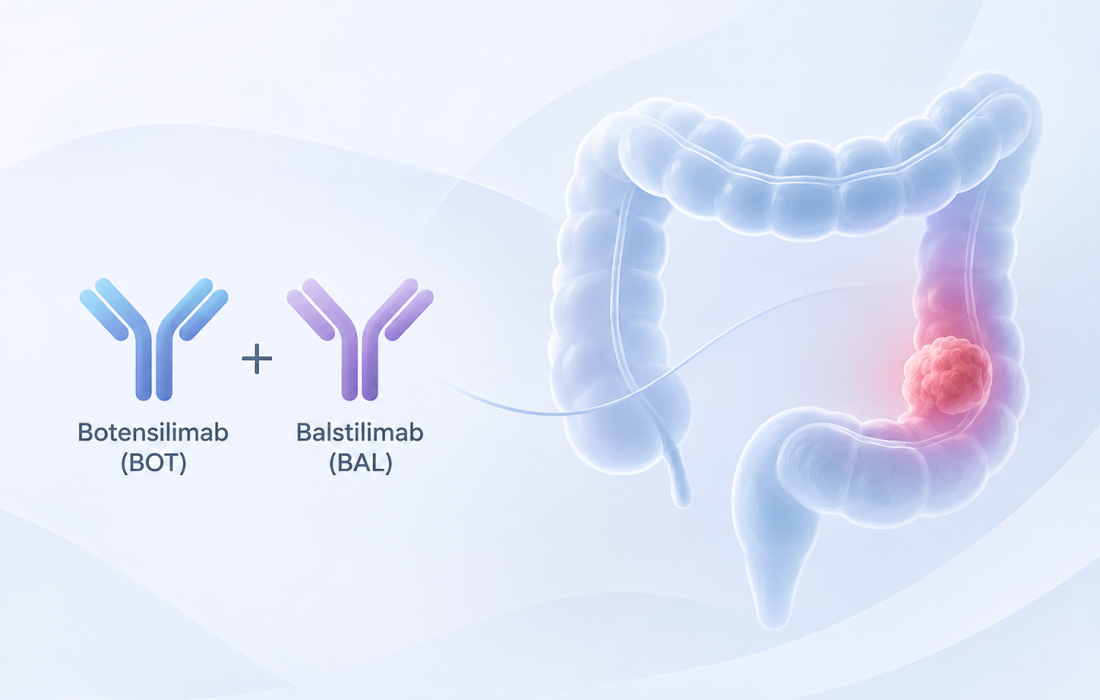
Agenus reports 36% major pathological response and 29% complete response with BOT+BAL in pMMR/MSS colon cancer in the Phase 2 UNICORN trial.
Written By: Sravani Pamanji, PharmD
Reviewed By: Pharmacally Editorial Team
Agenus has announced the publication of results from the multicenter Phase 2 UNICORN trial in Nature Medicine, evaluating neoadjuvant botensilimab (BOT), alone or in combination with balstilimab (BAL), in patients with resectable, locally advanced colon cancer.
The study investigated whether short-course immunotherapy administered before surgery could induce meaningful pathological responses in patients with mismatch repair-proficient/microsatellite stable (pMMR/MSS) and mismatch repair-deficient/microsatellite instability-high (dMMR/MSI-H) disease. The findings are particularly relevant to pMMR/MSS colon cancer, which has historically shown limited responsiveness to conventional immune checkpoint inhibitors.
Among patients receiving BOT+BAL, the major pathological response (pMR) rate reached 36% in pMMR/MSS disease, including a pathological complete response (pCR) rate of 29%. These findings provide an encouraging clinical signal in a population with limited established immunotherapy options.
UNICORN Phase 2 Trial: Study Design and Treatment Approach
UNICORN (NCT05845450) is an ongoing, multicenter, open-label, non-randomized Phase 2 window-of-opportunity trial sponsored by Fondazione GONO. The published analysis covered four sequentially enrolled treatment cohorts comprising 56 patients, with 14 patients in each cohort. Enrollment took place between June 2023 and July 2024.
Patients received BOT, a multifunctional Fc-enhanced anti-CTLA-4 antibody, either alone or with BAL, an anti-PD-1 antibody. BOT monotherapy was administered at 1 mg/kg on Day 1. The combination regimen included BOT 1 mg/kg on Day 1 and BAL 3 mg/kg on Days 1 and 15. Surgery was planned for Day 35 ± 5 days.
The primary endpoint was centrally assessed pMR, defined as 10% or less residual viable tumour at surgery. The sequential cohort design did not provide a randomized comparison between treatment regimens.
Key Results: Pathological Responses Across Treatment Cohorts
The study met its primary endpoint in three of the four cohorts, with the exception of the pMMR/MSS BOT monotherapy cohort.
In pMMR/MSS disease, BOT+BAL achieved a 36% pMR rate, including pCR in 29% of patients. Another 36% achieved a pathological partial response (pPR), defined as more than 10% and up to 50% residual viable tumour. By comparison, BOT monotherapy produced pPR in 43% of patients, but none achieved pMR or pCR.
In dMMR/MSI-H disease, the combination demonstrated a 100% pMR rate, with 13 of 14 patients (93%) achieving pCR. The corresponding BOT monotherapy cohort reported pMR and pCR rates of 36% and 29%, respectively.
The results indicate substantial pathological activity across both molecular subtypes, although the small, non-randomized cohorts limit direct comparisons between treatment regimens.
Exploratory Efficacy and Tumour-Microenvironment Findings
At the February 9, 2026 data cutoff, median follow-up was 19.2 months in the pMMR/MSS BOT+BAL cohort and 16.7 months in the dMMR/MSI-H combination cohort. The 12-month event-free survival rate was 100% in both combination cohorts.
Exploratory circulating tumour DNA (ctDNA) analysis showed that all five evaluable pMMR/MSS patients achieving pMR cleared ctDNA before surgery. No patient with ctDNA clearance had experienced recurrence at the data cutoff.
Paired tumour analyses also identified reductions in immunosuppressive regulatory T-cell signatures and increased immune-cell infiltration. These exploratory findings are consistent with the proposed immune-modulating activity of botensilimab but do not independently establish its mechanism in clinical response.
Safety and Surgical Feasibility
All 56 patients underwent surgical resection, and 54 (96%) completed the planned treatment. Two patients did not receive the second BAL administration because of immune-related adverse events.
Surgical timing was preserved in 98% of patients. One patient experienced a 10-day delay associated with Grade 3 hyperthyroidism. Grade 3 immune-related adverse events occurred in approximately 2% of the overall study population.
These findings support the feasibility of administering short-course BOT-based immunotherapy before planned surgery, although the limited patient population warrants further safety evaluation.
Clinical Interpretation and Phase 3 Development
UNICORN provides encouraging evidence for neoadjuvant BOT+BAL in resectable pMMR/MSS colon cancer, particularly given the limited activity historically observed with conventional checkpoint inhibitors in this molecular subtype.
However, the results should be interpreted cautiously. The study included only 14 patients per cohort, used sequential non-randomized enrolment and did not include a standard-of-care control arm. The observed pathological responses and early event-free survival findings therefore do not establish improved long-term survival or cure rates.
Agenus is advancing the global randomized Phase 3 ROBBIN trial, evaluating neoadjuvant BOT+BAL followed by standard care against standard care alone in previously untreated patients with high-risk Stage II or Stage III pMMR/MSS colon cancer. Event-free survival is the planned primary endpoint.
The randomized study will be important in determining whether the pathological responses observed in UNICORN translate into meaningful long-term clinical benefits. Together with earlier NEST findings, the results add to the clinical evidence supporting further investigation of BOT+BAL in the curative-intent setting.
References
Agenus Inc. Agenus announces Nature Medicine publication of multicenter UNICORN Phase 2 trial demonstrating deep responses with neoadjuvant BOT+BAL in resectable colon cancer. November 2, 2026.
Ghelardi, F., Ambrosini, M., Raimondi, A. et al. Neoadjuvant botensilimab with or without balstilimab in pMMR and dMMR colon cancer: the phase 2 UNICORN trial. Nat Med (2026). https://doi.org/10.1038/s41591-026-04710-1
Pre-operative Targeted Treatments in Molecularly Selected Resectable Colorectal Cancer (UNICORN), ClinicalTrials.gov ID NCT05845450

About the Writer
Sravani Pamanji is a PharmD (LinkedIn) professional with experience in scientific writing, medical literature review, drug profile preparation, and clinical case documentation. She has contributed to scientific publication and presented at the 74th Indian Pharmaceutical Congress. Her training includes ICH GCP E6(R3), scientific research, and medication safety. She is passionate about evidence-based medical communication and accurate dissemination of clinical and pharmaceutical information.