
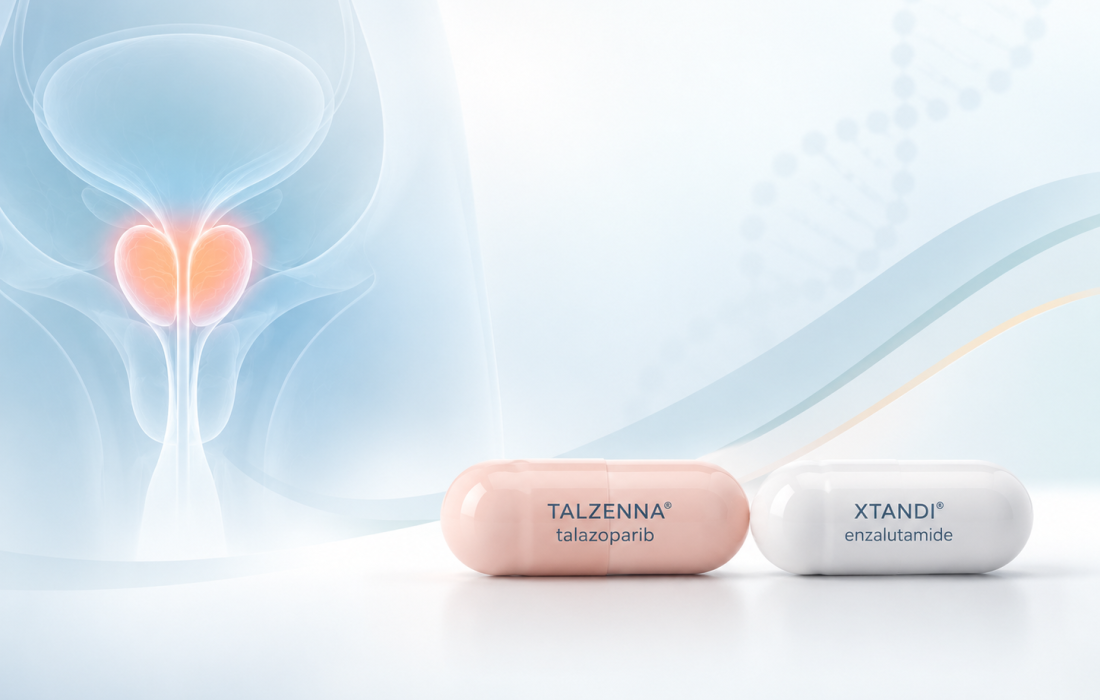
The FDA approves Pfizer’s TALZENNA plus XTANDI for HRR-mutated metastatic hormone-sensitive prostate cancer after TALAPRO-3 showed a 52% lower risk of progression or death.
Written By: Siddhi Bhadekar, M. Pharm (QA)
Reviewed By: Pharmacally Editorial Team
On October 26, 2026, Pfizer announced that the U.S. Food and Drug Administration (FDA) had expanded approval of TALZENNA (talazoparib) plus XTANDI (enzalutamide) for adults with homologous recombination repair (HRR) gene-mutated metastatic androgen pathway modulation-naïve or -sensitive (mAPMN/S) prostate cancer, also known as metastatic hormone-sensitive prostate cancer (mHSPC). The decision moves the combination into an earlier treatment setting, supported by Phase 3 TALAPRO-3 results demonstrating a significant improvement in radiographic progression-free survival (rPFS).
Expanded Indication and Regulatory Context
The combination was first approved in the United States in 2023 for HRR-mutated metastatic androgen pathway modulation-resistant prostate cancer, also known as metastatic castration-resistant prostate cancer (mCRPC).
HRR mutation confirmation is a mandatory eligibility requirement for the expanded indication. Patients must have an HRR gene mutation detected by an FDA-authorized test. The FDA has previously approved FoundationOne CDx and FoundationOne Liquid CDx as companion diagnostic devices to identify eligible patients. The indication should not be interpreted as covering metastatic hormone-sensitive prostate cancer without a qualifying HRR mutation.
The application received FDA Priority Review and was reviewed under Project Orbis, which facilitates coordinated oncology reviews among international regulatory partners. Pfizer said the corresponding application for this population remains under review by the European Medicines Agency (EMA), with additional global filings planned or underway.
How the Combination Works
Talazoparib is an oral poly ADP-ribose polymerase (PARP) inhibitor that blocks PARP activity and traps the enzyme at sites of DNA damage, impairing cancer-cell survival. Enzalutamide inhibits androgen receptor signalling, a pathway that drives prostate cancer growth. The combination targets complementary mechanisms involved in tumour progression.
TALAPRO-3: Key Clinical Evidence
The multicentre, randomized, double-blind, placebo-controlled Phase 3 TALAPRO-3 trial (NCT04821622) enrolled 599 patients with HRR-mutated mAPMN/S prostate cancer. Participants had received no more than three months of androgen deprivation therapy (ADT), with or without an approved androgen receptor pathway inhibitor in this setting. All patients received continuous ADT and were randomized to talazoparib 0.5 mg daily plus enzalutamide 160 mg daily or placebo plus enzalutamide at the same dose.
The primary endpoint was investigator-assessed rPFS, measured from randomization until radiographic progression in soft tissue or bone, or death.
Key efficacy findings:
- Primary endpoint met: The combination significantly improved rPFS compared with placebo plus enzalutamide.
- Relative reduction in risk: 52% lower hazard of radiographic progression or death (hazard ratio [HR], 0.48; 95% confidence interval [CI], 0.36–0.65; p<0.0001).
- Three-year rPFS: An estimated 77% of patients receiving the combination remained progression-free at three years.
- Mutation subgroups: Pfizer reported consistent benefit in patients with BRCA and non-BRCA HRR gene mutations.
The findings were presented at the 2026 American Society of Clinical Oncology Annual Meeting and published in The New England Journal of Medicine.
Safety and Treatment Considerations
Pfizer reported a safety profile consistent with the known effects of the individual agents, with no new safety signals identified.
Key safety findings:
- Common adverse events: Anemia, fatigue, decreased neutrophil count and asthenia.
- Grade 3 or higher anemia: 51% with talazoparib plus enzalutamide versus 3% with placebo plus enzalutamide.
- Treatment discontinuation: 5% of patients discontinued talazoparib because of anemia.
- Serious adverse events: The published trial reported events in 42% of patients in the combination group versus 32% in the control group.
TALZENNA carries warnings for myelosuppression and myelodysplastic syndrome/acute myeloid leukemia. Blood-count monitoring, dose modification and supportive care are important to manage hematologic toxicity.
Clinical Interpretation
TALAPRO-3 supports the use of talazoparib plus enzalutamide earlier in the disease course for patients with HRR-mutated mHSPC. The 52% relative reduction in the hazard of progression or death and the estimated three-year rPFS rate of 77% indicate a substantial delay in disease progression compared with enzalutamide alone. Reported benefit across BRCA and non-BRCA subgroups also reinforces the importance of HRR testing at diagnosis.
However, the progression benefit does not yet establish a survival advantage. Overall survival remains immature, requiring further follow-up. The benefit must also be weighed against the high incidence of severe anemia and the greater frequency of serious adverse events. Biomarker-confirmed eligibility and appropriate toxicity monitoring are therefore central to treatment selection and management.
References
Pfizer’s TALZENNA Plus XTANDI FDA-Approved for an Earlier Metastatic Prostate Cancer Treatment Setting. Pfizer Inc., October 26, 2026.
U.S. Food and Drug Administration. FDA approves talazoparib with enzalutamide for metastatic androgen pathway modulation-naïve or -sensitive prostate cancer with HRR gene mutations. October 26, 2026.
Agarwal N, et al. PARP and Androgen-Signaling Inhibition plus ADT in Metastatic Prostate Cancer. N Engl J Med. 2026;395:427–439. doi:10.1056/NEJMoa2604126

About the Writer
Siddhi Rajendra Bhadekar (Linkedin) is an M.Pharm professional with expertise in medical and scientific writing, literature review, publication writing, and evidence synthesis, supported by four peer-reviewed publications.
She brings working knowledge of ICH-GCP, MedDRA, pharmacovigilance, ADR/AE reporting, clinical data management, and regulatory documentation.
With experience across pharmaceutical R&D, Quality Control, and Quality Assurance, she combines scientific research skills with strong attention to accuracy and detail.
Her background in manuscript development, publication planning, and scientific communication enables her to translate complex healthcare information into clear, reliable content.