
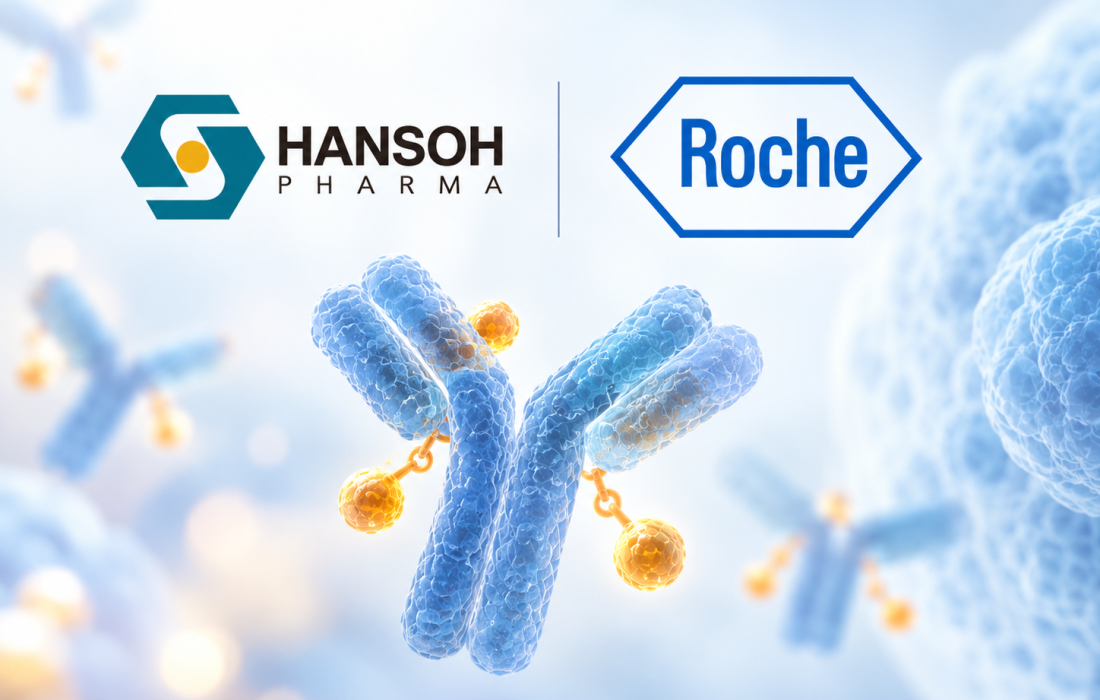
Hansoh Pharma expands its ADC partnership with Roche in a deal offering $510 million in fixed payments, over $15 billion in potential milestones and tiered royalties.
Written By: Siddhi Bhadekar, M. Pharm (QA)
Reviewed By: Pharmacally Editorial Team
Jiangsu Hansoh Pharmaceutical Group (Hansoh Pharma; 03692.HK) has entered into a strategic collaboration and licensing agreement with Roche to advance a portfolio of antibody-drug conjugates (ADCs) for multiple cancer types. Announced on October 19, the agreement provides Hansoh with US$400 million upfront, a further US$110 million payment on the first anniversary, and eligibility for potentially more than US$15 billion in milestone payments, plus tiered royalties on future product sales.
The agreement marks the companies’ second ADC collaboration and expands their partnership from a previously licensed investigational asset to a broader portfolio of programs. The deal combines Hansoh’s ADC technology platform with targets proposed by Roche, while dividing development responsibilities and commercial rights geographically.
Portfolio Expands Beyond Two Preclinical ADC Programs
The collaboration covers two preclinical ADC programs originated by Hansoh and multiple additional programs directed at targets proposed by Roche and developed using Hansoh’s proprietary ADC technology platform.
Neither company has disclosed the identities of the additional targets, specific drug candidates, payloads or intended cancer indications. The development stage of the Roche-proposed programs has also not been specified.
The agreement builds on the companies’ October 2025 licensing deal for HS-20110, an investigational CDH17-targeting ADC being developed for colorectal cancer and other solid tumours. Under that earlier agreement, Hansoh received an upfront payment of US$80 million and became eligible for up to US$1.45 billion in milestone payments, alongside royalties.
The new collaboration broadens the relationship beyond a single named asset to a multi-program ADC portfolio.
Hansoh Leads Early Development Through Phase Ia
Hansoh will lead early development of the programs through completion of global Phase Ia clinical trials. Roche will be responsible for further development worldwide, excluding mainland China, Hong Kong, Macau and Taiwan. Hansoh retains the rights to develop, register and commercialize the programs in those four territories.
Phase Ia studies typically evaluate initial human safety, tolerability, pharmacokinetics and dose escalation. However, the companies have not disclosed program-specific trial designs, timelines or plans for individual clinical studies.
Hansoh also has the option to select up to two programs and contribute to their development outside its retained territories. In return, it would become eligible for additional upside linked to the US commercialization of those programs. This participation is conditional on the option and development contribution, rather than an automatic entitlement to US commercialization revenue.
Financial Terms Separate Fixed Payments from Milestones
The agreement provides for the following payments to Hansoh:
- US$400 million: Upfront payment.
- US$110 million: First-anniversary payment.
- Potentially more than US$15 billion: Milestone payments associated with development, regulatory approval and commercialization.
- Additional royalties: Tiered royalties on potential future product sales.
The upfront and first-anniversary payments total US$510 million in fixed consideration. The milestone amount is contingent on future development and commercial achievements and should not be interpreted as expected revenue or a forecast of product sales.
The financial structure gives Hansoh substantial initial consideration while linking much of the agreement’s potential value to the progress and eventual commercialization of the licensed programs.
ADC Development Potential Remains Unproven
ADCs combine a monoclonal antibody with a cytotoxic payload linked through a chemical linker. The antibody is designed to recognize a target antigen, enabling delivery of the payload to target-expressing cells. Their performance depends on factors including target selection, linker stability, payload properties and the potential effects on neighbouring cells.
For this collaboration, Hansoh contributes its ADC technology platform, while Roche proposes targets for additional programs. The announcement provides no program-specific data on payload chemistry, linker design, preclinical efficacy or safety.
The agreement is therefore a business and development milestone, not evidence of clinical benefit. Although the two Hansoh-originated programs remain preclinical, the status of the Roche-proposed programs has not been disclosed.
The scale of the potential milestone payments highlights the commercial ambition of the partnership, but does not establish the clinical validity of the candidates. Key uncertainties include target selection, translation of preclinical findings into human outcomes, safety and tolerability, and the time required to advance the programs through clinical development.
Future trial registrations and early-phase results will be important for assessing whether the expanded collaboration produces ADC candidates with meaningful therapeutic potential.
References
Hansoh Pharma Announces Strategic Collaboration and License Agreement with Roche to Advance Novel ADC Portfolio, Hansoh Pharma, 19 October 2026

About the Writer
Siddhi Rajendra Bhadekar (Linkedin) is an M.Pharm professional with expertise in medical and scientific writing, literature review, publication writing, and evidence synthesis, supported by four peer-reviewed publications.
She brings working knowledge of ICH-GCP, MedDRA, pharmacovigilance, ADR/AE reporting, clinical data management, and regulatory documentation.
With experience across pharmaceutical R&D, Quality Control, and Quality Assurance, she combines scientific research skills with strong attention to accuracy and detail.
Her background in manuscript development, publication planning, and scientific communication enables her to translate complex healthcare information into clear, reliable content.