
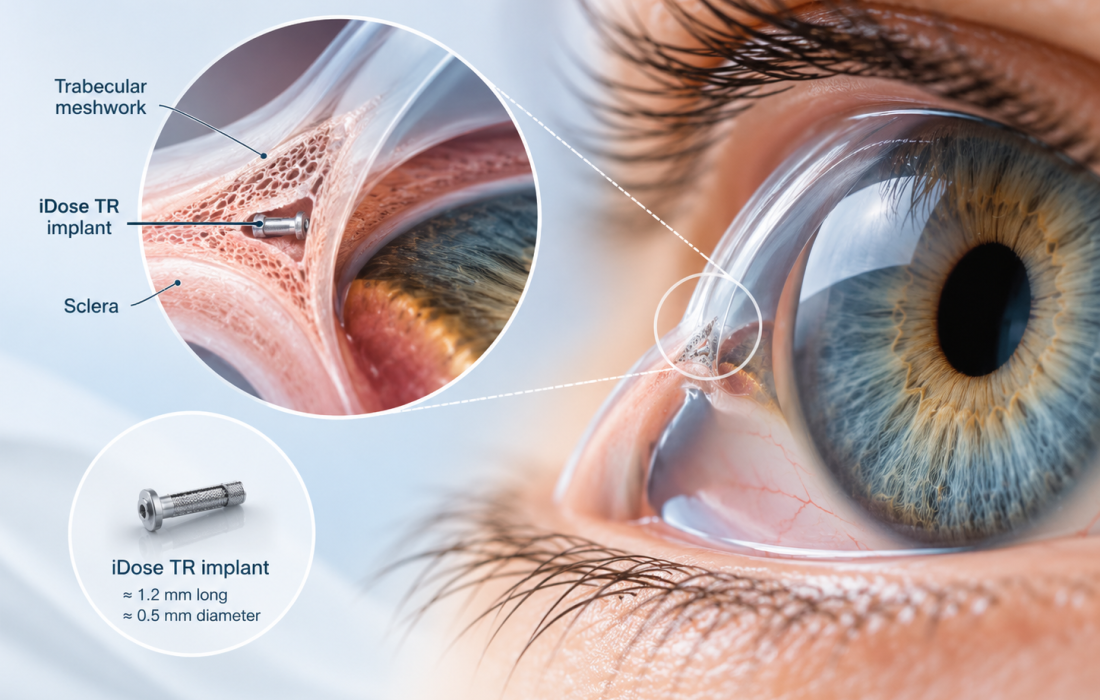
Glaukos reports Phase 4 GLK-101-04 results showing greater intraocular pressure reduction with iDose TR plus cataract surgery than surgery alone at month 3.
Written By: Charvi Kalal, PharmD
Reviewed By: Pharmacally Editorial Team
Glaukos Corporation announced positive topline results on October 9, 2026, from GLK-101-04, a Phase 4 prospective, randomised, controlled clinical trial evaluating iDose TR (travoprost intracameral implant) administered during cataract surgery in adults with open-angle glaucoma (OAG) or ocular hypertension (OHT).
The study met its primary endpoint, demonstrating statistically significant superiority for iDose TR combined with cataract surgery over cataract surgery alone in reducing mean diurnal intraocular pressure (IOP) at month 3. Glaukos also reported a favourable safety profile through three months.
About Open-Angle Glaucoma and Ocular Hypertension
Open-angle glaucoma is a chronic optic neuropathy that can cause progressive, irreversible vision loss. Ocular hypertension refers to elevated IOP without established glaucomatous optic nerve damage. Lowering IOP is a central strategy for reducing the risk of glaucoma progression.
Treatment commonly involves daily topical eye drops. Maintaining long-term adherence can be challenging for some patients, creating interest in sustained drug-delivery approaches that reduce dependence on daily medication.
About iDose TR
iDose TR is a long-duration intracameral implant containing 75 mcg of travoprost, a prostaglandin analogue used to lower IOP. The medical-grade titanium implant is positioned through the trabecular meshwork and the back wall of Schlemm’s canal into scleral tissue. A membrane-controlled system releases the preservative-free drug formulation into the anterior chamber.
The implant is designed to provide continuous drug delivery and reduce reliance on daily eye drops. Earlier clinical studies have evaluated its prolonged IOP-lowering effects. However, the present Phase 4 study provides only three months of follow-up for iDose TR administered alongside cataract surgery.
In the United States, iDose TR is approved to reduce IOP in patients with OAG or OHT. In January 2026, the US Food and Drug Administration (FDA) approved a labelling supplement permitting re-administration under specified conditions, including assessment of corneal endothelial cell density.
GLK-101-04 Study Design
GLK-101-04 was a multicentre, randomised, double-masked, parallel-group Phase 4 trial. It compared iDose TR administered during cataract surgery with cataract surgery alone in adults with OAG or OHT.
The study randomised 149 study eyes: 74 to receive iDose TR plus cataract surgery and 75 to undergo cataract surgery alone. The primary endpoint was the change from baseline in mean diurnal IOP at month 3.
iDose TR Demonstrates Greater IOP Reduction
At month 3, mean diurnal IOP decreased by 11.1 mmHg from baseline in the iDose TR plus cataract surgery group, compared with 7.4 mmHg in the cataract surgery-alone group.
Glaukos reported an incremental treatment effect of 3.6 mmHg in favour of iDose TR (p<0.0001). The company also reported statistically significant superiority across all prespecified secondary responder analyses, although detailed numerical results for those analyses were not included in the available topline information.
The company-reported treatment effect should be distinguished from the difference calculated using the rounded arm-level reductions, which is 3.7 mmHg. The underlying unrounded values were not provided in the available announcement.
The control group is important to the interpretation of these results. Cataract surgery alone was associated with a 7.4 mmHg reduction in IOP, indicating that the reported additional effect reflects the contribution of iDose TR beyond the reduction observed with surgery alone.
Safety Findings Through Three Months
Glaukos reported no treatment-related adverse events of corneal endothelial cell loss or cystoid macular oedema (CME), and no serious corneal adverse events through month 3. The company stated that the overall safety findings were consistent with the established safety profile of iDose TR and previous clinical experience.
These findings represent an early safety assessment. Detailed corneal endothelial cell measurements, full adverse-event counts and longer-term follow-up were not included in the available topline results. The findings therefore do not establish long-term safety in patients undergoing cataract surgery.
Company Perspective
Thomas Burns, chairman and chief executive officer of Glaukos, said the Phase 4 results add to the evidence supporting iDose TR’s efficacy, durability and safety. He also highlighted the potential versatility of the implant as a standalone procedure or in combination with cataract surgery.
Burns said the findings support the company’s broader effort to advance earlier, interventional approaches to glaucoma care.
What the Results Mean
GLK-101-04 provides post-approval evidence that adding iDose TR to cataract surgery can produce a greater short-term reduction in mean diurnal IOP than cataract surgery alone in the studied population.
The results are relevant because cataract surgery itself can lower IOP, making the additional treatment effect an important consideration when evaluating the implant’s contribution. Nevertheless, the findings should be interpreted within the limits of the available data.
The announcement reports topline results with three months of follow-up. It does not provide detailed secondary responder results, the proportion of patients who discontinued or remained off IOP-lowering eye drops, or the full corneal endothelial cell data. The findings have not yet been presented here as peer-reviewed evidence.
Further follow-up and a complete clinical data release will be important for assessing the durability of the additional IOP reduction, longer-term safety and the potential role of iDose TR in glaucoma management during cataract surgery.
References
Glaukos Corporation. Glaukos Announces Positive Topline Results from Phase 4 Prospective Randomized Controlled Clinical Trial Evaluating iDose TR in Combination with Cataract Surgery. October 9, 2026

About the Writer
Charvi Kalal (LinkedIn) is a Pharm.D intern and aspiring medical writer with hands-on experience in medical writing, clinical research, pharmacovigilance, and clinical pharmacy. She has experience in medical content writing through CliMed, along with exposure to ADR monitoring, prescription analysis, patient counselling, literature review, and research documentation. Her research focuses on ADR monitoring and reporting in breast cancer patients receiving targeted therapy. With certifications in GCP, biomedical research, scientific writing, and clinical research, she is passionate about transforming scientific evidence into accurate, engaging, and accessible healthcare content.