
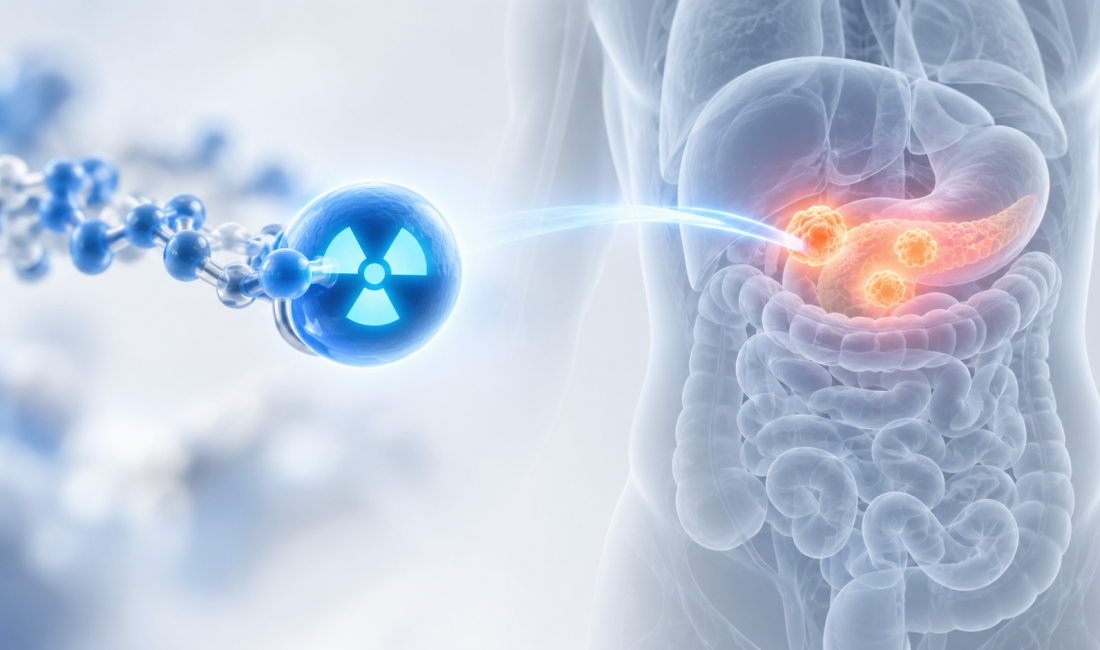
ASTRO 2026 data on 177Lu-edotreotide show tumor dosimetry findings and real-world re-treatment outcomes in patients with GEP-NETs.
Written By: Mayuresh Slavi, PharmD
Reviewed By: Pharmacally Editorial Team
ITM Isotope Technologies Munich SE (ITM) and its oncology therapeutics division, Lumara Bio, presented new data on investigational non-carrier-added (n.c.a.) ¹⁷⁷Lu-edotreotide (ITM-11) at the 2026 American Society for Radiation Oncology (ASTRO) Annual Meeting in Boston. The data comprised a retrospective SwissNet Registry analysis of re-treatment and a dosimetry substudy from the Phase 3 COMPETE trial in gastroenteropancreatic neuroendocrine tumors (GEP-NETs). ¹⁷⁷Lu-edotreotide remains investigational and is not approved by any regulatory authority.
SwissNet Analysis Reports Re-treatment Outcomes
The SwissNet presentation included 49 adults with metastatic, well-differentiated, somatostatin receptor (SSTR)-positive neuroendocrine tumors who had progressed at least 12 months after completing initial ¹⁷⁷Lu-edotreotide treatment. Thirty-seven patients underwent re-treatment, while 12 received non-radiopharmaceutical systemic therapy.
Median real-world progression-free survival (rwPFS) was 12.5 months with re-treatment versus 4.8 months with systemic therapy (p<0.001). Median overall survival (OS) was 90.1 months and 39.8 months, respectively (p<0.001).
The findings require cautious interpretation because the analysis was retrospective and non-randomized. Treatment allocation was not experimentally assigned, and differences in patient characteristics, prior therapy, disease status, or clinical selection may have contributed to the observed outcomes. The September 27 announcement did not report comparative safety or tolerability outcomes, and the small systemic-therapy group further limits interpretation.
COMPETE Analysis Characterizes Dosimetry
The second ASTRO presentation analyzed absorbed radiation dose in Substudy A of the Phase 3 COMPETE trial (NCT03049189). The analysis included 17 patients for healthy-organ dosimetry and 17 tumor lesions from nine patients.
Tumor absorbed dose was reported to be significantly higher than absorbed dose in normal organs. Kidney absorbed-dose coefficients (ADCs) showed low intra-patient variability, with a median variability of 14%. Tumor ADCs decreased over time, while tumor-to-kidney ADC ratios remained above 1 across treatment cycles, indicating higher estimated absorbed-dose coefficients in the evaluated tumor lesions than in the kidneys.
These findings provide additional information on radiation distribution and kidney exposure. However, the dosimetry results should not be interpreted as direct evidence of clinical benefit.
COMPETE Provides Clinical Context
The ASTRO findings build on efficacy results from the randomized Phase 3 COMPETE trial, which evaluated ¹⁷⁷Lu-edotreotide against everolimus in patients with progressive Grade 1 or Grade 2 GEP-NETs.
Among 309 randomized patients, median PFS was 23.9 months with ¹⁷⁷Lu-edotreotide versus 14.1 months with everolimus, corresponding to a hazard ratio of 0.67 (95% CI, 0.48–0.95; p=0.022).
¹⁷⁷Lu-edotreotide is also being evaluated in the Phase 3 COMPOSE study in patients with well-differentiated, aggressive Grade 2 or Grade 3, SSTR-positive GEP-NETs.
FDA Review Remains Ongoing
The ASTRO data come amid ongoing U.S. regulatory work. ITM announced in August 2026 that the FDA had issued a Complete Response Letter (CRL) for ¹⁷⁷Lu-edotreotide. According to ITM, the CRL identified chemistry, manufacturing and controls (CMC) and third-party commercial facility inspection-related issues. The company stated that the FDA did not request additional clinical or nonclinical data and did not identify clinical safety or efficacy concerns in the letter.
These statements represent ITM’s account of the regulatory communication. ¹⁷⁷Lu-edotreotide therefore remains an investigational product.
What the ASTRO Data Add
The two presentations provide complementary information on the ongoing development of ¹⁷⁷Lu-edotreotide. The COMPETE analysis adds dosimetry data on tumor and kidney radiation exposure, while the SwissNet analysis provides real-world observations following re-treatment after disease progression.
The SwissNet findings show an association between re-treatment and longer observed rwPFS and OS, but the retrospective, non-randomized design prevents attribution of these differences to re-treatment itself. The dosimetry findings further characterize radiation distribution but require continued evaluation alongside clinical outcomes.
Together, the data add to the clinical-development evidence for ¹⁷⁷Lu-edotreotide while the investigational therapy continues through clinical and regulatory evaluation.
Reference
ITM and Lumara Bio Announce Real-World Re-Treatment Data and Dosimetry Results from COMPETE for ¹⁷⁷Luedotreotide (ITM-11) in GEP-NETs at ASTRO 2026, ITM, 27 September 2026
Efficacy and Safety of 177Lu-edotreotide PRRT in GEP-NET Patients (COMPETE), ClinicalTrials.gov ID NCT03049189

About the Writer
Mayuresh Sunil Salvi (Linkedin) is a PharmD professional and healthcare writer with a strong interest in pharmacovigilance, drug safety, and emerging medical research. He is passionate about exploring new drug discoveries, clinical research, and advances in evidence-based medicine. His interests also include ward rounds, prescription audits, and treatment analysis to support rational pharmacotherapy and improved patient care.