
CUE-221 showed dose-responsive efficacy in a Phase 2 chronic spontaneous urticaria trial, with durable hive resolution 12 weeks after treatment.
Written By: Mayuresh Salvi, PharmD
Reviewed By: Pharmacally Editorial Team
Cue Biopharma reported positive topline results from the Phase 2 CUE-221 trial conducted in China by Genesis Life Sciences. The randomized, double-blind study enrolled 145 patients with moderate-to-severe chronic spontaneous urticaria (CSU) whose disease remained inadequately controlled despite H1 antihistamine treatment.
Patients received subcutaneous CUE-221 at 4 mg/kg, 2 mg/kg, or 1 mg/kg every four weeks, placebo, or omalizumab 300 mg every four weeks. The primary endpoint was complete resolution of hives, defined as HSS7=0, at week 12.
CUE-221 met the primary endpoint at all three dose levels. HSS7=0 occurred in 54% of patients receiving 4 mg/kg, 53% receiving 2 mg/kg, and 43% receiving 1 mg/kg, compared with 11% for placebo. The differences versus placebo were statistically significant, with p<0.005 for the 4 mg/kg and 2 mg/kg groups and p<0.05 for the 1 mg/kg group.
The key secondary endpoint, complete response defined as UAS7=0, also showed a dose-related effect. At 4 mg/kg, 46% of patients achieved UAS7=0 at week 12 versus 11% with placebo, reaching statistical significance.
CUE-221 Uses a Dual Anti-IgE Mechanism
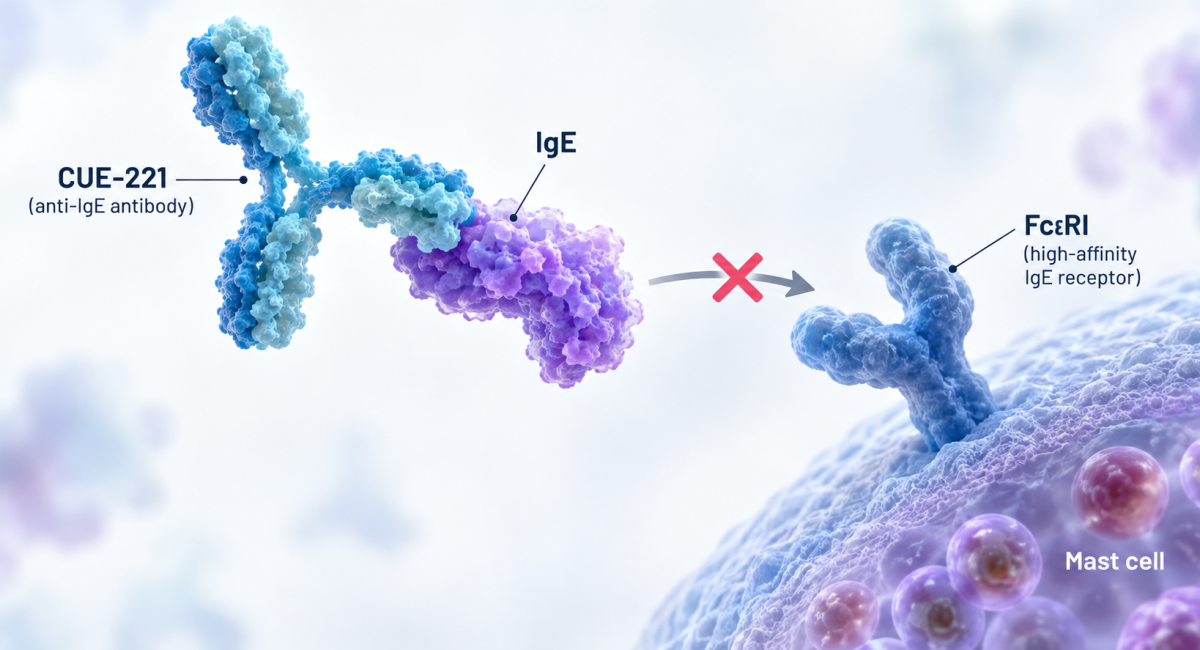
CUE-221 is a humanized anti-IgE IgG1 monoclonal antibody that binds IgE at sites distinct from those targeted by other anti-IgE antibodies.
The reported mechanism has two components. CUE-221 strongly neutralizes free IgE, limiting its ability to bind the high-affinity FcεRI receptor involved in IgE-mediated allergic responses. At the same time, it preserves IgE binding to CD23 on B cells. According to the company, this interaction reduces the synthesis of new IgE.
This differs from conventional IgE neutralization because the approach targets both existing IgE activity and subsequent IgE production. The clinical findings are therefore being evaluated as an early test of whether this biological distinction can produce more sustained disease control.
Clinical Benefit Persisted After Treatment
The response increased after the week 12 primary endpoint. Complete hive resolution peaked at week 22, reaching 69% with the 4 mg/kg dose, 61% with 2 mg/kg, and 57% with 1 mg/kg.
Patients received their final dose at week 16. At week 28, 12 weeks after treatment ended, HSS7=0 remained at 60% in the 4 mg/kg group, compared with 31% and 24% in the 2 mg/kg and 1 mg/kg groups, respectively, and 11% with placebo.
A post hoc analysis reported a 36-percentage-point difference between CUE-221 4 mg/kg and omalizumab at week 28, with statistical significance reported at p<0.05.
Safety Profile Remained Favorable
CUE-221 showed no treatment-related serious adverse events in the reported analysis, and no hypersensitivity reactions, including anaphylaxis, were observed. Injection-site reactions were infrequent. Only one reaction was greater than grade 1, and none resulted in treatment discontinuation.
Next Development Steps
Cue Biopharma plans to advance CUE-221 into a Phase 2b/3 study in CSU and continue development in food allergy through a planned Phase 2 study.
The company said complete 36-week data, including pharmacokinetic and IgE analyses, will be presented at an upcoming scientific meeting. The additional data will help clarify the relationship between CUE-221 exposure, IgE suppression, and the persistence of clinical benefit after treatment withdrawal.
CUE-221 remains an investigational therapy. The Phase 2 findings provide clinical evidence supporting further evaluation of its dual anti-IgE mechanism, but larger controlled studies will be needed to establish its efficacy, durability, and safety across broader patient populations.
Reference
Cue Biopharma Announces Positive Topline Results from CUE-221 Phase 2 Study in Chronic Spontaneous Urticaria, Cue Biopharma, 20 September 2026
A Study to Evaluate the Pharmacodynamics, Pharmacokinetics, Safety, and Efficacy of UB-221 IV Infusion as an add-on Therapy in Patients With Chronic Spontaneous Urticaria, ClinicalTrials.gov ID NCT05298215

About the Writer
Mayuresh Sunil Salvi (Linkedin) is a PharmD professional and healthcare writer with a strong interest in pharmacovigilance, drug safety, and emerging medical research. He is passionate about exploring new drug discoveries, clinical research, and advances in evidence-based medicine. His interests also include ward rounds, prescription audits, and treatment analysis to support rational pharmacotherapy and improved patient care.