
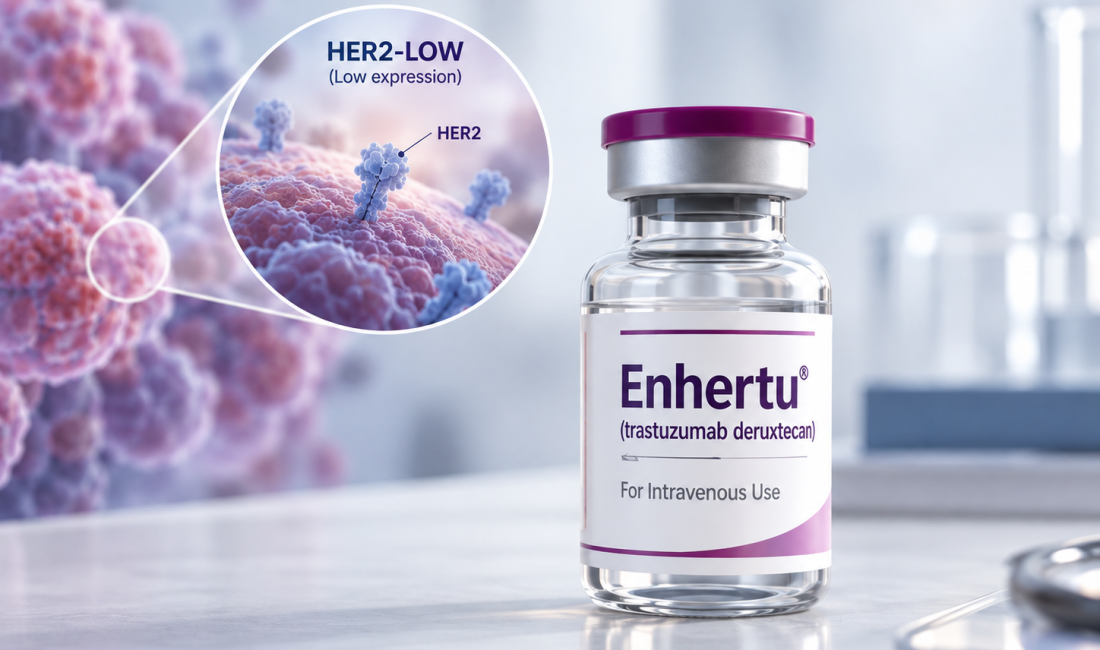
NICE recommends Enhertu (trastuzumab deruxtecan) for HER2-low metastatic or unresectable breast cancer after chemotherapy, expanding NHS access.
Written By: Rishabh Sonawane, BPharm
Reviewed By: Pharmacally Editorial Team
NICE has issued positive final draft guidance recommending trastuzumab deruxtecan (Enhertu) as an option for adults with HER2-low metastatic or unresectable breast cancer after chemotherapy, subject to a confidential commercial access agreement. The recommendation follows a rapid review of earlier guidance after updated cost-effectiveness modelling and quality-of-life methods changed the economic assessment.
NICE Expands Access to HER2-Low Targeted Therapy
Under the recommendation, trastuzumab deruxtecan can be used in adults with HER2-low metastatic or unresectable breast cancer after chemotherapy in the metastatic setting, or when disease recurs during adjuvant chemotherapy or within six months of completing it. NICE states that the treatment should be funded in England when the responsible healthcare professional considers it the most suitable option.
HER2-low breast cancer was historically classified within the HER2-negative group. It is defined by low HER2 protein expression, generally corresponding to an immunohistochemistry (IHC) score of 1+ or 2+ without HER2 gene amplification. NICE identifies trastuzumab deruxtecan as the first licensed treatment specifically targeting HER2 in this population.
DESTINY-Breast04 Established the Clinical Benefit
The principal clinical evidence came from DESTINY-Breast04, an international, multicentre, randomised, open-label trial that compared trastuzumab deruxtecan with treatment of physician choice (TPC). The study enrolled 557 patients with HER2-low metastatic or unresectable breast cancer who had previously received one or two lines of chemotherapy in the metastatic setting or had disease recurrence after prior treatment. Most participants, 89%, had hormone-receptor-positive disease, while 11% had hormone-receptor-negative disease.
Trastuzumab deruxtecan produced statistically significant improvements in both progression-free survival and overall survival compared with TPC. The hazard ratio for progression-free survival was 0.50 (95% CI, 0.40–0.60), while the hazard ratio for overall survival was 0.60 (95% CI, 0.50–0.80). NICE concluded that the treatment delayed disease progression and improved survival in HER2-low metastatic or unresectable breast cancer.
The committee also acknowledged limitations in applying the trial results directly to NHS practice. Trial participants were younger and generally fitter than the broader NHS population, and the study did not include patients with an ECOG performance status of 2. NICE nevertheless considered the population broadly representative of patients likely to receive trastuzumab deruxtecan in NHS practice.
Commercial Agreement Changes the NICE Decision
The positive recommendation follows an earlier decision not to recommend trastuzumab deruxtecan under the proposed commercial terms. Daiichi Sankyo subsequently submitted revised cost-effectiveness modelling incorporating an updated commercial access agreement and revised EQ-5D-5L utility estimates.
The commercial agreement provides the NHS with a confidential discount. NICE lists the undiscounted price at £1,455 per 100 mg vial, excluding VAT. The exact discount and final incremental cost-effectiveness ratio remain confidential.
NICE also incorporated updated approaches to valuing EQ-5D-5L quality-of-life data and applied a severity weight of 1.2 to QALYs. The committee judged that an acceptable incremental cost-effectiveness ratio could be around £35,000 per QALY gained, reflecting the severity of the disease, unmet need and potential benefits not fully captured by standard quality-of-life measures.
Routine NHS Funding Follows Final Publication
The guidance states that early funding is available through the Cancer Drugs Fund until 90 days after final publication, after which funding should move to routine NHS commissioning in England. NICE also states that eligible patients should have access when their treating healthcare professional considers trastuzumab deruxtecan appropriate.
The recommendation remains subject to the current appeal process. The final draft guidance is available for appeal until 5pm on 7 October 2026.
NICE’s decision marks an important change in the UK treatment pathway for HER2-low advanced breast cancer, bringing a HER2-directed therapy into routine NHS use for a population previously managed largely through HER2-negative treatment strategies.
Reference
NICE recommends Enhertu for people with HER2-low advanced breast cancer, NICE, 17 September 2026
Trastuzumab Deruxtecan (DS-8201a) Versus Investigator’s Choice for HER2-low Breast Cancer That Has Spread or Cannot be Surgically Removed [DESTINY-Breast04], ClinicalTrials.gov ID NCT03734029

About the Writer
Rishabha Sonawane, B.Pharm (LinkedIn) is healthcare writer with a strong interest in medical writing, regulatory affairs, clinical research, and AI-driven drug discovery. He has completed specialized training from the NIH and ICMR in clinical pharmacology, clinical research, and scientific writing. Passionate about evidence-based healthcare communication, he focuses on translating complex scientific research into clear, accurate, and engaging medical content.